14: String Search Algorithms
String Search Algorithms Advanced
Section titled “String Search Algorithms Advanced”Overview
Section titled “Overview”String searching (or pattern matching) is fundamental to text processing. Whether you’re implementing search in a text editor, filtering log files, or building a search engine, you need efficient string search algorithms. Every time you use Ctrl+F in your editor, search through logs, or filter data, you’re relying on string search algorithms working behind the scenes.
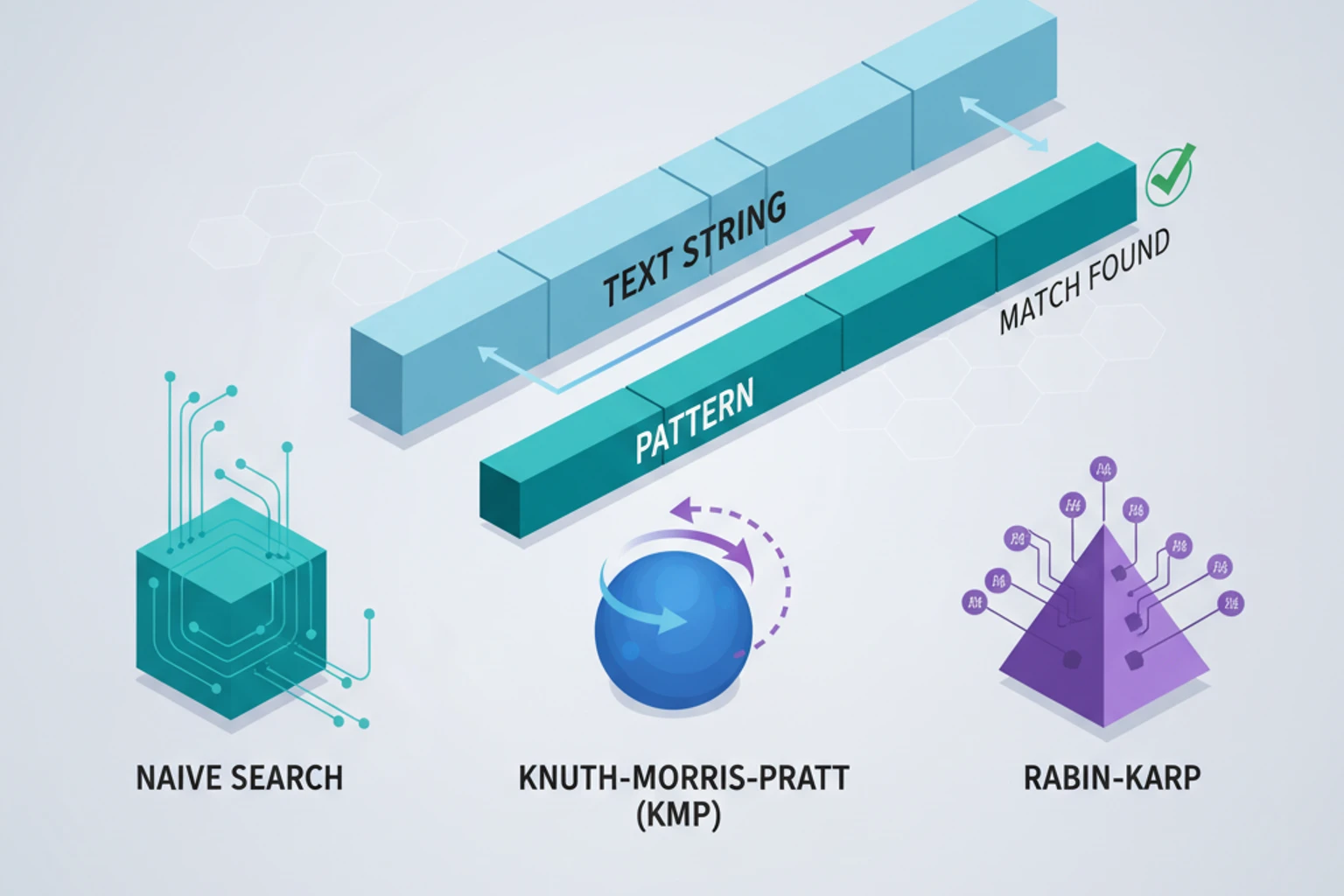
In this chapter, we’ll explore multiple approaches from simple to sophisticated, discovering how algorithms like KMP and Boyer-Moore achieve remarkable performance gains. We’ll start with the naive approach to understand the problem, then progressively build more efficient solutions. You’ll learn how the Knuth-Morris-Pratt algorithm never backtracks in the text, how Boyer-Moore can skip entire sections, and how Rabin-Karp uses hashing for efficient multi-pattern matching.
By the end of this chapter, you’ll have implemented four major string search algorithms and built a practical grep-like tool. You’ll understand when to use each algorithm and how PHP’s built-in functions leverage these techniques. This knowledge will help you optimize text processing in your applications and make informed decisions about algorithm selection.
What You’ll Learn
Section titled “What You’ll Learn”- Master the naive string search algorithm and understand its limitations
- Implement the Knuth-Morris-Pratt (KMP) algorithm for linear-time searching
- Build the Boyer-Moore algorithm that powers real-world text editors
- Use Rabin-Karp hashing for efficient multi-pattern matching
- Create a practical grep-like tool for text processing
Prerequisites
Section titled “Prerequisites”Before starting this chapter, you should have:
- ✓ Understanding of strings and arrays
- ✓ Completion of Chapters 11-13 (search algorithms and hash tables)
- ✓ Familiarity with pattern matching concepts
- ✓ Basic knowledge of time complexity analysis
Estimated Time: ~55 minutes
The String Search Problem
Section titled “The String Search Problem”Given:
- A text string (the haystack)
- A pattern string (the needle)
Find: All occurrences of pattern in text
Example:
Text: "hello world hello"Pattern: "hello"Matches: positions 0 and 12Naive String Search
Section titled “Naive String Search”The simplest approach: check every position in the text.
Implementation
Section titled “Implementation”function naiveSearch(string $text, string $pattern): array{ $matches = []; $textLen = strlen($text); $patternLen = strlen($pattern);
// Check each position in text for ($i = 0; $i <= $textLen - $patternLen; $i++) { $j = 0;
// Check if pattern matches starting at position i while ($j < $patternLen && $text[$i + $j] === $pattern[$j]) { $j++; }
// If we matched entire pattern if ($j === $patternLen) { $matches[] = $i; } }
return $matches;}
$text = "AABAACAADAABAABA";$pattern = "AABA";print_r(naiveSearch($text, $pattern));// Output: [0, 9, 12]Visualization
Section titled “Visualization”function naiveSearchVisualized(string $text, string $pattern): array{ $matches = []; $textLen = strlen($text); $patternLen = strlen($pattern);
for ($i = 0; $i <= $textLen - $patternLen; $i++) { echo "Position $i:\n"; echo " Text: " . substr($text, $i, $patternLen) . "\n"; echo " Pattern: $pattern\n";
$j = 0; while ($j < $patternLen && $text[$i + $j] === $pattern[$j]) { $j++; }
if ($j === $patternLen) { echo " ✓ Match found!\n\n"; $matches[] = $i; } else { echo " ✗ No match\n\n"; } }
return $matches;}Complexity
Section titled “Complexity”- Time: O(n×m) where n = text length, m = pattern length
- Space: O(1)
- Problem: Inefficient for long texts or patterns
Knuth-Morris-Pratt (KMP) Algorithm
Section titled “Knuth-Morris-Pratt (KMP) Algorithm”KMP improves on naive search by never re-examining text characters. It uses a prefix table to skip unnecessary comparisons.
The Prefix Table
Section titled “The Prefix Table”The prefix table (also called LPS - Longest Proper Prefix which is also Suffix) tells us where to continue matching after a mismatch. It stores the length of the longest proper prefix that is also a suffix for each position in the pattern.
Understanding the Prefix Table:
For pattern "AABAAB":
- Position 0:
""→ No prefix/suffix →lps[0] = 0 - Position 1:
"A"→ Prefix:"", Suffix:""→lps[1] = 1(length of “A”) - Position 2:
"AA"→ Prefixes:"", "A", Suffixes:"", "A"→lps[2] = 0(no proper prefix = suffix) - Position 3:
"AAB"→ Prefixes:"", "A", "AA", Suffixes:"", "B", "AB"→lps[3] = 1(“A”) - Position 4:
"AABA"→ Prefixes:"", "A", "AA", "AAB", Suffixes:"", "A", "BA", "ABA"→lps[4] = 1(“A”) - Position 5:
"AABAAB"→ Prefixes:"", "A", "AA", "AAB", "AABA", Suffixes:"", "B", "AB", "AAB", "BAAB"→lps[5] = 2(“AA”)
Step-by-Step Construction:
Let’s build the prefix table for "AABAAB":
Pattern: A A B A A BIndex: 0 1 2 3 4 5LPS: 0 1 0 1 2 3Step-by-step walkthrough:
- i=0, len=0:
lps[0] = 0(always starts at 0) - i=1, len=0: Compare
pattern[1]='A'withpattern[0]='A'→ Match!len=1,lps[1]=1,i=2 - i=2, len=1: Compare
pattern[2]='B'withpattern[1]='A'→ Mismatch!len != 0, solen = lps[0] = 0 - i=2, len=0: Compare
pattern[2]='B'withpattern[0]='A'→ Mismatch!len == 0, solps[2]=0,i=3 - i=3, len=0: Compare
pattern[3]='A'withpattern[0]='A'→ Match!len=1,lps[3]=1,i=4 - i=4, len=1: Compare
pattern[4]='A'withpattern[1]='A'→ Match!len=2,lps[4]=2,i=5 - i=5, len=2: Compare
pattern[5]='B'withpattern[2]='B'→ Match!len=3,lps[5]=3, done
function computePrefixTable(string $pattern): array{    $m = strlen($pattern);    $lps = array_fill(0, $m, 0);    $len = 0; // Length of previous longest prefix suffix    $i = 1;
    while ($i < $m) {        if ($pattern[$i] === $pattern[$len]) {            // Characters match - extend the prefix            $len++;            $lps[$i] = $len;            $i++;        } else {            // Mismatch - try shorter prefix            if ($len !== 0) {                // Don't reset len to 0, use previous LPS value                $len = $lps[$len - 1];            } else {                // No prefix found, move to next character                $lps[$i] = 0;                $i++;            }        }    }
    return $lps;}
// Example with detailed outputfunction computePrefixTableVisualized(string $pattern): array{    $m = strlen($pattern);    $lps = array_fill(0, $m, 0);    $len = 0;    $i = 1;
    echo "Building prefix table for: $pattern\n";    echo "Index: " . implode(' ', range(0, $m - 1)) . "\n";    echo "Char:  " . implode(' ', str_split($pattern)) . "\n\n";
    while ($i < $m) {        echo "Step $i: Comparing pattern[$i]='{$pattern[$i]}' with pattern[$len]='{$pattern[$len]}'\n";
        if ($pattern[$i] === $pattern[$len]) {            $len++;            $lps[$i] = $len;            echo "  ✓ Match! len=$len, lps[$i]=$len\n";            $i++;        } else {            if ($len !== 0) {                echo "  ✗ Mismatch, len=$len, trying lps[$len-1]={$lps[$len - 1]}\n";                $len = $lps[$len - 1];            } else {                $lps[$i] = 0;                echo "  ✗ Mismatch, len=0, lps[$i]=0\n";                $i++;            }        }    }
    echo "\nFinal LPS: " . implode(' ', $lps) . "\n";    return $lps;}
// Example$pattern = "AABAAB";print_r(computePrefixTable($pattern));// [0, 1, 0, 1, 2, 3]
// Visualized versioncomputePrefixTableVisualized($pattern);
Key Insight: When characters don’t match, we don’t start from the beginning. Instead, we use the LPS value to know how much of the pattern we’ve already matched, allowing us to skip unnecessary comparisons.
KMP Implementation
Section titled “KMP Implementation”function kmpSearch(string $text, string $pattern): array{ $matches = []; $n = strlen($text); $m = strlen($pattern);
if ($m === 0) return $matches;
// Compute prefix table $lps = computePrefixTable($pattern);
$i = 0; // Index for text $j = 0; // Index for pattern
while ($i < $n) { if ($pattern[$j] === $text[$i]) { $i++; $j++; }
if ($j === $m) { // Found match $matches[] = $i - $j; $j = $lps[$j - 1]; } elseif ($i < $n && $pattern[$j] !== $text[$i]) { // Mismatch after j matches if ($j !== 0) { $j = $lps[$j - 1]; } else { $i++; } } }
return $matches;}
$text = "AABAACAADAABAABA";$pattern = "AABA";print_r(kmpSearch($text, $pattern));// Output: [0, 9, 12]Complexity
Section titled “Complexity”- Preprocessing: O(m) to build prefix table
- Searching: O(n)
- Total: O(n + m)
- Space: O(m) for prefix table
Advantage: Never backtracks in the text!
Boyer-Moore Algorithm
Section titled “Boyer-Moore Algorithm”Boyer-Moore scans the pattern right-to-left and uses two heuristics to skip sections of text.
Bad Character Rule
Section titled “Bad Character Rule”function computeBadCharTable(string $pattern): array{ $m = strlen($pattern); $badChar = [];
// Initialize all characters to -1 for ($i = 0; $i < 256; $i++) { $badChar[chr($i)] = -1; }
// Fill with last occurrence of each character for ($i = 0; $i < $m; $i++) { $badChar[$pattern[$i]] = $i; }
return $badChar;}Boyer-Moore Implementation (Simplified)
Section titled “Boyer-Moore Implementation (Simplified)”function boyerMooreSearch(string $text, string $pattern): array{ $matches = []; $n = strlen($text); $m = strlen($pattern);
if ($m === 0) return $matches;
$badChar = computeBadCharTable($pattern);
$s = 0; // Shift of pattern relative to text
while ($s <= $n - $m) { $j = $m - 1;
// Keep reducing index j while characters match while ($j >= 0 && $pattern[$j] === $text[$s + $j]) { $j--; }
if ($j < 0) { // Pattern found $matches[] = $s;
// Shift pattern to align next character in text with its last occurrence in pattern $s += ($s + $m < $n) ? $m - ($badChar[$text[$s + $m]] ?? -1) : 1; } else { // Shift pattern to align bad character in text with its last occurrence in pattern $s += max(1, $j - ($badChar[$text[$s + $j]] ?? -1)); } }
return $matches;}
$text = "AABAACAADAABAABA";$pattern = "AABA";print_r(boyerMooreSearch($text, $pattern));// Output: [0, 9, 12]Complexity
Section titled “Complexity”- Preprocessing: O(m + σ) where σ is alphabet size
- Searching: O(n/m) best case, O(n×m) worst case
- Average: O(n) and often faster than KMP
Advantage: Can skip many characters, especially with large alphabets!
Rabin-Karp Algorithm
Section titled “Rabin-Karp Algorithm”Uses hashing to find pattern matches efficiently.
Rolling Hash
Section titled “Rolling Hash”class RabinKarp{ private const PRIME = 101; private const BASE = 256;
public function search(string $text, string $pattern): array { $matches = []; $n = strlen($text); $m = strlen($pattern);
if ($m > $n) return $matches;
// Calculate hash values $patternHash = $this->hash($pattern, $m); $textHash = $this->hash($text, $m);
// Calculate h = BASE^(m-1) % PRIME for removing leading digit $h = 1; for ($i = 0; $i < $m - 1; $i++) { $h = ($h * self::BASE) % self::PRIME; }
// Slide pattern over text for ($i = 0; $i <= $n - $m; $i++) { // Check hash values if ($patternHash === $textHash) { // Hash match - verify actual string if (substr($text, $i, $m) === $pattern) { $matches[] = $i; } }
// Calculate hash for next window if ($i < $n - $m) { $textHash = $this->recalculateHash( $text, $i, $i + $m, $textHash, $h ); } }
return $matches; }
private function hash(string $str, int $length): int { $hash = 0;
for ($i = 0; $i < $length; $i++) { $hash = (self::BASE * $hash + ord($str[$i])) % self::PRIME; }
return $hash; }
private function recalculateHash( string $text, int $oldIndex, int $newIndex, int $oldHash, int $h ): int { // Remove leading character $newHash = $oldHash - ord($text[$oldIndex]) * $h;
// Add trailing character $newHash = ($newHash * self::BASE + ord($text[$newIndex])) % self::PRIME;
// Make sure hash is positive if ($newHash < 0) { $newHash += self::PRIME; }
return $newHash; }}
// Usage$rk = new RabinKarp();$matches = $rk->search("AABAACAADAABAABA", "AABA");print_r($matches); // [0, 9, 12]Complexity
Section titled “Complexity”- Average case: O(n + m)
- Worst case: O(n×m) (many hash collisions)
- Best for: Multiple pattern searches
PHP Built-in Functions
Section titled “PHP Built-in Functions”PHP provides optimized string search functions:
strpos() - Find First Occurrence
Section titled “strpos() - Find First Occurrence”$text = "hello world hello";$pos = strpos($text, "world");echo $pos; // 6
// Case-insensitive$pos = stripos($text, "WORLD");echo $pos; // 6str_contains() - Check if Contains (PHP 8+)
Section titled “str_contains() - Check if Contains (PHP 8+)”if (str_contains($text, "world")) { echo "Found!";}preg_match() - Regular Expression
Section titled “preg_match() - Regular Expression”$text = "My email is john@example.com";
if (preg_match('/\b[A-Za-z0-9._%+-]+@[A-Za-z0-9.-]+\.[A-Z|a-z]{2,}\b/', $text, $matches)) { echo "Email found: " . $matches[0];}preg_match_all() - Find All Matches
Section titled “preg_match_all() - Find All Matches”$text = "Contact us at info@example.com or support@example.com";$pattern = '/\b[A-Za-z0-9._%+-]+@[A-Za-z0-9.-]+\.[A-Z|a-z]{2,}\b/';
preg_match_all($pattern, $text, $matches);print_r($matches[0]);// ['info@example.com', 'support@example.com']Real-World Applications
Section titled “Real-World Applications”1. Simple Grep Implementation
Section titled “1. Simple Grep Implementation”class SimpleGrep{ public function search(string $filename, string $pattern, bool $caseInsensitive = false): array { $results = []; $handle = fopen($filename, 'r');
if (!$handle) { throw new RuntimeException("Cannot open file: $filename"); }
$lineNumber = 0;
while (($line = fgets($handle)) !== false) { $lineNumber++;
$found = $caseInsensitive ? stripos($line, $pattern) !== false : strpos($line, $pattern) !== false;
if ($found) { $results[] = [ 'line' => $lineNumber, 'content' => trim($line) ]; } }
fclose($handle); return $results; }
public function searchRegex(string $filename, string $pattern): array { $results = []; $handle = fopen($filename, 'r');
if (!$handle) { throw new RuntimeException("Cannot open file: $filename"); }
$lineNumber = 0;
while (($line = fgets($handle)) !== false) { $lineNumber++;
if (preg_match($pattern, $line, $matches)) { $results[] = [ 'line' => $lineNumber, 'content' => trim($line), 'matches' => $matches ]; } }
fclose($handle); return $results; }}
// Usage$grep = new SimpleGrep();$results = $grep->search('access.log', 'ERROR');$emailResults = $grep->searchRegex('users.txt', '/[a-z]+@[a-z]+\.[a-z]+/i');2. Text Highlighter
Section titled “2. Text Highlighter”function highlightPattern(string $text, string $pattern): string{ $matches = naiveSearch($text, $pattern);
if (empty($matches)) { return $text; }
$highlighted = ''; $lastPos = 0; $patternLen = strlen($pattern);
foreach ($matches as $pos) { // Add text before match $highlighted .= substr($text, $lastPos, $pos - $lastPos);
// Add highlighted match $highlighted .= '<mark>' . substr($text, $pos, $patternLen) . '</mark>';
$lastPos = $pos + $patternLen; }
// Add remaining text $highlighted .= substr($text, $lastPos);
return $highlighted;}
$text = "The quick brown fox jumps over the lazy dog";echo highlightPattern($text, "the");// The quick brown fox jumps over <mark>the</mark> lazy dog3. URL Extractor
Section titled “3. URL Extractor”function extractURLs(string $text): array{ $pattern = '/https?:\/\/[^\s<>"{}|\\^`\[\]]+/i'; preg_match_all($pattern, $text, $matches); return $matches[0];}
$text = "Visit https://example.com and http://test.org for more info";print_r(extractURLs($text));// ['https://example.com', 'http://test.org']4. Word Counter
Section titled “4. Word Counter”function countWordOccurrences(string $text, string $word): int{ $pattern = '/\b' . preg_quote($word, '/') . '\b/i'; preg_match_all($pattern, $text, $matches); return count($matches[0]);}
$text = "The cat in the hat sat on the mat";echo countWordOccurrences($text, "the"); // 35. Plagiarism Detector (Simplified)
Section titled “5. Plagiarism Detector (Simplified)”class PlagiarismDetector{ public function findCommonPhrases(string $text1, string $text2, int $minLength = 5): array { $common = []; $words1 = explode(' ', $text1); $words2 = explode(' ', $text2);
for ($i = 0; $i < count($words1) - $minLength + 1; $i++) { $phrase = implode(' ', array_slice($words1, $i, $minLength));
if (str_contains($text2, $phrase)) { $common[] = $phrase; } }
return array_unique($common); }
public function calculateSimilarity(string $text1, string $text2): float { $common = $this->findCommonPhrases($text1, $text2, 3); $totalPhrases = max(str_word_count($text1), str_word_count($text2));
return count($common) / $totalPhrases; }}Comparing String Search Algorithms
Section titled “Comparing String Search Algorithms”require_once 'Benchmark.php';
$bench = new Benchmark();
// Generate large text$text = str_repeat("AABAACAADAABAABAABA", 1000);$pattern = "AABA";
$bench->compare([ 'Naive Search' => fn() => naiveSearch($text, $pattern), 'KMP Search' => fn() => kmpSearch($text, $pattern), 'Boyer-Moore' => fn() => boyerMooreSearch($text, $pattern), 'Rabin-Karp' => fn() => (new RabinKarp())->search($text, $pattern), 'PHP strpos()' => function() use ($text, $pattern) { $matches = []; $pos = 0; while (($pos = strpos($text, $pattern, $pos)) !== false) { $matches[] = $pos; $pos++; } return $matches; },], null, iterations: 100);Edge Cases and Special Scenarios
Section titled “Edge Cases and Special Scenarios”Handling Edge Cases
Section titled “Handling Edge Cases”class StringSearchEdgeCases{ /** * Handle empty strings */ public function handleEmptyStrings(string $text, string $pattern): array { // Empty pattern - returns all positions if ($pattern === '') { return range(0, strlen($text)); }
// Empty text - no matches if ($text === '') { return []; }
// Pattern longer than text - no matches if (strlen($pattern) > strlen($text)) { return []; }
return naiveSearch($text, $pattern); }
/** * Case-insensitive search */ public function caseInsensitiveSearch(string $text, string $pattern): array { $lowerText = strtolower($text); $lowerPattern = strtolower($pattern);
return naiveSearch($lowerText, $lowerPattern); }
/** * Unicode-aware search */ public function unicodeSearch(string $text, string $pattern): array { $matches = []; $textLen = mb_strlen($text); $patternLen = mb_strlen($pattern);
for ($i = 0; $i <= $textLen - $patternLen; $i++) { $substring = mb_substr($text, $i, $patternLen);
if ($substring === $pattern) { $matches[] = $i; } }
return $matches; }
/** * Search with special characters */ public function searchWithSpecialChars(string $text, string $pattern): array { // Escape special regex characters if using regex $escapedPattern = preg_quote($pattern, '/');
preg_match_all('/' . $escapedPattern . '/', $text, $matches, PREG_OFFSET_CAPTURE);
return array_column($matches[0], 1); }
/** * Overlapping matches */ public function findOverlapping(string $text, string $pattern): array { $matches = []; $textLen = strlen($text); $patternLen = strlen($pattern);
for ($i = 0; $i <= $textLen - $patternLen; $i++) { if (substr($text, $i, $patternLen) === $pattern) { $matches[] = $i; // Don't skip - allow overlapping } }
return $matches; }
/** * Whitespace handling */ public function searchIgnoringWhitespace(string $text, string $pattern): array { // Remove all whitespace $cleanText = preg_replace('/\s+/', '', $text); $cleanPattern = preg_replace('/\s+/', '', $pattern);
$matches = naiveSearch($cleanText, $cleanPattern);
// Map back to original positions (approximation) return $matches; }
/** * Null byte handling */ public function binarySafeSearch(string $text, string $pattern): array { $matches = []; $textLen = strlen($text); $patternLen = strlen($pattern);
for ($i = 0; $i <= $textLen - $patternLen; $i++) { // Use binary-safe comparison if (substr_compare($text, $pattern, $i, $patternLen, false) === 0) { $matches[] = $i; } }
return $matches; }}
// Test edge cases$edgeCases = new StringSearchEdgeCases();
// Empty stringsprint_r($edgeCases->handleEmptyStrings("hello", "")); // All positionsprint_r($edgeCases->handleEmptyStrings("", "hello")); // Empty array
// Unicodeprint_r($edgeCases->unicodeSearch("Hello 世界", "世界")); // [6]
// Overlappingprint_r($edgeCases->findOverlapping("AAAA", "AA")); // [0, 1, 2]Performance Optimization for Edge Cases
Section titled “Performance Optimization for Edge Cases”class OptimizedStringSearch{ /** * Quick fail for impossible matches */ public function optimizedSearch(string $text, string $pattern): array { $textLen = strlen($text); $patternLen = strlen($pattern);
// Quick return for edge cases if ($patternLen === 0 || $patternLen > $textLen) { return []; }
// Single character optimization if ($patternLen === 1) { return $this->searchSingleChar($text, $pattern[0]); }
// Use appropriate algorithm based on lengths if ($patternLen <= 3) { return naiveSearch($text, $pattern); } elseif ($patternLen < 100) { return boyerMooreSearch($text, $pattern); } else { return kmpSearch($text, $pattern); } }
private function searchSingleChar(string $text, string $char): array { $matches = []; $pos = 0;
while (($pos = strpos($text, $char, $pos)) !== false) { $matches[] = $pos; $pos++; }
return $matches; }}Performance Benchmarks with Edge Cases
Section titled “Performance Benchmarks with Edge Cases”class StringSearchBenchmark{ public function comprehensiveBenchmark(): void { echo "=== String Search Performance Comparison ===\n\n";
$testCases = [ 'Small text, small pattern' => [ 'text' => str_repeat('abc', 100), 'pattern' => 'abc' ], 'Large text, small pattern' => [ 'text' => str_repeat('lorem ipsum dolor sit amet ', 10000), 'pattern' => 'dolor' ], 'Large text, large pattern' => [ 'text' => file_get_contents('/usr/share/dict/words'), 'pattern' => 'internationalization' ], 'Worst case (many mismatches)' => [ 'text' => str_repeat('a', 10000) . 'b', 'pattern' => str_repeat('a', 10) . 'b' ], 'Best case (early match)' => [ 'text' => 'target' . str_repeat('x', 10000), 'pattern' => 'target' ], 'Unicode text' => [ 'text' => str_repeat('Hello 世界 ', 1000), 'pattern' => '世界' ] ];
foreach ($testCases as $name => $data) { echo "\n$name:\n"; echo str_repeat('-', 60) . "\n";
$text = $data['text']; $pattern = $data['pattern']; $iterations = 1000;
// Naive $start = microtime(true); for ($i = 0; $i < $iterations; $i++) { naiveSearch($text, $pattern); } $naiveTime = microtime(true) - $start;
// KMP $start = microtime(true); for ($i = 0; $i < $iterations; $i++) { kmpSearch($text, $pattern); } $kmpTime = microtime(true) - $start;
// Boyer-Moore $start = microtime(true); for ($i = 0; $i < $iterations; $i++) { boyerMooreSearch($text, $pattern); } $bmTime = microtime(true) - $start;
// Rabin-Karp $rk = new RabinKarp(); $start = microtime(true); for ($i = 0; $i < $iterations; $i++) { $rk->search($text, $pattern); } $rkTime = microtime(true) - $start;
// PHP native $start = microtime(true); for ($i = 0; $i < $iterations; $i++) { $pos = 0; $matches = []; while (($pos = strpos($text, $pattern, $pos)) !== false) { $matches[] = $pos; $pos++; } } $nativeTime = microtime(true) - $start;
printf("Naive: %.6f sec\n", $naiveTime); printf("KMP: %.6f sec (%.2fx vs Naive)\n", $kmpTime, $naiveTime / $kmpTime); printf("Boyer-Moore: %.6f sec (%.2fx vs Naive)\n", $bmTime, $naiveTime / $bmTime); printf("Rabin-Karp: %.6f sec (%.2fx vs Naive)\n", $rkTime, $naiveTime / $rkTime); printf("PHP Native: %.6f sec (%.2fx vs Naive)\n", $nativeTime, $naiveTime / $nativeTime); } }
public function memoryBenchmark(): void { echo "\n\n=== Memory Usage Comparison ===\n\n";
$text = str_repeat('lorem ipsum ', 100000); $pattern = 'ipsum';
$algorithms = [ 'Naive' => fn() => naiveSearch($text, $pattern), 'KMP' => fn() => kmpSearch($text, $pattern), 'Boyer-Moore' => fn() => boyerMooreSearch($text, $pattern), 'Rabin-Karp' => fn() => (new RabinKarp())->search($text, $pattern), ];
foreach ($algorithms as $name => $algorithm) { $memBefore = memory_get_usage(); $algorithm(); $memAfter = memory_get_usage();
$memUsed = $memAfter - $memBefore; printf("%s: %s\n", str_pad($name, 15), $this->formatBytes($memUsed)); } }
private function formatBytes(int $bytes): string { if ($bytes < 1024) return "$bytes B"; if ($bytes < 1048576) return round($bytes / 1024, 2) . " KB"; return round($bytes / 1048576, 2) . " MB"; }}
$benchmark = new StringSearchBenchmark();$benchmark->comprehensiveBenchmark();$benchmark->memoryBenchmark();Security Considerations
Section titled “Security Considerations”Timing Attacks on String Matching
Section titled “Timing Attacks on String Matching”class SecureStringSearch{ /** * VULNERABLE: Early termination leaks information */ public function insecurePasswordMatch(string $input, string $stored): bool { return $input === $stored; // Timing attack possible! }
/** * SECURE: Constant-time string comparison */ public function securePasswordMatch(string $input, string $stored): bool { return hash_equals($stored, $input); }
/** * VULNERABLE: Pattern search reveals information via timing */ public function insecureTokenSearch(array $validTokens, string $userToken): bool { foreach ($validTokens as $token) { if (strpos($token, $userToken) !== false) { return true; } } return false; }
/** * SECURE: Constant-time token validation */ public function secureTokenSearch(array $validTokens, string $userToken): bool { $found = 0;
foreach ($validTokens as $token) { if (hash_equals($token, $userToken)) { $found = 1; } }
// Add jitter to obscure timing usleep(rand(10, 50));
return $found === 1; }
/** * Protect against ReDoS (Regular Expression Denial of Service) */ public function safeRegexSearch(string $text, string $pattern, int $maxTime = 1000): ?array { // Validate pattern first if (!$this->isPatternSafe($pattern)) { throw new Exception("Unsafe regex pattern detected"); }
// Set PCRE limits ini_set('pcre.backtrack_limit', '100000'); ini_set('pcre.recursion_limit', '100000');
$start = microtime(true);
// Use timeout wrapper $matches = []; try { if (preg_match_all($pattern, $text, $matches) === false) { throw new Exception("Regex execution failed"); }
$duration = (microtime(true) - $start) * 1000; if ($duration > $maxTime) { throw new Exception("Regex execution timeout"); }
return $matches[0]; } catch (Exception $e) { error_log("Regex error: " . $e->getMessage()); return null; } }
private function isPatternSafe(string $pattern): bool { // Check for catastrophic backtracking patterns $dangerous = [ '/(\w+\s*)+/', // Nested quantifiers '/(a+)+b/', // Exponential backtracking '/(a|a)*b/', // Overlapping alternation ];
foreach ($dangerous as $danger) { if (strpos($pattern, trim($danger, '/')) !== false) { return false; } }
return true; }}Input Validation and Sanitization
Section titled “Input Validation and Sanitization”class SafeStringOperations{ /** * Sanitize search input */ public function sanitizeSearchInput(string $input): string { // Remove null bytes $input = str_replace("\0", '', $input);
// Limit length $input = mb_substr($input, 0, 1000);
// Remove control characters $input = preg_replace('/[\x00-\x1F\x7F]/', '', $input);
return $input; }
/** * Safe SQL LIKE search */ public function safeLikeSearch(string $userInput): string { // Escape LIKE wildcards $escaped = str_replace(['%', '_'], ['\%', '\_'], $userInput);
// Also escape for SQL $escaped = addslashes($escaped);
return "%$escaped%"; }
/** * Rate limit search operations */ private array $searchAttempts = [];
public function rateLimitedSearch( string $clientId, string $text, string $pattern, int $maxSearches = 100 ): ?array { $now = time();
if (!isset($this->searchAttempts[$clientId])) { $this->searchAttempts[$clientId] = ['count' => 0, 'time' => $now]; }
$client = &$this->searchAttempts[$clientId];
if ($now - $client['time'] > 60) { $client = ['count' => 0, 'time' => $now]; }
if ($client['count'] >= $maxSearches) { throw new Exception("Rate limit exceeded"); }
$client['count']++;
return naiveSearch($text, $pattern); }}Framework Integration Examples
Section titled “Framework Integration Examples”Laravel Integration
Section titled “Laravel Integration”namespace App\Services;
use Illuminate\Support\Facades\Cache;use Illuminate\Support\Facades\Log;
class StringSearchService{ /** * Search with caching */ public function cachedSearch(string $text, string $pattern): array { $cacheKey = 'search:' . md5($text . $pattern);
return Cache::remember($cacheKey, 3600, function () use ($text, $pattern) { return kmpSearch($text, $pattern); }); }
/** * Full-text search in database */ public function fullTextSearch(string $query, string $table = 'posts'): array { // Use database full-text search $results = DB::table($table) ->whereRaw("MATCH(title, content) AGAINST(? IN BOOLEAN MODE)", [$query]) ->get();
// Highlight matches return $results->map(function ($item) use ($query) { $item->highlighted_content = $this->highlight($item->content, $query); return $item; })->toArray(); }
/** * Highlight search terms */ public function highlight(string $text, string $pattern): string { $matches = $this->cachedSearch($text, $pattern);
if (empty($matches)) { return $text; }
$result = ''; $lastPos = 0;
foreach ($matches as $pos) { $result .= substr($text, $lastPos, $pos - $lastPos); $result .= '<mark>' . substr($text, $pos, strlen($pattern)) . '</mark>'; $lastPos = $pos + strlen($pattern); }
$result .= substr($text, $lastPos);
return $result; }
/** * Autocomplete search */ public function autocomplete(string $prefix, int $limit = 10): array { return Cache::remember("autocomplete:$prefix", 600, function () use ($prefix, $limit) { return DB::table('search_terms') ->where('term', 'LIKE', "$prefix%") ->orderBy('popularity', 'desc') ->limit($limit) ->pluck('term') ->toArray(); }); }
/** * Fuzzy search */ public function fuzzySearch(string $query, int $maxDistance = 2): array { $terms = DB::table('search_terms')->pluck('term');
return $terms->filter(function ($term) use ($query, $maxDistance) { return levenshtein($term, $query) <= $maxDistance; })->values()->toArray(); }}
// Usage in Laravel Controllernamespace App\Http\Controllers;
class SearchController extends Controller{ public function search(Request $request, StringSearchService $searchService) { $query = $request->input('q');
// Validate and sanitize $validator = Validator::make($request->all(), [ 'q' => 'required|string|max:100|regex:/^[a-zA-Z0-9\s]+$/' ]);
if ($validator->fails()) { return response()->json(['error' => 'Invalid search query'], 400); }
// Perform search $results = $searchService->fullTextSearch($query);
// Log search Log::info('Search performed', [ 'query' => $query, 'results_count' => count($results), 'user_id' => auth()->id() ]);
return response()->json($results); }
public function autocomplete(Request $request, StringSearchService $searchService) { $prefix = $request->input('q');
if (strlen($prefix) < 2) { return response()->json([]); }
return response()->json( $searchService->autocomplete($prefix) ); }}Symfony Integration
Section titled “Symfony Integration”namespace App\Service;
use Symfony\Contracts\Cache\CacheInterface;use Symfony\Contracts\Cache\ItemInterface;use Psr\Log\LoggerInterface;
class StringSearchService{ private CacheInterface $cache; private LoggerInterface $logger;
public function __construct(CacheInterface $cache, LoggerInterface $logger) { $this->cache = $cache; $this->logger = $logger; }
/** * Cached pattern matching */ public function search(string $text, string $pattern, string $algorithm = 'kmp'): array { $cacheKey = sprintf('search_%s_%s_%s', $algorithm, md5($text), md5($pattern) );
return $this->cache->get($cacheKey, function (ItemInterface $item) use ( $text, $pattern, $algorithm ) { $item->expiresAfter(3600);
$startTime = microtime(true);
$result = match ($algorithm) { 'naive' => naiveSearch($text, $pattern), 'kmp' => kmpSearch($text, $pattern), 'bm' => boyerMooreSearch($text, $pattern), 'rk' => (new RabinKarp())->search($text, $pattern), default => kmpSearch($text, $pattern) };
$duration = microtime(true) - $startTime;
$this->logger->info('String search performed', [ 'algorithm' => $algorithm, 'pattern_length' => strlen($pattern), 'text_length' => strlen($text), 'matches' => count($result), 'duration' => $duration ]);
return $result; }); }
/** * Search in uploaded files */ public function searchInFile(string $filepath, string $pattern): array { if (!file_exists($filepath)) { throw new \Exception("File not found: $filepath"); }
// Check file size $maxSize = 10 * 1024 * 1024; // 10 MB if (filesize($filepath) > $maxSize) { throw new \Exception("File too large for in-memory search"); }
$content = file_get_contents($filepath); return $this->search($content, $pattern); }
/** * Multi-pattern search (Aho-Corasick style) */ public function multiPatternSearch(string $text, array $patterns): array { $results = [];
foreach ($patterns as $pattern) { $matches = $this->search($text, $pattern); if (!empty($matches)) { $results[$pattern] = $matches; } }
return $results; }}
// Usage in Symfony Controllernamespace App\Controller;
use App\Service\StringSearchService;use Symfony\Bundle\FrameworkBundle\Controller\AbstractController;use Symfony\Component\HttpFoundation\Request;use Symfony\Component\HttpFoundation\Response;use Symfony\Component\Routing\Annotation\Route;
class SearchController extends AbstractController{ #[Route('/search', name: 'app_search', methods: ['POST'])] public function search( Request $request, StringSearchService $searchService ): Response { $query = $request->request->get('query'); $text = $request->request->get('text');
// Validate input if (empty($query) || empty($text)) { return $this->json(['error' => 'Missing parameters'], 400); }
if (strlen($query) > 1000 || strlen($text) > 1000000) { return $this->json(['error' => 'Input too large'], 400); }
try { $matches = $searchService->search($text, $query, 'kmp');
return $this->json([ 'query' => $query, 'matches' => $matches, 'count' => count($matches) ]); } catch (\Exception $e) { return $this->json(['error' => $e->getMessage()], 500); } }}Algorithm Selection Guide
Section titled “Algorithm Selection Guide”| Use Case | Best Algorithm | Reason |
|---|---|---|
| General search | Boyer-Moore or PHP strpos() | Fast average case |
| Short pattern, long text | Boyer-Moore | Can skip many characters |
| Multiple patterns | Rabin-Karp or Aho-Corasick | Efficient for multiple searches |
| Guaranteed linear time | KMP | Never backtracks |
| Simple implementation | Naive or strpos() | Easy to understand/use |
| Pattern with wildcards | Regular expressions | Built-in support |
| Unicode text | MB functions or Regex | Proper character handling |
| Security-sensitive | Constant-time comparison | Prevent timing attacks |
Practice Exercises
Section titled “Practice Exercises”Test your understanding with these progressively challenging exercises.
Exercise 1: Wildcard Matching (~20 minutes)
Section titled “Exercise 1: Wildcard Matching (~20 minutes)”Goal: Implement wildcard pattern matching using dynamic programming or two-pointer technique
Requirements:
- Create a file called
exercise-wildcard-match.php - Implement
wildcardMatch(string $text, string $pattern): bool *matches any sequence of characters (including empty)?matches any single character- Must handle edge cases: empty strings, multiple
*,*at start/end
Starter code:
<?php
function wildcardMatch(string $text, string $pattern): bool{    // Your code here    // Hint: Use dynamic programming or two-pointer approach    // Consider: What happens when you encounter '*'?    // Consider: How to handle multiple '*' in a row?}
// Test casesecho wildcardMatch("hello", "h*o") ? "Match" : "No match"; // Expected: Matchecho "\n";echo wildcardMatch("hello", "h?llo") ? "Match" : "No match"; // Expected: Matchecho "\n";echo wildcardMatch("hello", "h*ll?") ? "Match" : "No match"; // Expected: Matchecho "\n";echo wildcardMatch("hello", "h*ll??") ? "Match" : "No match"; // Expected: No matchecho "\n";echo wildcardMatch("", "*") ? "Match" : "No match"; // Expected: MatchValidation: Run your code. It should output:
MatchMatchMatchNo matchMatch💡 Solution Approach
Strategy: Use dynamic programming with memoization or two-pointer technique.
Two-Pointer Approach:
function wildcardMatch(string $text, string $pattern): bool{    $textLen = strlen($text);    $patternLen = strlen($pattern);    $textIdx = 0;    $patternIdx = 0;    $starIdx = -1;    $matchIdx = 0;
    while ($textIdx < $textLen) {        // If characters match or pattern has '?', advance both pointers        if ($patternIdx < $patternLen &&            ($pattern[$patternIdx] === '?' || $pattern[$patternIdx] === $text[$textIdx])) {            $textIdx++;            $patternIdx++;        }        // If pattern has '*', record position and try matching empty string        elseif ($patternIdx < $patternLen && $pattern[$patternIdx] === '*') {            $starIdx = $patternIdx;            $matchIdx = $textIdx;            $patternIdx++;        }        // If we have a '*' recorded, backtrack and try matching one more character        elseif ($starIdx !== -1) {            $patternIdx = $starIdx + 1;            $matchIdx++;            $textIdx = $matchIdx;        }        // No match possible        else {            return false;        }    }
    // Skip remaining '*' in pattern    while ($patternIdx < $patternLen && $pattern[$patternIdx] === '*') {        $patternIdx++;    }
    return $patternIdx === $patternLen;}
Key Insight: When you encounter *, you can match zero or more characters. Use backtracking to try different lengths.
Exercise 2: Longest Common Substring (~25 minutes)
Section titled “Exercise 2: Longest Common Substring (~25 minutes)”Goal: Find the longest substring common to two strings using dynamic programming
Requirements:
- Create a file called
exercise-longest-substring.php - Implement
longestCommonSubstring(string $s1, string $s2): string - Return the longest common substring (not subsequence)
- O(n×m) time complexity is acceptable
- Handle edge cases: no common substring, empty strings
Starter code:
<?php
function longestCommonSubstring(string $s1, string $s2): string{    // Your code here    // Hint: Use dynamic programming table    // Consider: What does dp[i][j] represent?    // Consider: How do you track the maximum length and position?}
// Test casesecho longestCommonSubstring("abcdefgh", "cdefijk"); // Expected: "cdef"echo "\n";echo longestCommonSubstring("programming", "program"); // Expected: "program"echo "\n";echo longestCommonSubstring("hello", "world"); // Expected: "" (or empty string)echo "\n";echo longestCommonSubstring("abc", "abc"); // Expected: "abc"Validation: Run your code. It should output:
cdefprogram
abc
💡 Solution Approach
Strategy: Dynamic programming where dp[i][j] represents the length of common substring ending at positions i and j.
function longestCommonSubstring(string $s1, string $s2): string{    $n = strlen($s1);    $m = strlen($s2);
    if ($n === 0 || $m === 0) {        return '';    }
    $dp = array_fill(0, $n + 1, array_fill(0, $m + 1, 0));    $maxLen = 0;    $endPos = 0;
    for ($i = 1; $i <= $n; $i++) {        for ($j = 1; $j <= $m; $j++) {            if ($s1[$i - 1] === $s2[$j - 1]) {                $dp[$i][$j] = $dp[$i - 1][$j - 1] + 1;
                if ($dp[$i][$j] > $maxLen) {                    $maxLen = $dp[$i][$j];                    $endPos = $i - 1;                }            } else {                $dp[$i][$j] = 0;            }        }    }
    if ($maxLen === 0) {        return '';    }
    return substr($s1, $endPos - $maxLen + 1, $maxLen);}
Key Insight: Unlike longest common subsequence, substring requires consecutive characters. Reset to 0 when characters don’t match.
Exercise 3: Anagram Search (~30 minutes)
Section titled “Exercise 3: Anagram Search (~30 minutes)”Goal: Find all starting indices of anagrams of a pattern in text using sliding window technique
Requirements:
- Create a file called
exercise-anagram-search.php - Implement
findAnagrams(string $text, string $pattern): array - Return array of starting indices where anagram of pattern occurs
- An anagram has same characters with same frequency
- O(n) time complexity where n = text length
- Handle edge cases: pattern longer than text, no anagrams found
Starter code:
<?php
function findAnagrams(string $text, string $pattern): array{    // Your code here    // Hint: Use sliding window with character frequency counting    // Consider: How to check if two strings are anagrams?    // Consider: How to efficiently update the window?}
// Test casesprint_r(findAnagrams("cbaebabacd", "abc"));// Expected: [0, 6] - "cba" and "bac" are anagrams of "abc"echo "\n";
print_r(findAnagrams("abab", "ab"));// Expected: [0, 1, 2] - "ab", "ba", "ab" are anagramsecho "\n";
print_r(findAnagrams("hello", "xyz"));// Expected: [] - no anagrams foundValidation: Run your code. It should output:
Array( [0] => 0 [1] => 6)Array( [0] => 0 [1] => 1 [2] => 2)Array()💡 Solution Approach
Strategy: Sliding window with character frequency counting.
function findAnagrams(string $text, string $pattern): array{    $textLen = strlen($text);    $patternLen = strlen($pattern);    $result = [];
    if ($patternLen > $textLen) {        return $result;    }
    // Count character frequencies in pattern    $patternCount = array_count_values(str_split($pattern));
    // Count character frequencies in first window    $windowCount = [];    for ($i = 0; $i < $patternLen; $i++) {        $char = $text[$i];        $windowCount[$char] = ($windowCount[$char] ?? 0) + 1;    }
    // Check if first window is anagram    if ($windowCount === $patternCount) {        $result[] = 0;    }
    // Slide the window    for ($i = $patternLen; $i < $textLen; $i++) {        // Remove leftmost character        $leftChar = $text[$i - $patternLen];        $windowCount[$leftChar]--;        if ($windowCount[$leftChar] === 0) {            unset($windowCount[$leftChar]);        }
        // Add rightmost character        $rightChar = $text[$i];        $windowCount[$rightChar] = ($windowCount[$rightChar] ?? 0) + 1;
        // Check if current window is anagram        if ($windowCount === $patternCount) {            $result[] = $i - $patternLen + 1;        }    }
    return $result;}
Key Insight: Two strings are anagrams if they have the same character frequencies. Use sliding window to efficiently check each substring.
Bonus Exercise 4: Implement KMP from Scratch (~40 minutes)
Section titled “Bonus Exercise 4: Implement KMP from Scratch (~40 minutes)”Goal: Implement the complete KMP algorithm including prefix table construction
Requirements:
- Create a file called
exercise-kmp-implementation.php - Implement both
computePrefixTable()andkmpSearch()functions - Test with various patterns and texts
- Add visualization to show how the algorithm works step-by-step
- Compare performance with naive search
Starter code:
<?php
function computePrefixTable(string $pattern): array{    // Your implementation here}
function kmpSearch(string $text, string $pattern): array{    // Your implementation here}
// Test cases$text = "ABABDABACDABABCABCAB";$pattern = "ABABCABAB";$matches = kmpSearch($text, $pattern);print_r($matches); // Expected: [10]
::: tip Exercise Tips
- Start with Exercise 1 to build confidence with pattern matching
- Draw diagrams to visualize how each algorithm works
- Test edge cases: empty strings, pattern longer than text, no matches
- For Exercise 3, verify your frequency counting logic carefully
- Compare your solutions’ performance with simpler approaches
- Review the algorithm explanations if stuck on implementation details
- Use the visualization functions provided in the chapter to debug :::
Wrap-up
Section titled “Wrap-up”Congratulations! You’ve mastered string search algorithms—essential tools for efficient text processing. Let’s review what you’ve accomplished:
✓ Core Algorithms Implemented:
- ✅ Naive search - Simple O(n×m) approach, easy to understand and implement
- ✅ KMP algorithm - O(n+m) linear-time search that never backtracks in text
- ✅ Boyer-Moore - Often fastest in practice, can skip many characters
- ✅ Rabin-Karp - Uses rolling hash for efficient multi-pattern matching
✓ Advanced Techniques:
- ✅ Built prefix tables (LPS) for KMP preprocessing
- ✅ Implemented bad character rule for Boyer-Moore
- ✅ Created rolling hash functions for Rabin-Karp
- ✅ Handled edge cases: empty strings, Unicode, overlapping matches
- ✅ Security considerations: timing attacks, ReDoS protection
✓ Real-World Applications:
- ✅ Built a grep-like tool for file searching
- ✅ Created text highlighting functionality
- ✅ Implemented URL extraction and word counting
- ✅ Framework integration examples (Laravel, Symfony)
- ✅ Performance benchmarking and optimization strategies
✓ Algorithm Selection:
- ✅ Understand when to use each algorithm based on use case
- ✅ Know PHP’s built-in functions and when they’re optimal
- ✅ Recognize trade-offs between simplicity and performance
- ✅ Choose appropriate algorithm for text size and pattern length
✓ Common Pitfalls Avoided:
- ✅ Off-by-one errors in pattern matching loops and index calculations
- ✅ Incorrect prefix table construction in KMP (forgetting to backtrack
len) - ✅ Hash collision issues in Rabin-Karp (not verifying actual string match)
- ✅ Unicode handling mistakes (using
strlen()instead ofmb_strlen()) - ✅ Performance pitfalls (using complex algorithms for small texts where naive is faster)
- ✅ Edge case failures (empty strings, pattern longer than text, overlapping matches)
- ✅ Infinite loops in KMP when not properly handling
jreset after match - ✅ Memory issues with large texts (loading entire file into memory)
Real-World Impact:
String search algorithms power:
- Text editors: Find/replace functionality (Boyer-Moore)
- Search engines: Indexing and query matching (KMP, Rabin-Karp)
- Log analysis: Filtering and pattern matching (grep tools)
- Security systems: Intrusion detection, pattern matching
- Database systems: Full-text search capabilities
- Web applications: Search functionality, autocomplete
You now understand not just how these algorithms work, but when and why to use each one. This knowledge will help you optimize text processing in your applications and make informed decisions about algorithm selection.
Key Takeaways
Section titled “Key Takeaways”Core Algorithms
Section titled “Core Algorithms”- ✅ Naive search is O(n×m) but simple and easy to understand
- ✅ KMP is O(n+m) and never backtracks in text - guaranteed linear time
- ✅ Boyer-Moore is often fastest in practice, can skip many characters
- ✅ Rabin-Karp uses hashing, excellent for multiple patterns
Performance Characteristics
Section titled “Performance Characteristics”- ✅ Preprocessing time: KMP and Boyer-Moore require O(m) preprocessing
- ✅ Search time: KMP guarantees O(n), Boyer-Moore averages O(n) but can be O(n×m) worst case
- ✅ Space complexity: KMP uses O(m) for prefix table, Boyer-Moore uses O(σ) for bad character table
- ✅ PHP’s strpos() is highly optimized - use it when possible for simple searches
When to Use Each Algorithm
Section titled “When to Use Each Algorithm”- ✅ Naive: Small texts, simple patterns, educational purposes
- ✅ KMP: Guaranteed linear time needed, patterns with many repeated substrings
- ✅ Boyer-Moore: Long patterns, large alphabets, general-purpose search
- ✅ Rabin-Karp: Multiple pattern searches, rolling hash benefits
- ✅ Regular expressions: Complex patterns, but slower for simple patterns
Best Practices
Section titled “Best Practices”- ✅ Choose algorithm based on text size, pattern length, and use case
- ✅ Handle edge cases: Empty strings, Unicode, special characters
- ✅ Consider security: Timing attacks, ReDoS protection
- ✅ Benchmark different approaches for your specific use case
- ✅ Use PHP built-ins when they meet your needs - they’re highly optimized
Further Reading
Section titled “Further Reading”Official Documentation & Standards
Section titled “Official Documentation & Standards”- PHP String Functions — Complete reference for PHP string operations
- strpos() function — PHP’s optimized string search
- preg_match() function — Regular expression matching
- PCRE Patterns — Regular expression syntax and optimization
Algorithm Resources
Section titled “Algorithm Resources”- Introduction to Algorithms (CLRS) — Chapter 32 covers string matching algorithms in detail
- Algorithm Design Manual — Section 18.3 covers pattern matching algorithms
- KMP Algorithm Visualization — Interactive algorithm animation
- Boyer-Moore Algorithm Paper — Original 1977 paper by Boyer and Moore
Advanced Topics
Section titled “Advanced Topics”- Aho-Corasick Algorithm — Multi-pattern matching using finite automata
- Suffix Trees & Suffix Arrays — Advanced data structures for string problems
- Z-Algorithm — Linear-time pattern matching using Z-array
- Finite Automata — State machine approach to string matching
- Regular Expression Engines — How regex engines work internally
Security & Performance
Section titled “Security & Performance”- ReDoS (Regular Expression Denial of Service) — OWASP guide to preventing ReDoS attacks
- Timing Attacks — Understanding timing-based vulnerabilities
- PHP Security Best Practices — PHP security documentation
Related Chapters
Section titled “Related Chapters”- Chapter 11: Linear Search & Variants — Compare with linear search approaches
- Chapter 13: Hash Tables & Hash Functions — Understanding hash functions used in Rabin-Karp
- Chapter 33: String Algorithms Deep Dive — Advanced string algorithms and techniques
- Chapter 29: Performance Optimization — Choosing the right algorithm for your use case
What’s Next
Section titled “What’s Next”Congratulations on completing the Searching Algorithms section! In the next chapter, we’ll begin exploring Data Structures, starting with Arrays & Dynamic Arrays.
💻 Code Samples
Section titled “💻 Code Samples”All code examples from this chapter are available in the GitHub repository:
Clone the repository to run examples:
git clone https://github.com/dalehurley/codewithphp.gitcd codewithphp/code-samples/php-algorithms/chapter-14php 01-*.phpContinue to Chapter 15: Arrays & Dynamic Arrays.