01: Algorithm Complexity & Big O Notation
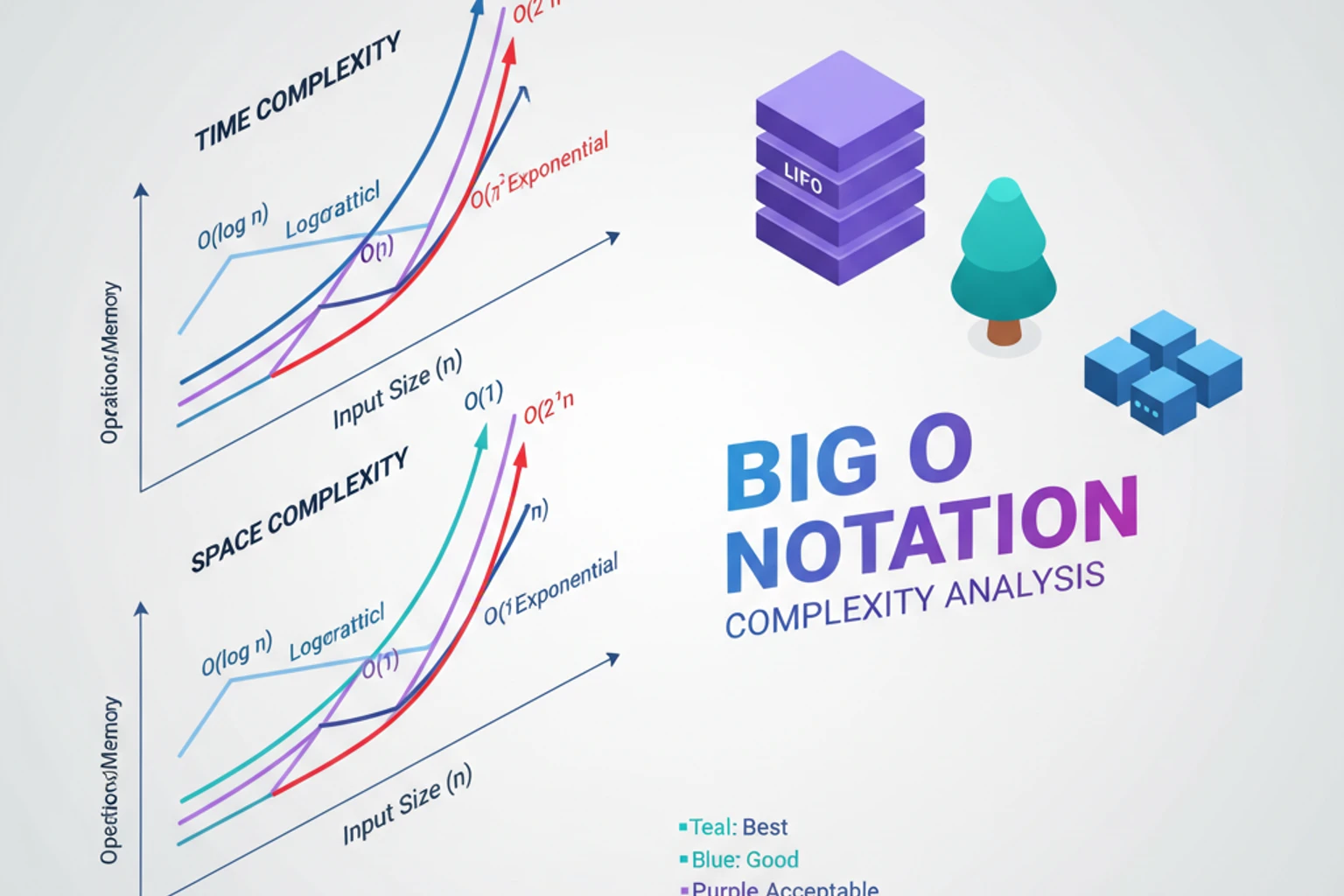
Algorithm Complexity & Big O Notation Intermediate
Section titled “Algorithm Complexity & Big O Notation Intermediate”In the previous chapter, we saw that some algorithms are faster than others. But how do we measure and compare algorithm efficiency? Enter Big O notation—the language we use to describe how algorithms scale.
What You’ll Learn
Section titled “What You’ll Learn”Estimated time: 60 minutes
By the end of this chapter, you will:
- Master Big O notation to analyze algorithm efficiency mathematically
- Understand time and space complexity with practical PHP examples and real-world scenarios
- Learn to calculate complexity for nested loops, recursion, and built-in PHP functions
- Recognize common complexity patterns (O(1), O(n), O(n²), etc.) and when to use each
- Apply complexity analysis to security considerations and avoid performance pitfalls
Prerequisites
Section titled “Prerequisites”Before starting this chapter, ensure you have:
- ✓ Understanding of basic PHP syntax (10 mins review if needed)
- ✓ Familiarity with loops and functions (10 mins review if needed)
- ✓ Completion of Chapter 0 (45 mins if not done)
Why Algorithm Complexity Matters
Section titled “Why Algorithm Complexity Matters”Imagine you’re building a user search feature for your PHP application:
// Version 1: Linear search - O(n)function findUserLinear(array $users, string $email): ?array{    foreach ($users as $user) {        if ($user['email'] === $email) {            return $user;        }    }    return null;}
// Version 2: Hash lookup - O(1)function findUserHash(array $usersByEmail, string $email): ?array{    return $usersByEmail[$email] ?? null;}
With 10 users, both versions feel instant. But with 1,000,000 users:
- Linear search: Might check 500,000 users on average
- Hash lookup: Always checks ~1 user
This is why complexity analysis matters—it predicts how your code performs as data grows.
What Is Big O Notation?
Section titled “What Is Big O Notation?”Big O notation describes how an algorithm’s runtime or memory usage grows relative to input size. It answers: “As my input gets larger, how much slower does my code get?”
The Basics
Section titled “The Basics”Big O uses this format: O(expression)
- O(1): Constant time—stays the same regardless of input size
- O(n): Linear time—grows proportionally with input size
- O(n²): Quadratic time—grows with the square of input size
The n represents input size (number of elements, string length, etc.).
An Analogy
Section titled “An Analogy”Think of Big O like describing how long it takes to find a book:
- O(1): You know exactly where it is—grab it instantly
- O(log n): Use the library catalog to narrow down the section
- O(n): Check every shelf one by one
- O(n²): Check every shelf, and for each book, flip through every page
Common Time Complexities
Section titled “Common Time Complexities”Let’s explore the most common complexities you’ll encounter:
O(1) - Constant Time
Section titled “O(1) - Constant Time”Operations that take the same time regardless of input size:
// Array access by key - O(1)function getFirstElement(array $arr): mixed{    return $arr[0];}
// Hash table lookup - O(1)function getUserById(array $users, int $id): ?array{    return $users[$id] ?? null;}
// Simple arithmetic - O(1)function calculateDiscount(float $price): float{    return $price * 0.1;}
Key insight: The operation takes the same amount of time whether you have 10 items or 10 million.
O(log n) - Logarithmic Time
Section titled “O(log n) - Logarithmic Time”Algorithms that halve the problem size with each step:
// Binary search - O(log n)function binarySearch(array $sorted, int $target): int|false{    $left = 0;    $right = count($sorted) - 1;
    while ($left <= $right) {        $mid = (int)(($left + $right) / 2);
        if ($sorted[$mid] === $target) {            return $mid;        } elseif ($sorted[$mid] < $target) {            $left = $mid + 1;        } else {            $right = $mid - 1;        }    }
    return false;}
// Searching 1,000,000 items takes only ~20 steps!$numbers = range(1, 1000000);$index = binarySearch($numbers, 742518);
Key insight: Doubling the input size only adds one more step. Very efficient!
O(n) - Linear Time
Section titled “O(n) - Linear Time”Algorithms that process each element once:
// Sum array - O(n)function sum(array $numbers): int|float{    $total = 0;    foreach ($numbers as $number) {        $total += $number;    }    return $total;}
// Find maximum - O(n)function findMax(array $numbers): int|float{    $max = $numbers[0];    foreach ($numbers as $number) {        if ($number > $max) {            $max = $number;        }    }    return $max;}
// Filter array - O(n)function filterEven(array $numbers): array{    $result = [];    foreach ($numbers as $number) {        if ($number % 2 === 0) {            $result[] = $number;        }    }    return $result;}
Key insight: Doubling the input size doubles the runtime.
O(n log n) - Linearithmic Time
Section titled “O(n log n) - Linearithmic Time”Efficient sorting algorithms fall into this category:
// Merge sort - O(n log n)function mergeSort(array $arr): array{    if (count($arr) <= 1) {        return $arr;    }
    $mid = (int)(count($arr) / 2);    $left = mergeSort(array_slice($arr, 0, $mid));    $right = mergeSort(array_slice($arr, $mid));
    return merge($left, $right);}
function merge(array $left, array $right): array{    $result = [];    $i = $j = 0;
    while ($i < count($left) && $j < count($right)) {        if ($left[$i] <= $right[$j]) {            $result[] = $left[$i++];        } else {            $result[] = $right[$j++];        }    }
    return array_merge($result, array_slice($left, $i), array_slice($right, $j));}
Key insight: Much faster than O(n²) for sorting, but slower than O(n).
O(n²) - Quadratic Time
Section titled “O(n²) - Quadratic Time”Nested loops over the same data:
// Bubble sort - O(n²)function bubbleSort(array $arr): array{    $n = count($arr);
    for ($i = 0; $i < $n - 1; $i++) {        for ($j = 0; $j < $n - $i - 1; $j++) {            if ($arr[$j] > $arr[$j + 1]) {                [$arr[$j], $arr[$j + 1]] = [$arr[$j + 1], $arr[$j]];            }        }    }
    return $arr;}
// Find all pairs - O(n²)function findAllPairs(array $items): array{    $pairs = [];
    for ($i = 0; $i < count($items); $i++) {        for ($j = $i + 1; $j < count($items); $j++) {            $pairs[] = [$items[$i], $items[$j]];        }    }
    return $pairs;}
Key insight: Doubling the input size quadruples the runtime. Gets slow quickly!
O(2ⁿ) - Exponential Time
Section titled “O(2ⁿ) - Exponential Time”Algorithms that double in runtime with each additional input:
// Fibonacci (naive recursive) - O(2ⁿ)function fibonacci(int $n): int{    if ($n <= 1) {        return $n;    }
    return fibonacci($n - 1) + fibonacci($n - 2);}
// This is VERY slow for large n!// fibonacci(40) might take seconds// fibonacci(50) might take hours!
Key insight: Avoid exponential algorithms for anything but tiny inputs.
Complexity Comparison Chart
Section titled “Complexity Comparison Chart”Here’s how these complexities compare with different input sizes:
| n (input) | O(1) | O(log n) | O(n) | O(n log n) | O(n²) | O(2ⁿ) |
|---|---|---|---|---|---|---|
| 10 | 1 | 3 | 10 | 33 | 100 | 1,024 |
| 100 | 1 | 7 | 100 | 664 | 10,000 | ~10³⁰ |
| 1,000 | 1 | 10 | 1,000 | 9,966 | 1M | ∞ |
| 10,000 | 1 | 13 | 10K | 130K | 100M | ∞ |
Notice how O(2ⁿ) becomes unusable very quickly!
Space Complexity
Section titled “Space Complexity”Big O also describes memory usage:
// O(1) space - only uses a fixed amount of extra memoryfunction sumArray(array $numbers): int{    $total = 0; // Only one variable    foreach ($numbers as $number) {        $total += $number;    }    return $total;}
// O(n) space - creates a new array proportional to inputfunction doubleValues(array $numbers): array{    $doubled = []; // New array grows with input    foreach ($numbers as $number) {        $doubled[] = $number * 2;    }    return $doubled;}
// O(n) space - recursive call stackfunction factorial(int $n): int{    if ($n <= 1) {        return 1;    }    return $n * factorial($n - 1); // Stack grows with n}
Analyzing Real PHP Code
Section titled “Analyzing Real PHP Code”Let’s analyze complexity for a practical example:
class UserRepository{    private array $users = [];
    // O(1) - direct array access    public function findById(int $id): ?array    {        return $this->users[$id] ?? null;    }
    // O(n) - must check each user    public function findByEmail(string $email): ?array    {        foreach ($this->users as $user) {            if ($user['email'] === $email) {                return $user;            }        }        return null;    }
    // O(n) - must process each user    public function findActive(): array    {        $active = [];        foreach ($this->users as $user) {            if ($user['active']) {                $active[] = $user;            }        }        return $active;    }
    // O(n²) - nested loops!    public function findCommonFriends(int $userId1, int $userId2): array    {        $user1Friends = $this->users[$userId1]['friends'];        $user2Friends = $this->users[$userId2]['friends'];        $common = [];
        foreach ($user1Friends as $friend1) {            foreach ($user2Friends as $friend2) {                if ($friend1 === $friend2) {                    $common[] = $friend1;                }            }        }
        return $common;    }
    // Better: O(n) using hash lookup    public function findCommonFriendsOptimized(int $userId1, int $userId2): array    {        $user1Friends = $this->users[$userId1]['friends'];        $user2Friends = $this->users[$userId2]['friends'];
        // Create hash set - O(n)        $friendSet = array_flip($user1Friends);
        // Check membership - O(n)        $common = [];        foreach ($user2Friends as $friend) {            if (isset($friendSet[$friend])) {                $common[] = $friend;            }        }
        return $common;    }}
Rules for Calculating Big O
Section titled “Rules for Calculating Big O”Rule 1: Drop Constants
Section titled “Rule 1: Drop Constants”O(2n) → O(n) O(500) → O(1)
// Both are O(n), even though one does twice the workfunction example1(array $arr): void {    foreach ($arr as $item) { }}
function example2(array $arr): void {    foreach ($arr as $item) { }    foreach ($arr as $item) { }}
Rule 2: Drop Non-Dominant Terms
Section titled “Rule 2: Drop Non-Dominant Terms”O(n² + n) → O(n²) O(n + log n) → O(n)
// This is O(n²), not O(n² + n)function example(array $arr): void {    foreach ($arr as $item) { } // O(n)
    foreach ($arr as $item1) {  // O(n²)        foreach ($arr as $item2) { }    }}
Rule 3: Different Inputs = Different Variables
Section titled “Rule 3: Different Inputs = Different Variables”// This is O(a + b), not O(n)function mergeTwoArrays(array $a, array $b): array { $result = [];
foreach ($a as $item) { $result[] = $item; }
foreach ($b as $item) { $result[] = $item; }
return $result;}
// This is O(a * b), not O(n²)function findCommonElements(array $a, array $b): array { $common = [];
foreach ($a as $itemA) { foreach ($b as $itemB) { if ($itemA === $itemB) { $common[] = $itemA; } } }
return $common;}Best, Worst, and Average Case
Section titled “Best, Worst, and Average Case”Some algorithms have different complexities depending on input:
function linearSearch(array $arr, $target): int|false{    foreach ($arr as $index => $value) {        if ($value === $target) {            return $index;        }    }    return false;}
// Best case: O(1) - target is first element// Worst case: O(n) - target is last or not present// Average case: O(n/2) → O(n)
We typically focus on worst-case complexity because it guarantees performance.
Practical Tips for PHP Developers
Section titled “Practical Tips for PHP Developers”1. Know Your Built-in Functions
Section titled “1. Know Your Built-in Functions”// in_array() - O(n)if (in_array($needle, $haystack)) { }
// isset() - O(1) for arraysif (isset($array[$key])) { }
// array_search() - O(n)$key = array_search($value, $array);
// sort() - O(n log n)sort($array);2. Use Hash Lookups When Possible
Section titled “2. Use Hash Lookups When Possible”// Bad: O(n) for each check$validEmails = ['user1@example.com', 'user2@example.com'];if (in_array($email, $validEmails)) { }
// Good: O(1) for each check$validEmails = [ 'user1@example.com' => true, 'user2@example.com' => true];if (isset($validEmails[$email])) { }3. Watch for Hidden Loops
Section titled “3. Watch for Hidden Loops”// This looks like O(n) but is actually O(n²)!function joinWithCommas(array $items): string{ $result = ''; foreach ($items as $item) { $result .= $item . ','; // String concatenation is O(n) } return rtrim($result, ',');}
// Better: O(n)function joinWithCommas(array $items): string{ return implode(',', $items);}Amortized Complexity
Section titled “Amortized Complexity”Sometimes an operation is expensive occasionally but cheap most of the time. Amortized analysis considers the average cost over a sequence of operations.
Dynamic Array Example
Section titled “Dynamic Array Example”class DynamicArray{ private array $data = []; private int $size = 0; private int $capacity = 1;
public function append($value): void { // If array is full, double the capacity if ($this->size === $this->capacity) { $this->resize($this->capacity * 2); // Expensive O(n) operation }
$this->data[$this->size++] = $value; }
private function resize(int $newCapacity): void { $newData = []; for ($i = 0; $i < $this->size; $i++) { $newData[$i] = $this->data[$i]; } $this->data = $newData; $this->capacity = $newCapacity; }}
// Individual append: O(1) usually, O(n) occasionally// Amortized complexity: O(1) per appendWhy O(1) amortized?
- Resize happens at sizes: 1, 2, 4, 8, 16, 32…
- For n appends, you copy: 1 + 2 + 4 + 8 + … + n/2 = n-1 elements total
- Average: (n-1)/n ≈ 1 copy per append → O(1) amortized
PHP’s Array Implementation
Section titled “PHP’s Array Implementation”PHP arrays use this strategy internally:
// PHP arrays have amortized O(1) append$arr = [];for ($i = 0; $i < 1000000; $i++) { $arr[] = $i; // Amortized O(1), not O(n) each time!}Common Mistakes in Complexity Analysis
Section titled “Common Mistakes in Complexity Analysis”Mistake 1: Confusing Best, Worst, and Average Cases
Section titled “Mistake 1: Confusing Best, Worst, and Average Cases”function findElement(array $arr, $target): bool{ foreach ($arr as $item) { if ($item === $target) { return true; // Might return early } } return false;}
// WRONG: "This is O(1) because it might find it immediately"// CORRECT: Worst case is O(n), which is what we reportRule: Unless specified, always report worst-case complexity.
Mistake 2: Ignoring Hidden Complexity
Section titled “Mistake 2: Ignoring Hidden Complexity”// This looks like O(n) but is actually O(n²)!function buildString(array $words): string{ $result = ''; foreach ($words as $word) { $result .= $word; // String concatenation creates new string: O(n) } return $result;}
// Each concatenation copies the entire string// Total: 0 + len(word1) + len(word1+word2) + ... = O(n²)Mistake 3: Not Considering Input Characteristics
Section titled “Mistake 3: Not Considering Input Characteristics”// Complexity depends on BOTH array sizesfunction findCommonElements(array $a, array $b): array{ $common = []; foreach ($a as $itemA) { foreach ($b as $itemB) { if ($itemA === $itemB) { $common[] = $itemA; } } } return $common;}
// WRONG: O(n²)// CORRECT: O(a × b) where a = len($a), b = len($b)Mistake 4: Calling count() in Loops
Section titled “Mistake 4: Calling count() in Loops”// Inefficient: count() called n timesfor ($i = 0; $i < count($arr); $i++) { // If count() is O(n), this becomes O(n²)!}
// Efficient: cache the count$n = count($arr);for ($i = 0; $i < $n; $i++) { // O(n)}Note: In PHP, count() is O(1) for regular arrays, but O(n) for some objects implementing Countable.
Security Considerations
Section titled “Security Considerations”Algorithm complexity affects security, not just performance.
Algorithmic Complexity Attacks
Section titled “Algorithmic Complexity Attacks”Attackers can exploit O(n²) or worse algorithms to cause denial of service:
// Vulnerable to hash collision attacksclass VulnerableCache{    private array $cache = [];
    public function add(string $key, $value): void    {        // If attacker finds hash collisions, this degrades to O(n)        $this->cache[$key] = $value;    }
    public function get(string $key)    {        return $this->cache[$key] ?? null;    }}
// Better: Use cryptographically secure hashing or rate limiting
ReDoS (Regular Expression Denial of Service)
Section titled “ReDoS (Regular Expression Denial of Service)”// Vulnerable: catastrophic backtracking O(2ⁿ)function validateEmail_VULNERABLE(string $email): bool{ // Pattern with nested quantifiers return (bool)preg_match('/^([a-zA-Z0-9]+)+@[a-zA-Z]+\.com$/', $email);}
// Attack: "aaaaaaaaaaaaaaaaaaaaaaaaaaaaaa!" takes exponential time
// Safe: Avoid nested quantifiersfunction validateEmail_SAFE(string $email): bool{ return (bool)preg_match('/^[a-zA-Z0-9]+@[a-zA-Z]+\.com$/', $email);}Input Validation
Section titled “Input Validation”Always validate input size to prevent resource exhaustion:
function processArray(array $data): array{    // Prevent attacks with huge inputs    if (count($data) > 10000) {        throw new InvalidArgumentException('Input too large');    }
    // Your O(n²) algorithm is now bounded    return someExpensiveOperation($data);}
Advanced PHP Performance Tips
Section titled “Advanced PHP Performance Tips”Tip 4: Array Functions vs Loops
Section titled “Tip 4: Array Functions vs Loops”// Benchmark reveals: loops are often faster for simple operations$bench = new Benchmark();$data = range(1, 10000);
$bench->compare([ 'array_map' => fn() => array_map(fn($x) => $x * 2, $data), 'foreach loop' => function() use ($data) { $result = []; foreach ($data as $x) { $result[] = $x * 2; } return $result; },], null, 100);
// Loops often win for simple operations due to function call overheadTip 5: Generator for Memory Efficiency
Section titled “Tip 5: Generator for Memory Efficiency”// Memory-intensive: O(n) spacefunction rangeArray(int $start, int $end): array{ $result = []; for ($i = $start; $i <= $end; $i++) { $result[] = $i; } return $result;}
// Memory-efficient: O(1) spacefunction rangeGenerator(int $start, int $end): Generator{ for ($i = $start; $i <= $end; $i++) { yield $i; }}
// Process 1 million items without using 1 million items of memoryforeach (rangeGenerator(1, 1000000) as $num) { processItem($num);}Tip 6: Opcode Cache Impact
Section titled “Tip 6: Opcode Cache Impact”// With OPcache enabled, code is compiled once// This can significantly affect benchmarks
// Always benchmark with production-like settings:// - OPcache enabled// - JIT enabled (PHP 8.0+)// - Production error reporting levelsEdge Cases to Consider
Section titled “Edge Cases to Consider”Empty Input
Section titled “Empty Input”function findMax(array $numbers): int|float{ // Bug: Crashes on empty array // return max($numbers);
// Fixed: Handle edge case if (empty($numbers)) { throw new InvalidArgumentException('Array cannot be empty'); } return max($numbers);}Single Element
Section titled “Single Element”function binarySearch(array $arr, $target): int|false{ // Edge case: single element if (count($arr) === 1) { return $arr[0] === $target ? 0 : false; }
// Main algorithm...}Very Large Numbers
Section titled “Very Large Numbers”function factorial(int $n): int{ // Edge case: integer overflow for large n if ($n > 20) { throw new OverflowException('Result would overflow'); }
// Use GMP for arbitrary precision if needed // return gmp_fact($n);
$result = 1; for ($i = 2; $i <= $n; $i++) { $result *= $i; } return $result;}Negative Numbers
Section titled “Negative Numbers”function power(int $base, int $exponent): int|float{ // Edge case: negative exponent if ($exponent < 0) { return 1 / power($base, -$exponent); }
if ($exponent === 0) { return 1; }
return $base * power($base, $exponent - 1);}Practice Problems
Section titled “Practice Problems”Problem 1: Analyze This Code
Section titled “Problem 1: Analyze This Code”What’s the time complexity?
function mystery(array $arr): int{    $count = 0;
    for ($i = 0; $i < count($arr); $i++) {        if ($arr[$i] % 2 === 0) {            $count++;        }    }
    for ($i = 0; $i < count($arr); $i++) {        if ($arr[$i] % 3 === 0) {            $count++;        }    }
    return $count;}
Answer
O(n) - Two sequential loops, each O(n), so O(n + n) = O(n)Problem 2: Optimize This
Section titled “Problem 2: Optimize This”Improve the complexity:
// Current: O(n²)function hasDuplicate(array $arr): bool{ for ($i = 0; $i < count($arr); $i++) { for ($j = $i + 1; $j < count($arr); $j++) { if ($arr[$i] === $arr[$j]) { return true; } } } return false;}Solution
// Optimized: O(n)function hasDuplicate(array $arr): bool{ $seen = []; foreach ($arr as $value) { if (isset($seen[$value])) { return true; } $seen[$value] = true; } return false;}Problem 3: Identify the Complexity
Section titled “Problem 3: Identify the Complexity”What’s the complexity of this nested loop?
function printPairs(int $n): void{ for ($i = 0; $i < $n; $i++) { for ($j = $i; $j < $n; $j++) { echo "($i, $j) "; } }}Answer
O(n²) - Even though inner loop starts at $i, total iterations:
- i=0: n iterations
- i=1: n-1 iterations
- i=2: n-2 iterations
- …
- Total: n + (n-1) + (n-2) + … + 1 = n(n+1)/2 ≈ n²/2 → O(n²)
Problem 4: Space Complexity
Section titled “Problem 4: Space Complexity”What’s the space complexity?
function fibonacci(int $n, array $memo = []): int{    if ($n <= 1) return $n;    if (isset($memo[$n])) return $memo[$n];
    $memo[$n] = fibonacci($n - 1, $memo) + fibonacci($n - 2, $memo);    return $memo[$n];}
Answer
O(n) space:
- Memoization array stores n values: O(n)
- Call stack depth: O(n)
- Total: O(n)
Problem 5: Real-World Optimization
Section titled “Problem 5: Real-World Optimization”Optimize this function that checks if any email in a list is valid:
// Current: O(n × m) where m is average email lengthfunction hasValidEmail(array $emails): bool{ foreach ($emails as $email) { if (filter_var($email, FILTER_VALIDATE_EMAIL)) { return true; } } return false;}Answer
This is already optimal - O(n) in best/average case, O(n × m) in worst case where no valid email is found. The complexity is unavoidable since we must check emails until we find a valid one. However, we can add optimizations:
function hasValidEmail(array $emails): bool{    // Quick check: if empty, return false    if (empty($emails)) {        return false;    }
    // Optimization: check shorter emails first (faster validation)    usort($emails, fn($a, $b) => strlen($a) <=> strlen($b));
    foreach ($emails as $email) {        // Skip obviously invalid (O(1) check before expensive validation)        if (strpos($email, '@') === false) {            continue;        }
        if (filter_var($email, FILTER_VALIDATE_EMAIL)) {            return true;        }    }    return false;}
Note: Sorting adds O(n log n) but can reduce average case if validation is expensive.
Problem 6: Hidden Complexity
Section titled “Problem 6: Hidden Complexity”What’s wrong with this code’s complexity?
function removeDuplicates(array $arr): array{ $result = []; foreach ($arr as $item) { if (!in_array($item, $result)) { $result[] = $item; } } return $result;}Answer
This is O(n²) because in_array() is O(n), called n times.
Optimized O(n) solution:
function removeDuplicates(array $arr): array{ return array_values(array_unique($arr)); // Or manually: // return array_keys(array_flip($arr)); // O(n)}Key Takeaways
Section titled “Key Takeaways”- Big O notation describes how algorithms scale with input size
- Focus on worst-case complexity for reliable performance guarantees
- Common complexities: O(1) < O(log n) < O(n) < O(n log n) < O(n²) < O(2ⁿ)
- Space complexity is just as important as time complexity
- Optimize smartly: Profile first, then optimize bottlenecks
- Know your tools: Understand PHP’s built-in function complexities
What’s Next
Section titled “What’s Next”In the next chapter, we’ll build a benchmarking framework to actually measure algorithm performance in PHP. You’ll learn to validate your complexity analysis with real data.
💻 Code Samples
Section titled “💻 Code Samples”All code examples from this chapter are available in the GitHub repository:
Files included:
01-complexity-examples.php- Demonstrates all major time complexity classes with working code02-space-complexity.php- Shows memory usage patterns and space complexity analysisREADME.md- Complete documentation and usage guide
Clone the repository to run the examples locally:
git clone https://github.com/dalehurley/codewithphp.gitcd codewithphp/code/php-algorithms/chapter-01php 01-complexity-examples.phpContinue to Chapter 02: Benchmarking & Performance Testing.