# 15: HTTP & Request/Response
[Original page](https://codewithphp.com/series/php-for-java-developers/chapters/15-http-and-request-response/)
> Master HTTP handling in PHP from superglobals to PSR-7 standards, with Java Servlet API comparisons
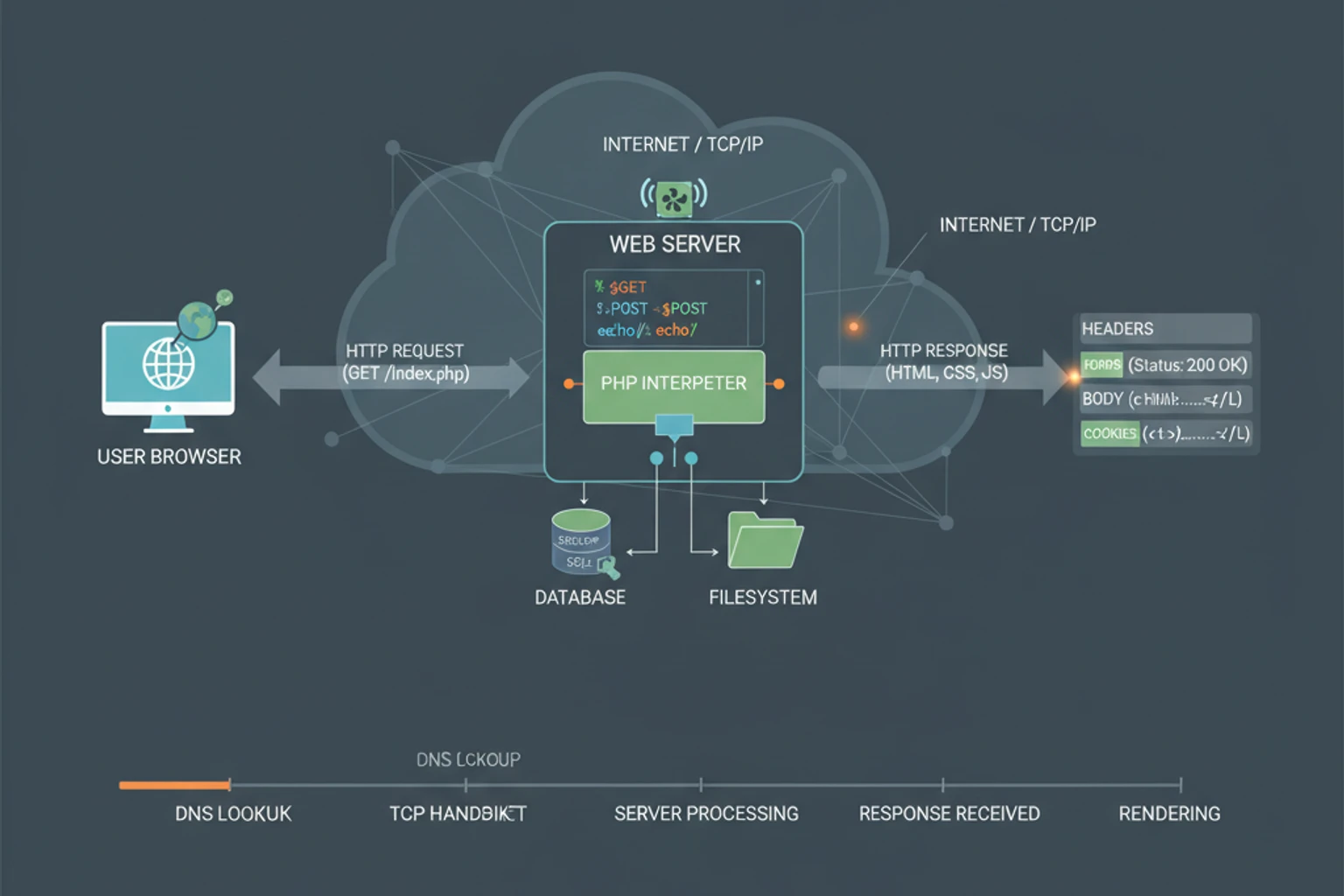
# Chapter 15: HTTP & Request/Response
Intermediate 90-120 min
## Overview
Understanding HTTP request and response handling is fundamental to web development in PHP. If you're coming from Java, you're familiar with the Servlet API's `HttpServletRequest` and `HttpServletResponse` interfaces. PHP offers both traditional superglobals (similar to JSP's implicit objects) and modern PSR-7 interfaces (similar to Java's Servlet API) for HTTP handling.
This chapter bridges Java's Servlet API concepts to PHP's HTTP handling mechanisms. You'll learn how PHP's superglobals compare to Java's request/response objects, how to work with PSR-7 interfaces (the PHP standard for HTTP messages), and how to implement middleware patterns similar to Java servlet filters.
**What You'll Learn:**
- PHP superglobals (`$_GET`, `$_POST`, `$_SERVER`, `$_COOKIE`, `$_FILES`) and their Java equivalents
- PSR-7 Request and Response interfaces (similar to Servlet API)
- Content negotiation (Accept headers, content types, languages)
- Request body parsing (JSON, XML, form-urlencoded, multipart)
- Working with HTTP headers and status codes
- Cookie management and session handling
- CORS preflight requests and OPTIONS method handling
- Caching headers (ETag, Last-Modified, Cache-Control)
- Content encoding (Gzip compression)
- HTTP method override (PUT/DELETE via POST)
- File upload handling and validation
- Range requests for partial content delivery
- Request size limits and validation
- Middleware pattern implementation
- Stream handling for large data
- Security best practices for HTTP handling
## Prerequisites
::: info Time Estimate
⏱️ **90-120 minutes** to complete this chapter
:::
Before starting this chapter, you should be comfortable with:
- PHP arrays and associative arrays (Chapter 2)
- Object-oriented programming in PHP (Chapter 3)
- Error handling and exceptions (Chapter 7)
- Basic understanding of HTTP protocol (methods, headers, status codes)
- Familiarity with Java's Servlet API (`HttpServletRequest`, `HttpServletResponse`)
## What You'll Build
In this chapter, you'll create:
- A request handler class using superglobals
- A PSR-7 compatible request/response wrapper
- A header management utility class
- A file upload handler with validation
- A middleware stack implementation
- A complete example combining all concepts
## Learning Objectives
By the end of this chapter, you will be able to:
1. **Use PHP superglobals** to access HTTP request data safely
2. **Work with PSR-7 interfaces** for modern HTTP message handling
3. **Implement content negotiation** for Accept headers, content types, and languages
4. **Parse request bodies** in multiple formats (JSON, XML, form-urlencoded, multipart)
5. **Manage HTTP headers** programmatically (set, get, remove)
6. **Handle cookies** securely with proper options
7. **Handle CORS preflight requests** and OPTIONS method
8. **Implement caching** with ETag, Last-Modified, and Cache-Control headers
9. **Compress responses** using Gzip content encoding
10. **Support HTTP method override** for PUT/DELETE via POST
11. **Process file uploads** with validation and security checks
12. **Handle range requests** for partial content delivery
13. **Validate request size limits** and handle large requests
14. **Implement middleware** patterns similar to servlet filters
15. **Work with streams** for handling large request/response bodies
16. **Use HTTP status codes** appropriately
17. **Apply security best practices** for HTTP handling
---
## Section 1: PHP Superglobals vs Java Servlet API
### Goal
Understand how PHP's superglobals compare to Java's `HttpServletRequest` and `HttpServletResponse`.
### PHP Superglobals Overview
PHP provides several **superglobals**—predefined arrays that are automatically available in all scopes. These are similar to JSP's implicit objects but work differently from Java's servlet API.
::: code-group
```php [PHP Superglobals]
getIntParam('id');
$method = $handler->getMethod();
$path = $handler->getPath();
```
### Troubleshooting
- **Error: "Undefined array key"** — Use null coalescing (`??`) or `isset()` checks
- **Type errors** — Always validate with `filter_input()` or type casting
- **Security warnings** — Never trust superglobal data; always validate
---
## Section 2: PSR-7 Interfaces
### Goal
Learn how to use PSR-7 interfaces for modern, object-oriented HTTP message handling.
### What is PSR-7?
PSR-7 (PHP Standard Recommendation 7) defines interfaces for HTTP messages. It's similar to Java's Servlet API but designed specifically for PHP. PSR-7 messages are **immutable**—methods return new instances rather than modifying existing ones.
### Installing PSR-7
```bash
# Install PSR-7 interfaces
composer require psr/http-message
# Install a PSR-7 implementation (Guzzle HTTP)
composer require guzzlehttp/psr7
```
### Basic PSR-7 Usage
::: code-group
```php [PHP PSR-7]
'Bearer token123'],
'{"name": "John"}'
);
// Access request properties
$method = $request->getMethod(); // GET
$uri = $request->getUri(); // UriInterface
$headers = $request->getHeaders(); // ['Authorization' => ['Bearer token123']]
$body = $request->getBody(); // StreamInterface
// Immutability: methods return new instances
$newRequest = $request->withMethod('POST');
$newRequest = $request->withHeader('Content-Type', 'application/json');
// Create a response
$response = new Response(
200,
['Content-Type' => 'application/json'],
json_encode(['status' => 'success'])
);
$statusCode = $response->getStatusCode(); // 200
$headers = $response->getHeaders(); // ['Content-Type' => ['application/json']]
```
```java [Java Servlet API]
// Java equivalent
public void doGet(HttpServletRequest request, HttpServletResponse response) {
// Request properties
String method = request.getMethod();
String uri = request.getRequestURI();
Enumeration headerNames = request.getHeaderNames();
// Response
response.setStatus(HttpServletResponse.SC_OK);
response.setContentType("application/json");
response.getWriter().write("{\"status\":\"success\"}");
}
```
:::
### ServerRequest: Handling Incoming Requests
For handling incoming HTTP requests, use `ServerRequest` which extends `Request`:
```php
getParsedBody(); // Array or object
// Access query parameters
$queryParams = $request->getQueryParams(); // ['id' => '123']
// Access uploaded files
$uploadedFiles = $request->getUploadedFiles(); // ['file' => UploadedFileInterface]
// Access server parameters (like $_SERVER)
$serverParams = $request->getServerParams();
// Access attributes (custom data)
$request = $request->withAttribute('userId', 123);
$userId = $request->getAttribute('userId');
```
### Working with URIs
```php
getScheme(); // https
$host = $uri->getHost(); // example.com
$port = $uri->getPort(); // 8080
$path = $uri->getPath(); // /users
$query = $uri->getQuery(); // id=123
$fragment = $uri->getFragment(); // section
// Modify URI (returns new instance)
$newUri = $uri->withPath('/posts')
->withQuery('page=2');
```
### Working with Streams
PSR-7 uses streams for request/response bodies:
```php
getContents(); // Reads entire stream
$body->rewind(); // Reset pointer
$chunk = $body->read(5); // Read 5 bytes
// Write to stream
$writableStream = \GuzzleHttp\Psr7\Utils::streamFor(
fopen('/path/to/output.txt', 'w')
);
$writableStream->write('Data to write');
```
### Why It Works
- **Immutability** prevents accidental modifications and enables safe sharing
- **Interfaces** allow different implementations (Guzzle, Zend, Symfony)
- **Streams** handle large data efficiently without loading everything into memory
- **Type safety** through interfaces provides better IDE support and error detection
### Complete Example: PSR-7 Request Handler
Here's a complete example using PSR-7 for handling requests:
```php
getMethod();
$path = $request->getUri()->getPath();
// Get query parameters
$queryParams = $request->getQueryParams();
$userId = $queryParams['id'] ?? null;
// Get parsed body (for JSON POST requests)
$body = $request->getParsedBody();
$data = is_array($body) ? $body : [];
// Get headers
$contentType = $request->getHeaderLine('Content-Type');
$authorization = $request->getHeaderLine('Authorization');
// Process request based on method
return match ($method) {
'GET' => $this->handleGet($request, $userId),
'POST' => $this->handlePost($request, $data),
'PUT' => $this->handlePut($request, $userId, $data),
'DELETE' => $this->handleDelete($request, $userId),
default => new Response(405, [], 'Method Not Allowed')
};
}
private function handleGet(RequestInterface $request, ?string $userId): ResponseInterface
{
if ($userId === null) {
// Return list
$data = ['users' => [/* ... */]];
} else {
// Return single user
$data = ['user' => ['id' => $userId, /* ... */]];
}
return new Response(
200,
['Content-Type' => 'application/json'],
json_encode($data)
);
}
private function handlePost(RequestInterface $request, array $data): ResponseInterface
{
// Create resource
$newId = 123; // Create logic here
return new Response(
201,
[
'Content-Type' => 'application/json',
'Location' => '/api/users/' . $newId
],
json_encode(['id' => $newId, 'data' => $data])
);
}
private function handlePut(RequestInterface $request, ?string $userId, array $data): ResponseInterface
{
if ($userId === null) {
return new Response(400, [], 'Missing user ID');
}
// Update logic here
return new Response(
200,
['Content-Type' => 'application/json'],
json_encode(['id' => $userId, 'updated' => true])
);
}
private function handleDelete(RequestInterface $request, ?string $userId): ResponseInterface
{
if ($userId === null) {
return new Response(400, [], 'Missing user ID');
}
// Delete logic here
return new Response(204); // No Content
}
}
// Usage
$request = ServerRequest::fromGlobals();
$handler = new ApiHandler();
$response = $handler->handle($request);
// Send response
http_response_code($response->getStatusCode());
foreach ($response->getHeaders() as $name => $values) {
foreach ($values as $value) {
header("$name: $value", false);
}
}
echo $response->getBody();
```
### Troubleshooting
- **Error: "Class not found"** — Install PSR-7 implementation (`composer require guzzlehttp/psr7`)
- **Stream already read** — Call `rewind()` before reading again, or use `getContents()` once
- **Memory issues** — Use streams for large files instead of loading entire content
---
## Section 2.5: Content Negotiation and Request Body Parsing
### Goal
Learn how to handle content negotiation (Accept headers) and parse different request body formats.
### Content Negotiation
Content negotiation allows clients to specify what content types, languages, and encodings they prefer. PHP doesn't have built-in content negotiation, but you can implement it easily.
```php
getHeaderLine('Accept');
if (empty($acceptHeader)) {
return $supportedTypes[0]; // Default to first supported type
}
// Parse Accept header with quality values
// Accept: application/json, application/xml;q=0.9, text/html;q=0.8
$acceptedTypes = [];
foreach (explode(',', $acceptHeader) as $type) {
$parts = explode(';', trim($type));
$mimeType = trim($parts[0]);
$quality = 1.0;
if (isset($parts[1]) && str_starts_with($parts[1], 'q=')) {
$quality = (float)substr($parts[1], 2);
}
$acceptedTypes[$mimeType] = $quality;
}
// Sort by quality (descending)
arsort($acceptedTypes);
// Find best match
foreach ($acceptedTypes as $mimeType => $quality) {
// Exact match
if (in_array($mimeType, $supportedTypes, true)) {
return $mimeType;
}
// Wildcard match (application/*)
if (str_ends_with($mimeType, '/*')) {
$baseType = substr($mimeType, 0, -2);
foreach ($supportedTypes as $supported) {
if (str_starts_with($supported, $baseType . '/')) {
return $supported;
}
}
}
}
// Check for */* wildcard
if (isset($acceptedTypes['*/*'])) {
return $supportedTypes[0];
}
return null; // No acceptable type found
}
/**
* Negotiate language from Accept-Language header
*/
public static function negotiateLanguage(
RequestInterface $request,
array $supportedLanguages = ['en', 'es', 'fr']
): string {
$acceptLanguage = $request->getHeaderLine('Accept-Language');
if (empty($acceptLanguage)) {
return $supportedLanguages[0];
}
$acceptedLanguages = [];
foreach (explode(',', $acceptLanguage) as $lang) {
$parts = explode(';', trim($lang));
$language = trim($parts[0]);
$quality = 1.0;
if (isset($parts[1]) && str_starts_with($parts[1], 'q=')) {
$quality = (float)substr($parts[1], 2);
}
// Extract base language (en-US -> en)
$baseLang = explode('-', $language)[0];
$acceptedLanguages[$baseLang] = max($acceptedLanguages[$baseLang] ?? 0, $quality);
}
arsort($acceptedLanguages);
foreach ($acceptedLanguages as $lang => $quality) {
if (in_array($lang, $supportedLanguages, true)) {
return $lang;
}
}
return $supportedLanguages[0];
}
}
// Usage
$request = ServerRequest::fromGlobals();
$contentType = ContentNegotiation::negotiateContentType(
$request,
['application/json', 'application/xml']
);
$language = ContentNegotiation::negotiateLanguage($request, ['en', 'es']);
```
### Request Body Parsing
Different content types require different parsing approaches:
```php
getHeaderLine('Content-Type');
// Remove charset and other parameters
$contentType = explode(';', $contentType)[0];
$contentType = trim($contentType);
$body = $request->getBody()->getContents();
return match ($contentType) {
'application/json' => self::parseJson($body),
'application/xml', 'text/xml' => self::parseXml($body),
'application/x-www-form-urlencoded' => self::parseFormUrlencoded($body),
'multipart/form-data' => self::parseMultipart($request),
default => $body // Return raw body
};
}
private static function parseJson(string $body): array
{
$data = json_decode($body, true);
if (json_last_error() !== JSON_ERROR_NONE) {
throw new \InvalidArgumentException(
'Invalid JSON: ' . json_last_error_msg()
);
}
return $data ?? [];
}
private static function parseXml(string $body): \SimpleXMLElement
{
libxml_use_internal_errors(true);
$xml = simplexml_load_string($body);
if ($xml === false) {
$errors = libxml_get_errors();
libxml_clear_errors();
throw new \InvalidArgumentException(
'Invalid XML: ' . ($errors[0]->message ?? 'Unknown error')
);
}
return $xml;
}
private static function parseFormUrlencoded(string $body): array
{
parse_str($body, $data);
return $data;
}
private static function parseMultipart(RequestInterface $request): array
{
// For multipart, use getParsedBody() which PSR-7 handles
$parsed = $request->getParsedBody();
return is_array($parsed) ? $parsed : [];
}
}
// Usage
$request = ServerRequest::fromGlobals();
$data = RequestBodyParser::parse($request);
```
### Why It Works
- **Content negotiation** allows clients to specify preferences, improving API flexibility
- **Quality values (q-values)** let clients prioritize content types (e.g., `application/json;q=0.9`)
- **Wildcard matching** (`*/*`, `application/*`) provides fallback options
- **Body parsing** handles different content types appropriately (JSON, XML, form data)
---
## Section 3: Headers and Cookies
### Goal
Learn how to manage HTTP headers and cookies in PHP, comparing to Java's servlet API.
### Setting HTTP Headers
::: code-group
```php [PHP Headers]
'application/json',
'X-Custom' => 'value'
]);
// Modify headers (immutable)
$newResponse = $response->withHeader('X-New-Header', 'new-value');
$newResponse = $response->withAddedHeader('X-Custom', 'another-value');
```
```java [Java Headers]
// Java Servlet API equivalent
public void doGet(HttpServletRequest request, HttpServletResponse response) {
// Set headers
response.setContentType("application/json");
response.setHeader("X-Custom-Header", "value");
response.setStatus(HttpServletResponse.SC_FOUND);
response.setHeader("Location", "/redirect");
// Add header (allows multiple values)
response.addHeader("X-Custom", "value1");
response.addHeader("X-Custom", "value2");
// Check if response committed
if (!response.isCommitted()) {
response.setHeader("X-Custom", "value");
}
}
```
:::
### Reading Request Headers
```php
getHeader('User-Agent');
$firstValue = $request->getHeaderLine('User-Agent'); // Comma-separated string
// Check if header exists
if ($request->hasHeader('Authorization')) {
$authHeader = $request->getHeaderLine('Authorization');
}
```
### Working with Cookies
::: code-group
```php [PHP Cookies]
time() + 3600, // Expiration time
'path' => '/', // Available path
'domain' => '.example.com', // Domain
'secure' => true, // HTTPS only
'httponly' => true, // JavaScript cannot access
'samesite' => 'Strict' // CSRF protection
]
);
// Read cookies
$username = $_COOKIE['username'] ?? null;
$sessionId = $_COOKIE['session_id'] ?? null;
// Delete cookie (set expiration in past)
setcookie('username', '', time() - 3600, '/');
// Using PSR-7 for cookies
use GuzzleHttp\Psr7\ServerRequest;
$request = ServerRequest::fromGlobals();
$cookies = $request->getCookieParams(); // ['username' => 'john']
```
```java [Java Cookies]
// Java Servlet API equivalent
public void doGet(HttpServletRequest request, HttpServletResponse response) {
// Set cookie
Cookie cookie = new Cookie("username", "john");
cookie.setMaxAge(3600);
cookie.setPath("/");
cookie.setSecure(true);
cookie.setHttpOnly(true);
response.addCookie(cookie);
// Read cookies
Cookie[] cookies = request.getCookies();
if (cookies != null) {
for (Cookie c : cookies) {
if ("username".equals(c.getName())) {
String value = c.getValue();
break;
}
}
}
// Delete cookie
Cookie deleteCookie = new Cookie("username", "");
deleteCookie.setMaxAge(0);
response.addCookie(deleteCookie);
}
```
:::
### Security Best Practices for Cookies
```php
time() + $expiresIn,
'path' => '/',
'domain' => '', // Current domain only
'secure' => true, // HTTPS only
'httponly' => true, // Prevent XSS
'samesite' => 'Strict' // CSRF protection
]
);
}
// Usage
setSecureCookie('session_id', bin2hex(random_bytes(32)));
```
### Why It Works
- **`header()` function** sends raw HTTP headers before content
- **`setcookie()`** sets the `Set-Cookie` header with proper formatting
- **PSR-7 interfaces** provide object-oriented, immutable header management
- **Cookie options** control security, scope, and expiration
### Complete Example: Response Builder
Here's a utility class for building responses:
```php
$url],
''
);
}
/**
* Create error response
*/
public static function error(
string $message,
int $statusCode = 400,
?array $errors = null
): Response {
$data = ['error' => $message];
if ($errors !== null) {
$data['errors'] = $errors;
}
return self::json($data, $statusCode);
}
/**
* Create success response
*/
public static function success(
mixed $data,
string $message = 'Success',
int $statusCode = 200
): Response {
return self::json([
'success' => true,
'message' => $message,
'data' => $data
], $statusCode);
}
}
// Usage
$response = ResponseBuilder::json(['users' => []], 200);
$response = ResponseBuilder::redirect('/login', 302);
$response = ResponseBuilder::error('Validation failed', 422, ['email' => 'Invalid']);
```
### CORS Preflight Requests
CORS (Cross-Origin Resource Sharing) preflight requests use the OPTIONS method to check if a cross-origin request is allowed:
```php
allowedOrigins = $allowedOrigins;
$this->allowedMethods = $allowedMethods;
$this->allowedHeaders = $allowedHeaders;
$this->maxAge = $maxAge;
}
public function process(
RequestInterface $request,
RequestHandlerInterface $handler
): ResponseInterface {
// Handle preflight OPTIONS request
if ($request->getMethod() === 'OPTIONS') {
return $this->handlePreflight($request);
}
// Handle actual request - add CORS headers to response
$response = $handler->handle($request);
return $this->addCorsHeaders($request, $response);
}
private function handlePreflight(RequestInterface $request): ResponseInterface
{
$origin = $request->getHeaderLine('Origin');
$requestMethod = $request->getHeaderLine('Access-Control-Request-Method');
$requestHeaders = $request->getHeaderLine('Access-Control-Request-Headers');
// Check if origin is allowed
if (!$this->isOriginAllowed($origin)) {
return new Response(403, [], 'Origin not allowed');
}
// Build CORS headers
$headers = [
'Access-Control-Allow-Origin' => $this->getAllowedOrigin($origin),
'Access-Control-Allow-Methods' => implode(', ', $this->allowedMethods),
'Access-Control-Allow-Headers' => $requestHeaders ?: implode(', ', $this->allowedHeaders),
'Access-Control-Max-Age' => (string)$this->maxAge,
];
// Add credentials if needed
if (in_array($origin, $this->allowedOrigins, true)) {
$headers['Access-Control-Allow-Credentials'] = 'true';
}
return new Response(204, $headers, '');
}
private function addCorsHeaders(
RequestInterface $request,
ResponseInterface $response
): ResponseInterface {
$origin = $request->getHeaderLine('Origin');
if (!$this->isOriginAllowed($origin)) {
return $response;
}
return $response
->withHeader('Access-Control-Allow-Origin', $this->getAllowedOrigin($origin))
->withHeader('Access-Control-Allow-Credentials', 'true')
->withHeader('Access-Control-Expose-Headers', 'X-Total-Count, X-Page-Count');
}
private function isOriginAllowed(string $origin): bool
{
if (empty($origin)) {
return false;
}
if (in_array('*', $this->allowedOrigins, true)) {
return true;
}
return in_array($origin, $this->allowedOrigins, true);
}
private function getAllowedOrigin(string $origin): string
{
return in_array('*', $this->allowedOrigins, true) ? '*' : $origin;
}
}
```
### Caching Headers
HTTP caching headers help reduce server load and improve performance:
```php
withHeader('ETag', $etag)
->withHeader('Cache-Control', "public, max-age=$maxAge")
->withHeader('Last-Modified', gmdate('D, d M Y H:i:s') . ' GMT');
}
/**
* Check if request has valid cached version (304 Not Modified)
*/
public static function checkNotModified(
RequestInterface $request,
ResponseInterface $response
): ?ResponseInterface {
// Check If-None-Match (ETag)
$ifNoneMatch = $request->getHeaderLine('If-None-Match');
$etag = $response->getHeaderLine('ETag');
if ($ifNoneMatch && $etag && $ifNoneMatch === $etag) {
return $response->withStatus(304)->withBody(
\GuzzleHttp\Psr7\Utils::streamFor('')
);
}
// Check If-Modified-Since
$ifModifiedSince = $request->getHeaderLine('If-Modified-Since');
$lastModified = $response->getHeaderLine('Last-Modified');
if ($ifModifiedSince && $lastModified) {
$ifModifiedSinceTime = strtotime($ifModifiedSince);
$lastModifiedTime = strtotime($lastModified);
if ($ifModifiedSinceTime >= $lastModifiedTime) {
return $response->withStatus(304)->withBody(
\GuzzleHttp\Psr7\Utils::streamFor('')
);
}
}
return null; // Not modified check failed, return original response
}
/**
* Set no-cache headers
*/
public static function noCache(ResponseInterface $response): ResponseInterface
{
return $response
->withHeader('Cache-Control', 'no-cache, no-store, must-revalidate')
->withHeader('Pragma', 'no-cache')
->withHeader('Expires', '0');
}
}
// Usage
$request = ServerRequest::fromGlobals();
$content = json_encode(['data' => 'value']);
$response = new Response(200, ['Content-Type' => 'application/json'], $content);
// Add caching
$response = CacheControl::withEtag($response, $content, 3600);
// Check if client has cached version
$notModified = CacheControl::checkNotModified($request, $response);
if ($notModified !== null) {
// Send 304 Not Modified
$response = $notModified;
}
```
### Content Encoding (Gzip Compression)
Compress responses to reduce bandwidth:
```php
handle($request);
// Check if client accepts gzip
$acceptEncoding = $request->getHeaderLine('Accept-Encoding');
if (str_contains($acceptEncoding, 'gzip')) {
$body = $response->getBody()->getContents();
$compressed = gzencode($body, 6); // Compression level 1-9
if ($compressed !== false) {
return $response
->withHeader('Content-Encoding', 'gzip')
->withHeader('Content-Length', (string)strlen($compressed))
->withBody(\GuzzleHttp\Psr7\Utils::streamFor($compressed));
}
}
return $response;
}
}
```
### HTTP Method Override
Support PUT/DELETE methods via POST (useful for HTML forms):
```php
getHeaderLine('X-HTTP-Method-Override');
if (!empty($overrideMethod)) {
$request = $request->withMethod(strtoupper($overrideMethod));
}
// Check _method parameter in POST body
elseif ($request->getMethod() === 'POST') {
$parsedBody = $request->getParsedBody();
if (is_array($parsedBody) && isset($parsedBody['_method'])) {
$method = strtoupper($parsedBody['_method']);
if (in_array($method, ['PUT', 'DELETE', 'PATCH'], true)) {
$request = $request->withMethod($method);
// Remove _method from parsed body
unset($parsedBody['_method']);
$request = $request->withParsedBody($parsedBody);
}
}
}
return $handler->handle($request);
}
}
// Usage in HTML form
//
```
### Troubleshooting
- **Error: "Cannot modify header information"** — Headers already sent; check for output before `header()` calls
- **Cookies not working** — Check `secure` flag (must be `false` for HTTP), `path`, and `domain` settings
- **SameSite warnings** — Use `'Strict'` or `'Lax'` for CSRF protection
- **CORS preflight failing** — Ensure OPTIONS method is handled and all required headers are returned
- **304 Not Modified not working** — Verify ETag or Last-Modified headers are set correctly
---
## Section 4: File Uploads
### Goal
Learn how to handle file uploads securely in PHP, comparing to Java's multipart handling.
### Basic File Upload Handling
::: code-group
```php [PHP File Uploads]
$maxSize) {
throw new InvalidArgumentException('File too large');
}
// Move uploaded file to destination
$destination = __DIR__ . '/uploads/' . basename($fileName);
if (move_uploaded_file($tmpName, $destination)) {
echo "File uploaded successfully";
} else {
throw new RuntimeException('Failed to move uploaded file');
}
}
```
```java [Java File Upload]
// Java Servlet API equivalent
@MultipartConfig
public class FileUploadServlet extends HttpServlet {
protected void doPost(HttpServletRequest request, HttpServletResponse response) {
try {
Part filePart = request.getPart("document");
String fileName = getFileName(filePart);
String contentType = filePart.getContentType();
long fileSize = filePart.getSize();
// Validate
List allowedTypes = Arrays.asList("image/jpeg", "image/png", "application/pdf");
long maxSize = 5 * 1024 * 1024;
if (!allowedTypes.contains(contentType)) {
throw new IllegalArgumentException("Invalid file type");
}
if (fileSize > maxSize) {
throw new IllegalArgumentException("File too large");
}
// Save file
String destination = getServletContext().getRealPath("/uploads/") + fileName;
filePart.write(destination);
} catch (Exception e) {
response.sendError(HttpServletResponse.SC_INTERNAL_SERVER_ERROR);
}
}
private String getFileName(Part part) {
String contentDisposition = part.getHeader("content-disposition");
// Parse filename from content-disposition header
return /* parsed filename */;
}
}
```
:::
### Upload Error Codes
```php
'No error',
UPLOAD_ERR_INI_SIZE => 'File exceeds upload_max_filesize',
UPLOAD_ERR_FORM_SIZE => 'File exceeds MAX_FILE_SIZE',
UPLOAD_ERR_PARTIAL => 'File partially uploaded',
UPLOAD_ERR_NO_FILE => 'No file uploaded',
UPLOAD_ERR_NO_TMP_DIR => 'Missing temporary folder',
UPLOAD_ERR_CANT_WRITE => 'Failed to write file to disk',
UPLOAD_ERR_EXTENSION => 'PHP extension stopped upload',
default => 'Unknown error'
};
}
// Usage
if ($_FILES['file']['error'] !== UPLOAD_ERR_OK) {
$errorMessage = handleUploadError($_FILES['file']['error']);
throw new RuntimeException("Upload failed: $errorMessage");
}
```
### Secure File Upload Class
```php
allowedTypes = $allowedTypes;
$this->maxSize = $maxSize;
$this->uploadDir = rtrim($uploadDir, '/') . '/';
// Create upload directory if it doesn't exist
if (!is_dir($this->uploadDir)) {
mkdir($this->uploadDir, 0755, true);
}
}
public function upload(string $fieldName): string
{
if (!isset($_FILES[$fieldName])) {
throw new InvalidArgumentException("No file uploaded for field: $fieldName");
}
$file = $_FILES[$fieldName];
// Check for upload errors
if ($file['error'] !== UPLOAD_ERR_OK) {
throw new RuntimeException("Upload error: " . $file['error']);
}
// Validate file type
$finfo = finfo_open(FILEINFO_MIME_TYPE);
$mimeType = finfo_file($finfo, $file['tmp_name']);
finfo_close($finfo);
if (!in_array($mimeType, $this->allowedTypes, true)) {
throw new InvalidArgumentException("Invalid file type: $mimeType");
}
// Validate file size
if ($file['size'] > $this->maxSize) {
throw new InvalidArgumentException("File too large: {$file['size']} bytes");
}
// Generate secure filename
$extension = pathinfo($file['name'], PATHINFO_EXTENSION);
$safeFileName = bin2hex(random_bytes(16)) . '.' . $extension;
$destination = $this->uploadDir . $safeFileName;
// Move uploaded file
if (!move_uploaded_file($file['tmp_name'], $destination)) {
throw new RuntimeException("Failed to move uploaded file");
}
return $safeFileName;
}
}
// Usage
$uploader = new SecureFileUpload(
['image/jpeg', 'image/png', 'application/pdf'],
5 * 1024 * 1024, // 5MB
__DIR__ . '/uploads'
);
try {
$fileName = $uploader->upload('document');
echo "File uploaded: $fileName";
} catch (Exception $e) {
echo "Error: " . $e->getMessage();
}
```
### Using PSR-7 for File Uploads
```php
getUploadedFiles();
if (isset($uploadedFiles['document'])) {
$file = $uploadedFiles['document'];
if ($file->getError() === UPLOAD_ERR_OK) {
$stream = $file->getStream();
$destination = __DIR__ . '/uploads/' . $file->getClientFilename();
// Write stream to file
$handle = fopen($destination, 'wb');
while (!$stream->eof()) {
fwrite($handle, $stream->read(8192));
}
fclose($handle);
}
}
```
### Why It Works
- **`$_FILES` superglobal** contains uploaded file information
- **`move_uploaded_file()`** safely moves files from temporary location
- **`finfo_file()`** detects actual MIME type (more secure than trusting client)
- **Random filenames** prevent overwriting and directory traversal attacks
- **PSR-7 `UploadedFileInterface`** provides object-oriented file handling
### Complete Example: File Upload Endpoint
Here's a complete file upload endpoint using PSR-7:
```php
getUploadedFiles();
if (!isset($uploadedFiles['file'])) {
return ResponseBuilder::error('No file uploaded', 400);
}
$file = $uploadedFiles['file'];
// Check upload error
if ($file->getError() !== UPLOAD_ERR_OK) {
return ResponseBuilder::error(
'Upload failed: ' . $this->getUploadErrorMessage($file->getError()),
400
);
}
// Validate file type
$mimeType = $this->detectMimeType($file);
if (!in_array($mimeType, self::ALLOWED_TYPES, true)) {
return ResponseBuilder::error("Invalid file type: $mimeType", 400);
}
// Validate file size
if ($file->getSize() > self::MAX_SIZE) {
return ResponseBuilder::error('File too large', 400);
}
// Generate secure filename
$extension = $this->getExtensionFromMimeType($mimeType);
$filename = bin2hex(random_bytes(16)) . '.' . $extension;
$destination = self::UPLOAD_DIR . $filename;
// Ensure upload directory exists
if (!is_dir(self::UPLOAD_DIR)) {
mkdir(self::UPLOAD_DIR, 0755, true);
}
// Move uploaded file
try {
$file->moveTo($destination);
} catch (\RuntimeException $e) {
return ResponseBuilder::error('Failed to save file', 500);
}
return ResponseBuilder::success([
'filename' => $filename,
'size' => $file->getSize(),
'type' => $mimeType,
'url' => '/uploads/' . $filename
], 'File uploaded successfully', 201);
}
private function detectMimeType(UploadedFileInterface $file): string
{
// Use finfo for accurate MIME type detection
$finfo = finfo_open(FILEINFO_MIME_TYPE);
$stream = $file->getStream();
$stream->rewind();
$chunk = $stream->read(8192);
$mimeType = finfo_buffer($finfo, $chunk);
finfo_close($finfo);
return $mimeType ?: 'application/octet-stream';
}
private function getExtensionFromMimeType(string $mimeType): string
{
return match ($mimeType) {
'image/jpeg' => 'jpg',
'image/png' => 'png',
'image/gif' => 'gif',
default => 'bin'
};
}
private function getUploadErrorMessage(int $errorCode): string
{
return match ($errorCode) {
UPLOAD_ERR_INI_SIZE => 'File exceeds upload_max_filesize',
UPLOAD_ERR_FORM_SIZE => 'File exceeds MAX_FILE_SIZE',
UPLOAD_ERR_PARTIAL => 'File partially uploaded',
UPLOAD_ERR_NO_FILE => 'No file uploaded',
UPLOAD_ERR_NO_TMP_DIR => 'Missing temporary folder',
UPLOAD_ERR_CANT_WRITE => 'Failed to write file to disk',
UPLOAD_ERR_EXTENSION => 'PHP extension stopped upload',
default => 'Unknown upload error'
};
}
}
// Usage
$request = ServerRequest::fromGlobals();
$controller = new FileUploadController();
$response = $controller->upload($request);
```
### Request Size Limits
PHP has several configuration limits for request handling:
```php
self::parseSize(ini_get('post_max_size')),
'upload_max_filesize' => self::parseSize(ini_get('upload_max_filesize')),
'max_file_uploads' => (int)ini_get('max_file_uploads'),
'memory_limit' => self::parseSize(ini_get('memory_limit')),
];
// Check Content-Length header
$contentLength = $_SERVER['CONTENT_LENGTH'] ?? 0;
$limits['request_size'] = (int)$contentLength;
$limits['exceeds_post_max'] = $contentLength > $limits['post_max_size'];
return $limits;
}
/**
* Parse PHP size string (e.g., "8M", "128K") to bytes
*/
private static function parseSize(string $size): int
{
$size = trim($size);
$last = strtolower($size[strlen($size) - 1]);
$size = (int)$size;
return match ($last) {
'g' => $size * 1024 * 1024 * 1024,
'm' => $size * 1024 * 1024,
'k' => $size * 1024,
default => $size
};
}
/**
* Validate request size before processing
*/
public static function validateRequestSize(int $maxSize = 0): void
{
if ($maxSize === 0) {
$maxSize = self::parseSize(ini_get('post_max_size'));
}
$contentLength = (int)($_SERVER['CONTENT_LENGTH'] ?? 0);
if ($contentLength > $maxSize) {
throw new \RuntimeException(
"Request size ($contentLength bytes) exceeds maximum ($maxSize bytes)"
);
}
}
}
// Usage
try {
RequestLimits::validateRequestSize();
// Process request
} catch (\RuntimeException $e) {
http_response_code(413); // Payload Too Large
echo json_encode(['error' => $e->getMessage()]);
}
```
### Range Requests (Partial Content)
Support HTTP Range requests for file downloads and streaming:
```php
getHeaderLine('Range');
// No Range header - return full file
if (empty($rangeHeader)) {
return self::sendFullFile($filePath, $fileSize, $contentType);
}
// Parse Range header: bytes=0-499, 500-999, etc.
if (!preg_match('/bytes=(\d+)-(\d*)/', $rangeHeader, $matches)) {
return new Response(416, ['Content-Range' => "bytes */$fileSize"], 'Range Not Satisfiable');
}
$start = (int)$matches[1];
$end = !empty($matches[2]) ? (int)$matches[2] : $fileSize - 1;
// Validate range
if ($start > $end || $start >= $fileSize || $end >= $fileSize) {
return new Response(416, ['Content-Range' => "bytes */$fileSize"], 'Range Not Satisfiable');
}
$length = $end - $start + 1;
// Read file chunk
$handle = fopen($filePath, 'rb');
fseek($handle, $start);
$content = fread($handle, $length);
fclose($handle);
$headers = [
'Content-Range' => "bytes $start-$end/$fileSize",
'Content-Length' => (string)$length,
'Content-Type' => $contentType,
'Accept-Ranges' => 'bytes',
];
return new Response(206, $headers, $content);
}
private static function sendFullFile(
string $filePath,
int $fileSize,
string $contentType
): ResponseInterface {
$headers = [
'Content-Length' => (string)$fileSize,
'Content-Type' => $contentType,
'Accept-Ranges' => 'bytes',
];
$stream = \GuzzleHttp\Psr7\Utils::streamFor(fopen($filePath, 'rb'));
return new Response(200, $headers, $stream);
}
}
// Usage
$request = ServerRequest::fromGlobals();
$response = RangeRequestHandler::handle(
$request,
'/path/to/video.mp4',
'video/mp4'
);
```
### Troubleshooting
- **Error: "File exceeds upload_max_filesize"** — Increase `upload_max_filesize` in `php.ini`
- **Error: "No file uploaded"** — Check form has `enctype="multipart/form-data"`
- **Permission errors** — Ensure upload directory is writable (`chmod 755`)
- **Security warnings** — Always validate file type and size; never trust client-provided names
- **Request too large** — Check `post_max_size` and `memory_limit` in `php.ini`
- **Range request failing** — Verify file exists and Range header is properly formatted
---
## Section 5: Middleware Pattern
### Goal
Implement middleware patterns in PHP, similar to Java servlet filters.
### What is Middleware?
Middleware is code that executes before and/or after your main request handler. It's similar to Java's servlet filters and allows you to add cross-cutting concerns like authentication, logging, and CORS handling.
### Basic Middleware Interface
```php
getMethod(),
$request->getUri()->getPath(),
date('Y-m-d H:i:s')
));
// Call next middleware/handler
$response = $handler->handle($request);
// After: Log response
error_log(sprintf(
'Response: %d - %s',
$response->getStatusCode(),
date('Y-m-d H:i:s')
));
return $response;
}
}
/**
* Authentication middleware
*/
class AuthMiddleware implements MiddlewareInterface
{
public function process(
RequestInterface $request,
RequestHandlerInterface $handler
): ResponseInterface {
// Check authentication
$authHeader = $request->getHeaderLine('Authorization');
if (empty($authHeader) || !$this->isValidToken($authHeader)) {
return new Response(401, [], 'Unauthorized');
}
// Add user info to request attributes
$user = $this->getUserFromToken($authHeader);
$request = $request->withAttribute('user', $user);
// Continue to next handler
return $handler->handle($request);
}
private function isValidToken(string $authHeader): bool
{
// Token validation logic
return str_starts_with($authHeader, 'Bearer ') &&
strlen($authHeader) > 20;
}
private function getUserFromToken(string $authHeader): array
{
// Extract and decode token
$token = str_replace('Bearer ', '', $authHeader);
// Decode JWT or lookup user
return ['id' => 123, 'username' => 'john'];
}
}
/**
* CORS middleware
*/
class CorsMiddleware implements MiddlewareInterface
{
public function process(
RequestInterface $request,
RequestHandlerInterface $handler
): ResponseInterface {
$response = $handler->handle($request);
// Add CORS headers
return $response
->withHeader('Access-Control-Allow-Origin', '*')
->withHeader('Access-Control-Allow-Methods', 'GET, POST, PUT, DELETE')
->withHeader('Access-Control-Allow-Headers', 'Content-Type, Authorization');
}
}
```
### Middleware Stack
```php
fallbackHandler = $fallbackHandler;
}
public function add(MiddlewareInterface $middleware): void
{
$this->middlewares[] = $middleware;
}
public function handle(RequestInterface $request): ResponseInterface
{
if (empty($this->middlewares)) {
return $this->fallbackHandler->handle($request);
}
// Create handler chain
$handler = $this->fallbackHandler;
// Build chain in reverse order
for ($i = count($this->middlewares) - 1; $i >= 0; $i--) {
$middleware = $this->middlewares[$i];
$handler = new MiddlewareHandler($middleware, $handler);
}
return $handler->handle($request);
}
}
/**
* Wrapper to execute middleware
*/
class MiddlewareHandler implements RequestHandlerInterface
{
public function __construct(
private MiddlewareInterface $middleware,
private RequestHandlerInterface $next
) {}
public function handle(RequestInterface $request): ResponseInterface
{
return $this->middleware->process($request, $this->next);
}
}
// Usage
$stack = new MiddlewareStack($finalHandler);
$stack->add(new CorsMiddleware());
$stack->add(new LoggingMiddleware());
$stack->add(new AuthMiddleware());
$response = $stack->handle($request);
```
### Simple Middleware (Without PSR-15)
If you're not using PSR-15, you can create a simpler middleware pattern:
```php
middlewares[] = $middleware;
}
public function process(RequestInterface $request, callable $finalHandler): ResponseInterface
{
$handler = $finalHandler;
// Build chain in reverse
foreach (array_reverse($this->middlewares) as $middleware) {
$handler = function ($request) use ($middleware, $handler) {
return $middleware->handle($request, $handler);
};
}
return $handler($request);
}
}
// Usage
$pipeline = new MiddlewarePipeline();
$pipeline->add(new LoggingMiddleware());
$pipeline->add(new AuthMiddleware());
$response = $pipeline->process($request, function ($request) {
// Final handler
return new Response(200, [], 'Hello, World!');
});
```
### Why It Works
- **Middleware pattern** allows cross-cutting concerns without modifying core logic
- **Chain of responsibility** passes request through middleware stack
- **PSR-15 standard** provides interoperability between frameworks
- **Immutability** ensures middleware doesn't accidentally modify shared state
### Complete Example: Middleware Application
Here's a complete example showing middleware in action:
```php
fallbackHandler = $fallbackHandler ?? new class implements RequestHandlerInterface {
public function handle(RequestInterface $request): ResponseInterface
{
return new Response(404, [], 'Not Found');
}
};
}
public function add(MiddlewareInterface $middleware): self
{
$this->middlewares[] = $middleware;
return $this;
}
public function run(RequestInterface $request): ResponseInterface
{
$handler = $this->fallbackHandler;
// Build middleware chain in reverse order
foreach (array_reverse($this->middlewares) as $middleware) {
$handler = new MiddlewareHandler($middleware, $handler);
}
return $handler->handle($request);
}
}
/**
* Wrapper for middleware execution
*/
class MiddlewareHandler implements RequestHandlerInterface
{
public function __construct(
private MiddlewareInterface $middleware,
private RequestHandlerInterface $next
) {}
public function handle(RequestInterface $request): ResponseInterface
{
return $this->middleware->process($request, $this->next);
}
}
// Usage example
$app = new Application();
// Add middleware in order (executes first to last)
$app->add(new CorsMiddleware())
->add(new LoggingMiddleware())
->add(new AuthMiddleware())
->add(new RateLimitMiddleware());
// Create request from superglobals
$request = ServerRequest::fromGlobals();
// Run application
$response = $app->run($request);
// Send response
http_response_code($response->getStatusCode());
foreach ($response->getHeaders() as $name => $values) {
foreach ($values as $value) {
header("$name: $value", false);
}
}
echo $response->getBody();
```
::: tip Middleware Execution Order
Middleware executes in the order it's added:
1. **CORS** - Adds headers (runs first, last to modify response)
2. **Logging** - Logs request/response
3. **Auth** - Validates authentication
4. **Rate Limit** - Checks rate limits (runs last before handler)
The response flows back through middleware in reverse order, allowing CORS to modify headers last.
:::
### Troubleshooting
- **Middleware not executing** — Check order in stack (executes in order added)
- **Response not returned** — Ensure middleware calls `$handler->handle($request)`
- **Headers already sent** — Use PSR-7 responses instead of `header()` function
---
## Exercises
### Exercise 1: Request Validator Middleware
**Goal**: Create a request validation middleware that checks required parameters.
Create a `RequestValidatorMiddleware` class that:
- Validates required query parameters exist
- Validates required POST body fields exist
- Returns 400 Bad Request if validation fails
- Adds validated data to request attributes if successful
**Starter Code**:
```php
getQueryParams()` and `$request->getParsedBody()` to access data.
### Exercise 2: Rate Limiting Middleware
**Goal**: Implement rate limiting to prevent abuse.
Create a `RateLimitMiddleware` class that:
- Tracks requests per IP address
- Limits to 100 requests per hour per IP
- Returns 429 Too Many Requests if limit exceeded
- Adds `X-RateLimit-Remaining` header to responses
**Starter Code**:
```php
getServerParams();
return $serverParams['REMOTE_ADDR'] ?? '0.0.0.0';
}
}
```
**Validation**: Make 101 requests quickly and verify 429 response on the 101st request.
**Hint**: Store request timestamps in an array keyed by IP address. Clean up old entries periodically.
### Exercise 3: File Upload Handler
**Goal**: Create a secure file upload endpoint.
Create a file upload handler that:
- Accepts only image files (JPEG, PNG, GIF)
- Limits file size to 2MB
- Generates secure random filenames
- Stores files in `uploads/` directory
- Returns JSON response with file information
**Starter Code**:
```php
add(new CorsMiddleware())
->add(new LoggingMiddleware())
->add(new AuthMiddleware());
// Create request from superglobals
$request = ServerRequest::fromGlobals();
// Run application
$response = $app->run($request);
// Send response
http_response_code($response->getStatusCode());
foreach ($response->getHeaders() as $name => $values) {
foreach ($values as $value) {
header("$name: $value", false);
}
}
echo $response->getBody();
```
This example demonstrates:
- ✅ Using PSR-7 for request/response handling
- ✅ Middleware stack for cross-cutting concerns
- ✅ Proper header management
- ✅ Complete request lifecycle
---
## HTTP Status Codes Reference
Here's a comprehensive reference for HTTP status codes commonly used in PHP applications:
### Success Codes (2xx)
| Code | Constant | Meaning | Use Case |
|------|----------|---------|----------|
| 200 | `200` | OK | Standard successful response |
| 201 | `201` | Created | Resource created successfully |
| 202 | `202` | Accepted | Request accepted for async processing |
| 204 | `204` | No Content | Success with no response body |
| 206 | `206` | Partial Content | Range request response |
### Redirection Codes (3xx)
| Code | Constant | Meaning | Use Case |
|------|----------|---------|----------|
| 301 | `301` | Moved Permanently | Permanent URL redirect |
| 302 | `302` | Found | Temporary redirect |
| 304 | `304` | Not Modified | Cached content is valid |
### Client Error Codes (4xx)
| Code | Constant | Meaning | Use Case |
|------|----------|---------|----------|
| 400 | `400` | Bad Request | Invalid request syntax |
| 401 | `401` | Unauthorized | Authentication required |
| 403 | `403` | Forbidden | Authenticated but not authorized |
| 404 | `404` | Not Found | Resource doesn't exist |
| 405 | `405` | Method Not Allowed | HTTP method not supported |
| 409 | `409` | Conflict | Resource conflict (e.g., duplicate) |
| 413 | `413` | Payload Too Large | Request body too large |
| 415 | `415` | Unsupported Media Type | Content-Type not supported |
| 422 | `422` | Unprocessable Entity | Validation failed |
| 429 | `429` | Too Many Requests | Rate limit exceeded |
### Server Error Codes (5xx)
| Code | Constant | Meaning | Use Case |
|------|----------|---------|----------|
| 500 | `500` | Internal Server Error | Generic server error |
| 501 | `501` | Not Implemented | Feature not implemented |
| 503 | `503` | Service Unavailable | Temporarily unavailable |
### Using Status Codes in PHP
```php
'/api/users/123'], '');
$response = new Response(404, [], 'Not Found');
$response = new Response(204); // No Content
// Common status code constants
class HttpStatus
{
public const OK = 200;
public const CREATED = 201;
public const NO_CONTENT = 204;
public const MOVED_PERMANENTLY = 301;
public const FOUND = 302;
public const NOT_MODIFIED = 304;
public const BAD_REQUEST = 400;
public const UNAUTHORIZED = 401;
public const FORBIDDEN = 403;
public const NOT_FOUND = 404;
public const METHOD_NOT_ALLOWED = 405;
public const CONFLICT = 409;
public const PAYLOAD_TOO_LARGE = 413;
public const UNPROCESSABLE_ENTITY = 422;
public const TOO_MANY_REQUESTS = 429;
public const INTERNAL_SERVER_ERROR = 500;
public const SERVICE_UNAVAILABLE = 503;
}
```
---
## Wrap-up
In this chapter, you've learned:
✓ **PHP superglobals** (`$_GET`, `$_POST`, `$_SERVER`, `$_COOKIE`, `$_FILES`) and how they compare to Java's Servlet API
✓ **PSR-7 interfaces** for modern, object-oriented HTTP message handling
✓ **Content negotiation** for Accept headers, content types, and languages
✓ **Request body parsing** for JSON, XML, form-urlencoded, and multipart data
✓ **Header management** using both `header()` function and PSR-7 methods
✓ **Cookie handling** with security best practices (secure, httponly, samesite)
✓ **CORS preflight requests** and OPTIONS method handling
✓ **Caching headers** (ETag, Last-Modified, Cache-Control) for performance
✓ **Content encoding** (Gzip compression) to reduce bandwidth
✓ **HTTP method override** for PUT/DELETE via POST
✓ **File upload processing** with validation and security checks
✓ **Range requests** for partial content delivery
✓ **Request size limits** and validation
✓ **Middleware patterns** similar to Java servlet filters
✓ **HTTP status codes** comprehensive reference
✓ **Security best practices** for HTTP handling (validation, sanitization, CSRF protection)
### Key Takeaways
- **Superglobals are convenient but require validation** — Always use `filter_input()` or type checking
- **PSR-7 provides modern, testable HTTP handling** — Use for new projects or when integrating with frameworks
- **Middleware enables cross-cutting concerns** — Similar to Java filters, perfect for auth, logging, CORS
- **Security is critical** — Never trust user input; always validate and sanitize
- **Choose the right tool** — Use superglobals for simple scripts, PSR-7 for applications and frameworks
### Comparison Summary: PHP vs Java
| Feature | PHP | Java |
|---------|-----|------|
| **Request Access** | Superglobals (`$_GET`) or PSR-7 | `HttpServletRequest` |
| **Response Handling** | `header()` function or PSR-7 | `HttpServletResponse` |
| **Middleware** | PSR-15 middleware | Servlet Filters |
| **File Uploads** | `$_FILES` or PSR-7 `UploadedFileInterface` | `Part` interface |
| **Cookies** | `setcookie()` or PSR-7 | `Cookie` class |
| **Headers** | `header()` or PSR-7 methods | `setHeader()` / `addHeader()` |
| **Content Negotiation** | Manual implementation | Built-in via `@Produces` annotation |
| **CORS** | Manual middleware | Built-in via `@CrossOrigin` annotation |
| **Caching** | Manual ETag/Last-Modified | Built-in via `@CacheControl` annotation |
| **Compression** | Manual gzip middleware | Built-in via server configuration |
| **Range Requests** | Manual implementation | Built-in via `@Range` annotation |
### Next Steps
In the next chapter, you'll learn about **Sessions and Authentication**, building on the HTTP concepts covered here. You'll implement session management, authentication strategies, and authorization patterns.
---
## Further Reading
- [PSR-7 HTTP Message Interfaces](https://www.php-fig.org/psr/psr-7/) — Official PSR-7 specification
- [PSR-15 HTTP Server Request Handlers](https://www.php-fig.org/psr/psr-15/) — Middleware standard
- [PHP Manual: Superglobals](https://www.php.net/manual/en/language.variables.superglobals.php) — Official documentation
- [PHP Manual: File Uploads](https://www.php.net/manual/en/features.file-upload.php) — File upload handling
- [OWASP: File Upload Cheat Sheet](https://cheatsheetseries.owasp.org/cheatsheets/File_Upload_Cheat_Sheet.html) — Security best practices
- [Guzzle PSR-7](https://github.com/guzzle/psr7) — Popular PSR-7 implementation
---