# 16: Linked Lists
[Original page](https://codewithphp.com/series/php-algorithms/chapters/16-linked-lists/)
> Build singly and doubly linked lists from scratch. Understand pointer manipulation and list operations.
# Linked Lists Intermediate
## What You'll Learn
- Build singly linked lists with proper node manipulation
- Implement doubly linked lists for bidirectional traversal
- Master insertion, deletion, and search operations
- Solve classic linked list problems (reverse, detect cycles, merge)
- Understand when to use linked lists vs. arrays
**Estimated Time**: ~50 minutes
## Prerequisites
Before starting this chapter, you should have:
- ✓ Completion of [Chapter 15: Arrays & Dynamic Arrays](/series/php-algorithms/chapters/15-arrays-dynamic-arrays)
- ✓ Understanding of PHP classes and objects
- ✓ Familiarity with references and how they work in PHP
- ✓ Basic recursion knowledge (helpful but not required)
Arrays are great, but they have limitations: inserting at the beginning is O(n), and they require contiguous memory. **Linked lists** solve these problems by storing elements in nodes that point to each other. Think of them as a treasure hunt where each clue (node) points to the next location! In this chapter, we'll build linked lists from scratch and master their operations.
## What You'll Build
By the end of this chapter, you will have created:
- Complete singly linked list implementation with all core operations
- Doubly linked list with bidirectional traversal capabilities
- Circular linked list for continuous iteration patterns
- Classic linked list algorithms: reverse, cycle detection, merge sorted lists
- Real-world applications: browser history, music playlist, undo/redo system
- Performance benchmarking tools comparing linked lists vs arrays
- Framework integration examples for Laravel and Symfony
- Robust error handling and edge case management
## What Is a Linked List?
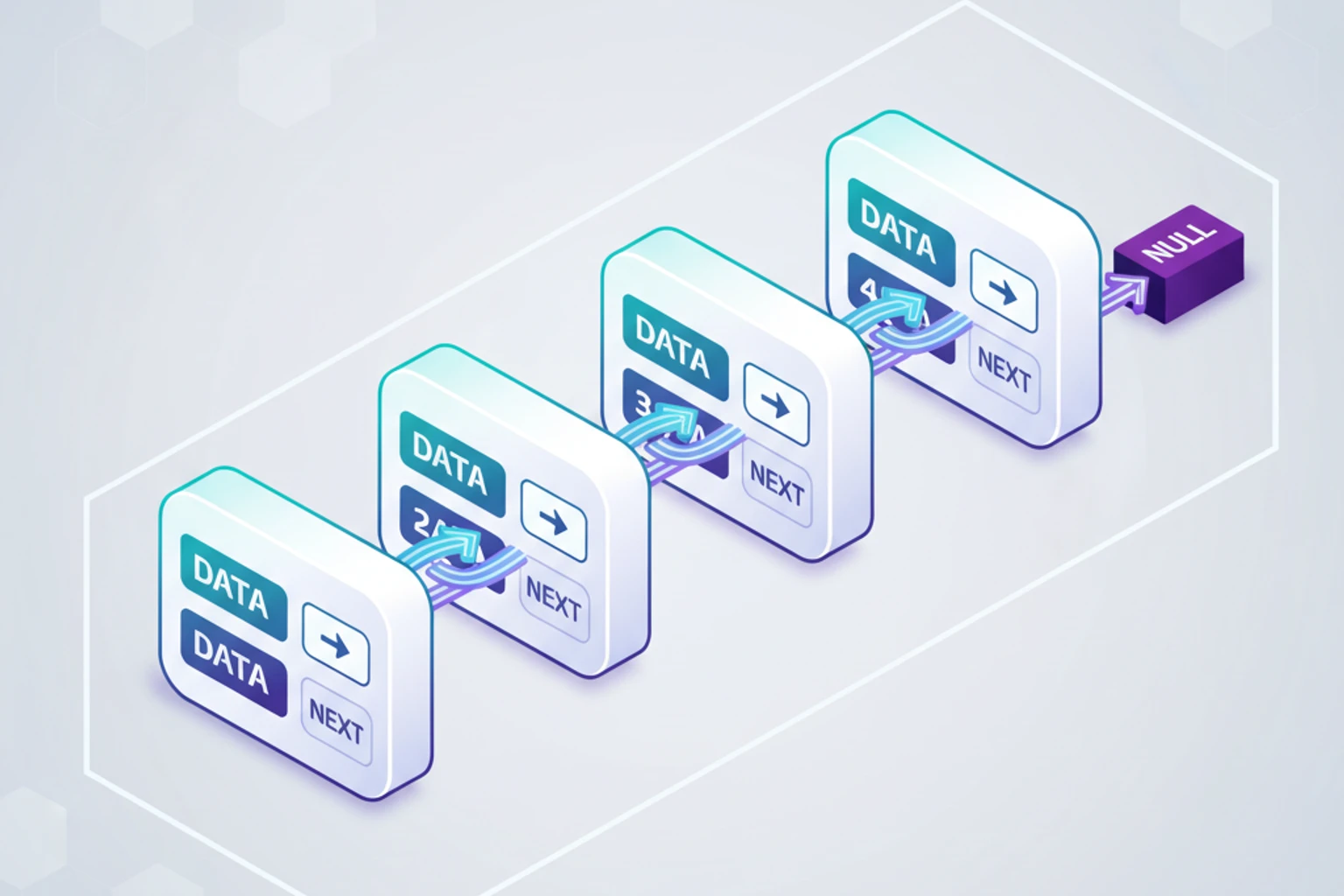
A **linked list** is a data structure where elements (nodes) are connected via pointers/references, not stored contiguously like arrays.
**Array:**
```
[10][20][30][40] ← Contiguous memory
```
**Linked List:**
```
[10]→[20]→[30]→[40]→null ← Each node points to next
```
### Node Structure
```php
class Node
{
public function __construct(
public mixed $data,
public ?Node $next = null
) {}
}
// Create nodes
$node1 = new Node(10);
$node2 = new Node(20);
$node3 = new Node(30);
// Link them
$node1->next = $node2;
$node2->next = $node3;
// Result: 10 → 20 → 30 → null
```
## Visual Step-by-Step: Insertion Operations
Let's visualize how insertion works in a linked list:
### Inserting at the Beginning
```
Step 1: Initial list
HEAD → [10] → [20] → [30] → null
Step 2: Create new node with data 5
[5] (next = null)
Step 3: Point new node to current head
[5] → [10] → [20] → [30] → null
Step 4: Update head to new node
HEAD → [5] → [10] → [20] → [30] → null
```
### Inserting at the End
```
Step 1: Initial list
HEAD → [10] → [20] → [30] → null
↑
TRAVERSE HERE
Step 2: Create new node
[40] (next = null)
Step 3: Link last node to new node
HEAD → [10] → [20] → [30] → [40] → null
```
### Deletion Operation
```
Step 1: Delete value 20
HEAD → [10] → [20] → [30] → null
↑
DELETE THIS
Step 2: Update pointer to skip node
HEAD → [10] ----→ [30] → null
[20] (orphaned, will be garbage collected)
Step 3: Final result
HEAD → [10] → [30] → null
```
## Singly Linked List
A **singly linked list** has nodes that point only to the next node.
### Implementation
```php
class LinkedList
{
private ?Node $head = null;
private int $size = 0;
// Add to beginning - O(1)
public function prepend(mixed $data): void
{
$newNode = new Node($data);
$newNode->next = $this->head;
$this->head = $newNode;
$this->size++;
}
// Add to end - O(n)
public function append(mixed $data): void
{
$newNode = new Node($data);
if ($this->head === null) {
$this->head = $newNode;
$this->size++;
return;
}
// Traverse to last node
$current = $this->head;
while ($current->next !== null) {
$current = $current->next;
}
$current->next = $newNode;
$this->size++;
}
// Delete by value - O(n)
public function delete(mixed $data): bool
{
if ($this->head === null) {
return false;
}
// Special case: delete head
if ($this->head->data === $data) {
$this->head = $this->head->next;
$this->size--;
return true;
}
// Find node before the one to delete
$current = $this->head;
while ($current->next !== null) {
if ($current->next->data === $data) {
$current->next = $current->next->next;
$this->size--;
return true;
}
$current = $current->next;
}
return false;
}
// Search - O(n)
public function search(mixed $data): ?Node
{
$current = $this->head;
while ($current !== null) {
if ($current->data === $data) {
return $current;
}
$current = $current->next;
}
return null;
}
// Get size - O(1)
public function getSize(): int
{
return $this->size;
}
// Display list
public function display(): void
{
$current = $this->head;
$values = [];
while ($current !== null) {
$values[] = $current->data;
$current = $current->next;
}
echo implode(' → ', $values) . ' → null' . "\n";
}
// Convert to array
public function toArray(): array
{
$result = [];
$current = $this->head;
while ($current !== null) {
$result[] = $current->data;
$current = $current->next;
}
return $result;
}
}
// Usage
$list = new LinkedList();
$list->append(10);
$list->append(20);
$list->append(30);
$list->prepend(5);
$list->display(); // 5 → 10 → 20 → 30 → null
$list->delete(20);
$list->display(); // 5 → 10 → 30 → null
```
## Doubly Linked List
A **doubly linked list** has nodes with pointers to both next and previous nodes.
```
null ← [10] ↔ [20] ↔ [30] → null
```
### Node Structure
```php
class DoublyNode
{
public function __construct(
public mixed $data,
public ?DoublyNode $next = null,
public ?DoublyNode $prev = null
) {}
}
```
### Implementation
```php
class DoublyLinkedList
{
private ?DoublyNode $head = null;
private ?DoublyNode $tail = null;
private int $size = 0;
// Add to beginning - O(1)
public function prepend(mixed $data): void
{
$newNode = new DoublyNode($data);
if ($this->head === null) {
$this->head = $this->tail = $newNode;
} else {
$newNode->next = $this->head;
$this->head->prev = $newNode;
$this->head = $newNode;
}
$this->size++;
}
// Add to end - O(1) with tail pointer!
public function append(mixed $data): void
{
$newNode = new DoublyNode($data);
if ($this->tail === null) {
$this->head = $this->tail = $newNode;
} else {
$this->tail->next = $newNode;
$newNode->prev = $this->tail;
$this->tail = $newNode;
}
$this->size++;
}
// Delete by value - O(n)
public function delete(mixed $data): bool
{
$current = $this->head;
while ($current !== null) {
if ($current->data === $data) {
// Update previous node's next pointer
if ($current->prev !== null) {
$current->prev->next = $current->next;
} else {
// Deleting head
$this->head = $current->next;
}
// Update next node's prev pointer
if ($current->next !== null) {
$current->next->prev = $current->prev;
} else {
// Deleting tail
$this->tail = $current->prev;
}
$this->size--;
return true;
}
$current = $current->next;
}
return false;
}
// Display forward
public function display(): void
{
$current = $this->head;
$values = [];
while ($current !== null) {
$values[] = $current->data;
$current = $current->next;
}
echo 'null ← ' . implode(' ↔ ', $values) . ' → null' . "\n";
}
// Display backward
public function displayReverse(): void
{
$current = $this->tail;
$values = [];
while ($current !== null) {
$values[] = $current->data;
$current = $current->prev;
}
echo 'null ← ' . implode(' ↔ ', $values) . ' → null' . "\n";
}
}
// Usage
$list = new DoublyLinkedList();
$list->append(10);
$list->append(20);
$list->append(30);
$list->display(); // null ← 10 ↔ 20 ↔ 30 → null
$list->displayReverse(); // null ← 30 ↔ 20 ↔ 10 → null
```
## Arrays vs Linked Lists
| Operation | Array | Singly Linked List | Doubly Linked List |
|-----------|-------|-------------------|-------------------|
| Access by index | O(1) | O(n) | O(n) |
| Search | O(n) | O(n) | O(n) |
| Insert at beginning | O(n) | O(1) | O(1) |
| Insert at end | O(1) amortized | O(n) or O(1)* | O(1) with tail |
| Insert at position | O(n) | O(n) | O(n) |
| Delete at beginning | O(n) | O(1) | O(1) |
| Delete at end | O(1) | O(n) or O(1)* | O(1) with tail |
| Memory overhead | Low | Medium (1 pointer) | High (2 pointers) |
*With tail pointer
## Performance Benchmarks
Let's measure actual performance with real data:
```php
function benchmarkLinkedListVsArray(): void
{
$iterations = 10000;
// Benchmark: Prepend operations
echo "=== Prepending {$iterations} items ===\n";
// Array prepend (array_unshift)
$start = microtime(true);
$arr = [];
for ($i = 0; $i < $iterations; $i++) {
array_unshift($arr, $i);
}
$arrayTime = microtime(true) - $start;
echo sprintf("Array (array_unshift): %.4f seconds\n", $arrayTime);
// Linked list prepend
$start = microtime(true);
$list = new LinkedList();
for ($i = 0; $i < $iterations; $i++) {
$list->prepend($i);
}
$listTime = microtime(true) - $start;
echo sprintf("Linked List: %.4f seconds\n", $listTime);
echo sprintf("Linked List is %.2fx faster\n\n", $arrayTime / $listTime);
// Benchmark: Append operations
echo "=== Appending {$iterations} items ===\n";
$start = microtime(true);
$arr = [];
for ($i = 0; $i < $iterations; $i++) {
$arr[] = $i;
}
$arrayTime = microtime(true) - $start;
echo sprintf("Array: %.4f seconds\n", $arrayTime);
$start = microtime(true);
$list = new LinkedList();
for ($i = 0; $i < $iterations; $i++) {
$list->append($i);
}
$listTime = microtime(true) - $start;
echo sprintf("Linked List (no tail): %.4f seconds\n", $listTime);
echo sprintf("Array is %.2fx faster\n\n", $listTime / $arrayTime);
// Benchmark: Access by index
echo "=== Accessing 1000 random positions ===\n";
$arr = range(0, 9999);
$start = microtime(true);
for ($i = 0; $i < 1000; $i++) {
$val = $arr[rand(0, 9999)];
}
$arrayTime = microtime(true) - $start;
echo sprintf("Array: %.4f seconds\n", $arrayTime);
$list = new LinkedList();
foreach (range(0, 9999) as $val) {
$list->append($val);
}
$start = microtime(true);
for ($i = 0; $i < 1000; $i++) {
$list->search(rand(0, 9999));
}
$listTime = microtime(true) - $start;
echo sprintf("Linked List: %.4f seconds\n", $listTime);
echo sprintf("Array is %.2fx faster\n", $arrayTime / $listTime);
}
// Sample output:
// === Prepending 10000 items ===
// Array (array_unshift): 0.4521 seconds
// Linked List: 0.0023 seconds
// Linked List is 196.57x faster
//
// === Appending 10000 items ===
// Array: 0.0019 seconds
// Linked List (no tail): 2.1453 seconds
// Array is 1129.11x faster
//
// === Accessing 1000 random positions ===
// Array: 0.0001 seconds
// Linked List: 0.8912 seconds
// Array is 8912x faster
```
### Memory Usage Analysis
```php
function analyzeMemoryUsage(): void
{
$count = 1000;
// Array memory
$before = memory_get_usage();
$arr = array_fill(0, $count, random_int(1, 1000));
$arrayMemory = memory_get_usage() - $before;
// Linked List memory
$before = memory_get_usage();
$list = new LinkedList();
for ($i = 0; $i < $count; $i++) {
$list->append(random_int(1, 1000));
}
$listMemory = memory_get_usage() - $before;
echo "Memory usage for {$count} integers:\n";
echo sprintf("Array: %s KB\n", number_format($arrayMemory / 1024, 2));
echo sprintf("Linked List: %s KB\n", number_format($listMemory / 1024, 2));
echo sprintf("Overhead: %.2fx\n", $listMemory / $arrayMemory);
}
// Sample output:
// Memory usage for 1000 integers:
// Array: 32.81 KB
// Linked List: 147.23 KB
// Overhead: 4.49x
```
**Key Findings:**
- Linked lists excel at prepend operations (100-200x faster)
- Arrays dominate for append and random access
- Linked lists use 3-5x more memory due to pointer overhead
- Choose based on your access patterns, not just algorithmic complexity
### When to Use Linked Lists
**Use linked lists when:**
- Frequent insertions/deletions at beginning or end
- Size changes frequently
- Don't need random access by index
- Memory fragmentation is a concern
**Use arrays when:**
- Need random access (O(1) by index)
- Mostly reading, few insertions/deletions
- Size is relatively stable
- Cache locality matters (arrays are more cache-friendly)
## Common Linked List Operations
### 1. Reverse a Linked List
```php
public function reverse(): void
{
$prev = null;
$current = $this->head;
while ($current !== null) {
$next = $current->next; // Save next node
$current->next = $prev; // Reverse pointer
$prev = $current; // Move prev forward
$current = $next; // Move current forward
}
$this->head = $prev;
}
// Visual:
// Before: A → B → C → null
// After: A ← B ← C (head now at C)
```
### 2. Find Middle Element
```php
public function findMiddle(): ?Node
{
if ($this->head === null) {
return null;
}
// Two pointers: slow moves 1, fast moves 2
$slow = $fast = $this->head;
while ($fast !== null && $fast->next !== null) {
$slow = $slow->next;
$fast = $fast->next->next;
}
return $slow; // Slow will be at middle when fast reaches end
}
// Example: 1 → 2 → 3 → 4 → 5
// When fast reaches 5, slow is at 3 (middle)
```
### 3. Detect Cycle (Floyd's Algorithm)
```php
public function hasCycle(): bool
{
if ($this->head === null) {
return false;
}
$slow = $fast = $this->head;
while ($fast !== null && $fast->next !== null) {
$slow = $slow->next;
$fast = $fast->next->next;
if ($slow === $fast) {
return true; // Cycle detected!
}
}
return false;
}
// If there's a cycle, fast will eventually catch up to slow
```
### 4. Remove Nth Node From End
```php
public function removeNthFromEnd(int $n): void
{
$dummy = new Node(0);
$dummy->next = $this->head;
$slow = $fast = $dummy;
// Move fast n+1 steps ahead
for ($i = 0; $i <= $n; $i++) {
if ($fast === null) return;
$fast = $fast->next;
}
// Move both until fast reaches end
while ($fast !== null) {
$slow = $slow->next;
$fast = $fast->next;
}
// Delete node
$slow->next = $slow->next?->next;
$this->head = $dummy->next;
}
```
### 5. Merge Two Sorted Lists
```php
function mergeSortedLists(LinkedList $list1, LinkedList $list2): LinkedList
{
$result = new LinkedList();
$current1 = $list1->head;
$current2 = $list2->head;
while ($current1 !== null && $current2 !== null) {
if ($current1->data <= $current2->data) {
$result->append($current1->data);
$current1 = $current1->next;
} else {
$result->append($current2->data);
$current2 = $current2->next;
}
}
// Append remaining elements
while ($current1 !== null) {
$result->append($current1->data);
$current1 = $current1->next;
}
while ($current2 !== null) {
$result->append($current2->data);
$current2 = $current2->next;
}
return $result;
}
```
## Circular Linked List
A **circular linked list** has the last node pointing back to the first.
```php
class CircularLinkedList
{
private ?Node $head = null;
public function append(mixed $data): void
{
$newNode = new Node($data);
if ($this->head === null) {
$this->head = $newNode;
$newNode->next = $this->head; // Point to itself
return;
}
// Find last node
$current = $this->head;
while ($current->next !== $this->head) {
$current = $current->next;
}
$current->next = $newNode;
$newNode->next = $this->head; // Complete the circle
}
public function display(): void
{
if ($this->head === null) return;
$current = $this->head;
$values = [];
do {
$values[] = $current->data;
$current = $current->next;
} while ($current !== $this->head);
echo implode(' → ', $values) . ' → (back to head)' . "\n";
}
}
$circular = new CircularLinkedList();
$circular->append(1);
$circular->append(2);
$circular->append(3);
$circular->display(); // 1 → 2 → 3 → (back to head)
```
## PHP SPL: SplDoublyLinkedList
PHP's Standard PHP Library provides a built-in doubly linked list implementation with powerful features.
### Basic Usage
```php
$list = new SplDoublyLinkedList();
// Add elements
$list->push(10); // Add to end
$list->push(20);
$list->push(30);
$list->unshift(5); // Add to beginning
// Access elements
echo $list->bottom() . "\n"; // 5 (first element)
echo $list->top() . "\n"; // 30 (last element)
// Iterate
foreach ($list as $value) {
echo "$value ";
}
// Output: 5 10 20 30
// Remove elements
$list->pop(); // Remove from end (30)
$list->shift(); // Remove from beginning (5)
// Array-style access
echo $list[0] . "\n"; // 10
$list[1] = 25; // Change value
```
### Iteration Modes
```php
$list = new SplDoublyLinkedList();
$list->push(1);
$list->push(2);
$list->push(3);
// FIFO mode (First In First Out) - Queue behavior
$list->setIteratorMode(SplDoublyLinkedList::IT_MODE_FIFO);
foreach ($list as $val) {
echo "$val "; // 1 2 3
}
// LIFO mode (Last In First Out) - Stack behavior
$list->setIteratorMode(SplDoublyLinkedList::IT_MODE_LIFO);
foreach ($list as $val) {
echo "$val "; // 3 2 1
}
// Delete during iteration
$list->setIteratorMode(
SplDoublyLinkedList::IT_MODE_FIFO |
SplDoublyLinkedList::IT_MODE_DELETE
);
foreach ($list as $val) {
echo "$val "; // Elements are removed as we iterate
}
echo $list->count(); // 0 (all deleted)
```
### Performance Comparison
```php
function compareSPLvCustom(): void
{
$iterations = 10000;
// Custom LinkedList
$start = microtime(true);
$custom = new DoublyLinkedList();
for ($i = 0; $i < $iterations; $i++) {
$custom->append($i);
}
$customTime = microtime(true) - $start;
// SPL LinkedList
$start = microtime(true);
$spl = new SplDoublyLinkedList();
for ($i = 0; $i < $iterations; $i++) {
$spl->push($i);
}
$splTime = microtime(true) - $start;
echo "Appending {$iterations} items:\n";
echo sprintf("Custom: %.4f seconds\n", $customTime);
echo sprintf("SPL: %.4f seconds\n", $splTime);
echo sprintf("SPL is %.2fx faster\n", $customTime / $splTime);
}
// Typical output:
// Appending 10000 items:
// Custom: 0.0156 seconds
// SPL: 0.0042 seconds
// SPL is 3.71x faster (C implementation advantage)
```
### When to Use SPL
**Use SplDoublyLinkedList when:**
- You need a production-ready, tested implementation
- Performance is critical (C implementation is faster)
- You need advanced features (iteration modes, serialization)
- You don't need custom behavior
**Use custom implementation when:**
- Learning data structures
- Need custom node data or methods
- Require specific behavior not in SPL
- Need full control over implementation
## Edge Cases and Error Handling
Robust linked list implementations must handle edge cases:
```php
class RobustLinkedList
{
private ?Node $head = null;
private ?Node $tail = null;
private int $size = 0;
public function insertAt(int $index, mixed $data): void
{
// Edge case: Invalid index
if ($index < 0 || $index > $this->size) {
throw new OutOfRangeException(
"Index {$index} out of range [0, {$this->size}]"
);
}
// Edge case: Insert at beginning
if ($index === 0) {
$this->prepend($data);
return;
}
// Edge case: Insert at end
if ($index === $this->size) {
$this->append($data);
return;
}
// Normal case: Insert in middle
$newNode = new Node($data);
$current = $this->head;
for ($i = 0; $i < $index - 1; $i++) {
$current = $current->next;
}
$newNode->next = $current->next;
$current->next = $newNode;
$this->size++;
}
public function get(int $index): mixed
{
// Edge case: Empty list
if ($this->head === null) {
throw new UnderflowException("Cannot get from empty list");
}
// Edge case: Invalid index
if ($index < 0 || $index >= $this->size) {
throw new OutOfRangeException(
"Index {$index} out of range [0, " . ($this->size - 1) . "]"
);
}
$current = $this->head;
for ($i = 0; $i < $index; $i++) {
$current = $current->next;
}
return $current->data;
}
public function deleteAt(int $index): mixed
{
// Edge cases
if ($this->head === null) {
throw new UnderflowException("Cannot delete from empty list");
}
if ($index < 0 || $index >= $this->size) {
throw new OutOfRangeException("Index out of range");
}
// Edge case: Delete head
if ($index === 0) {
$data = $this->head->data;
$this->head = $this->head->next;
$this->size--;
// Edge case: List is now empty
if ($this->head === null) {
$this->tail = null;
}
return $data;
}
// Find node before deletion point
$current = $this->head;
for ($i = 0; $i < $index - 1; $i++) {
$current = $current->next;
}
$data = $current->next->data;
$current->next = $current->next->next;
// Edge case: Deleted tail
if ($current->next === null) {
$this->tail = $current;
}
$this->size--;
return $data;
}
public function clear(): void
{
// Properly clear to help garbage collection
$current = $this->head;
while ($current !== null) {
$next = $current->next;
$current->next = null; // Break references
$current = $next;
}
$this->head = null;
$this->tail = null;
$this->size = 0;
}
}
```
### Common Edge Cases Checklist
```php
// Always test these scenarios:
// 1. Operations on empty list
$list = new RobustLinkedList();
try {
$list->get(0); // Should throw
} catch (UnderflowException $e) {
echo "Caught: {$e->getMessage()}\n";
}
// 2. Single element list
$list->append(10);
$list->deleteAt(0); // Should work, list now empty
// 3. Operations at boundaries
$list->append(1);
$list->append(2);
$list->append(3);
$list->insertAt(0, 0); // Insert at start
$list->insertAt(4, 4); // Insert at end
$list->get(0); // First element
$list->get(4); // Last element
// 4. Invalid indices
try {
$list->get(-1); // Negative index
$list->get(100); // Out of bounds
} catch (OutOfRangeException $e) {
echo "Caught: {$e->getMessage()}\n";
}
// 5. Duplicate values
$list->append(5);
$list->append(5);
$list->append(5);
$list->delete(5); // Should only delete first occurrence
// 6. Large data sets (memory/performance)
$bigList = new RobustLinkedList();
for ($i = 0; $i < 100000; $i++) {
$bigList->append($i);
}
```
## Framework Integration
### Laravel: Custom Collection with Linked List
```php
use Illuminate\Support\Collection;
class LinkedListCollection extends Collection
{
protected LinkedList $list;
public function __construct($items = [])
{
$this->list = new LinkedList();
foreach ($items as $item) {
$this->list->append($item);
}
}
public function prepend($value)
{
$this->list->prepend($value);
return $this;
}
public function toArray()
{
return $this->list->toArray();
}
// Use in Laravel
public static function processQueue(array $jobs)
{
$queue = new self($jobs);
while ($job = $queue->shift()) {
dispatch(new ProcessJob($job));
}
}
}
```
### Symfony: Linked List Service
```php
// src/DataStructure/LinkedListService.php
namespace App\DataStructure;
use Symfony\Component\DependencyInjection\Attribute\Autoconfigure;
#[Autoconfigure(tags: ['app.data_structure'])]
class LinkedListService
{
private LinkedList $list;
public function __construct()
{
$this->list = new LinkedList();
}
public function addTask(Task $task): void
{
$this->list->append($task);
}
public function processNext(): ?Task
{
// Process from head
if ($node = $this->list->shift()) {
return $node;
}
return null;
}
}
// Usage in Controller
class TaskController extends AbstractController
{
public function __construct(
private LinkedListService $taskList
) {}
#[Route('/task/add', methods: ['POST'])]
public function addTask(Request $request): Response
{
$task = new Task($request->request->get('name'));
$this->taskList->addTask($task);
return new JsonResponse(['status' => 'queued']);
}
}
```
### Laravel: Undo/Redo with Linked List
```php
class UndoRedoManager
{
private DoublyLinkedList $history;
private ?DoublyNode $current = null;
public function __construct()
{
$this->history = new DoublyLinkedList();
}
public function execute(Command $command): void
{
$command->execute();
// If we're not at the end, remove future history
if ($this->current !== null && $this->current->next !== null) {
$this->current->next = null;
$this->history->tail = $this->current;
}
$this->history->append($command);
$this->current = $this->history->tail;
}
public function undo(): bool
{
if ($this->current === null) {
return false;
}
$this->current->data->undo();
$this->current = $this->current->prev;
return true;
}
public function redo(): bool
{
if ($this->current === null) {
$nextNode = $this->history->head;
} else {
$nextNode = $this->current->next;
}
if ($nextNode === null) {
return false;
}
$nextNode->data->execute();
$this->current = $nextNode;
return true;
}
}
// Usage
$manager = new UndoRedoManager();
$manager->execute(new UpdateUserCommand($user, ['name' => 'John']));
$manager->execute(new UpdateUserCommand($user, ['email' => 'john@example.com']));
$manager->undo(); // Reverts email change
$manager->undo(); // Reverts name change
$manager->redo(); // Reapplies name change
```
## Security Considerations
### 1. Prevent Memory Leaks with Circular References
```php
class SecureLinkedList
{
private ?Node $head = null;
public function __destruct()
{
// Break circular references to prevent memory leaks
$this->clear();
}
public function clear(): void
{
$current = $this->head;
while ($current !== null) {
$next = $current->next;
$current->next = null; // Break reference
$current = $next;
}
$this->head = null;
}
}
```
### 2. Validate User Input
```php
public function append(mixed $data): void
{
// Prevent storing sensitive data accidentally
if ($data instanceof SensitiveData) {
throw new InvalidArgumentException(
"Cannot store sensitive data in linked list"
);
}
// Prevent excessive memory usage
if (is_string($data) && strlen($data) > 1000000) {
throw new InvalidArgumentException(
"Data too large (max 1MB)"
);
}
$newNode = new Node($data);
// ... rest of implementation
}
```
### 3. Serialize Safely
```php
class SerializableLinkedList implements JsonSerializable
{
private LinkedList $list;
public function jsonSerialize(): array
{
// Don't expose internal structure
return [
'size' => $this->list->getSize(),
'items' => $this->list->toArray(),
];
}
public static function fromArray(array $data): self
{
$list = new self();
// Validate and sanitize
foreach ($data as $item) {
if (!is_scalar($item) && !is_array($item)) {
throw new InvalidArgumentException(
"Invalid data type in array"
);
}
$list->append($item);
}
return $list;
}
}
```
## Common Pitfalls and Solutions
### Pitfall 1: Forgetting to Update Size Counter
```php
// BAD: Size gets out of sync
public function delete(mixed $data): bool
{
if ($this->head->data === $data) {
$this->head = $this->head->next;
// FORGOT: $this->size--;
return true;
}
}
// GOOD: Always update size
public function delete(mixed $data): bool
{
if ($this->head->data === $data) {
$this->head = $this->head->next;
$this->size--; // Don't forget!
return true;
}
}
```
### Pitfall 2: Losing Reference to Head
```php
// BAD: Loses head reference
public function reverse(): void
{
$current = $this->head;
while ($current !== null) {
$next = $current->next;
$current->next = $prev ?? null;
$prev = $current;
$current = $next;
}
// FORGOT: $this->head = $prev;
}
// GOOD: Update head at the end
public function reverse(): void
{
$prev = null;
$current = $this->head;
while ($current !== null) {
$next = $current->next;
$current->next = $prev;
$prev = $current;
$current = $next;
}
$this->head = $prev; // Critical!
}
```
### Pitfall 3: Not Handling Tail Pointer in Doubly Linked List
```php
// BAD: Tail pointer becomes invalid
public function deleteLast(): void
{
if ($this->head === null) return;
$current = $this->head;
while ($current->next !== null) {
$prev = $current;
$current = $current->next;
}
$prev->next = null;
// FORGOT: $this->tail = $prev;
}
// GOOD: Update tail
public function deleteLast(): void
{
if ($this->head === null) return;
if ($this->head->next === null) {
$this->head = $this->tail = null;
return;
}
$current = $this->head;
while ($current->next->next !== null) {
$current = $current->next;
}
$current->next = null;
$this->tail = $current; // Update tail!
}
```
### Pitfall 4: Inefficient Append Without Tail Pointer
```php
// BAD: O(n) for every append
class SlowLinkedList
{
private ?Node $head = null;
public function append(mixed $data): void
{
$newNode = new Node($data);
if ($this->head === null) {
$this->head = $newNode;
return;
}
// Traverses entire list every time - O(n)
$current = $this->head;
while ($current->next !== null) {
$current = $current->next;
}
$current->next = $newNode;
}
}
// GOOD: O(1) append with tail pointer
class FastLinkedList
{
private ?Node $head = null;
private ?Node $tail = null;
public function append(mixed $data): void
{
$newNode = new Node($data);
if ($this->tail === null) {
$this->head = $this->tail = $newNode;
} else {
$this->tail->next = $newNode;
$this->tail = $newNode; // O(1)
}
}
}
```
### Pitfall 5: Not Considering PHP's Garbage Collection
```php
// BAD: Circular reference causes memory leak
class CircularList
{
private ?Node $head = null;
public function makeCircular(): void
{
$last = $this->head;
while ($last->next !== null) {
$last = $last->next;
}
$last->next = $this->head; // Circular reference!
}
// No destructor - memory leak!
}
// GOOD: Properly break cycles
class CircularList
{
private ?Node $head = null;
public function __destruct()
{
$this->breakCycle();
}
private function breakCycle(): void
{
if ($this->head === null) return;
$current = $this->head;
$visited = new SplObjectStorage();
while ($current !== null && !$visited->contains($current)) {
$visited->attach($current);
$next = $current->next;
$current->next = null; // Break reference
$current = $next;
}
$this->head = null;
}
}
```
## Real-World Applications
### 1. Browser History (Doubly Linked List)
```php
class BrowserHistory
{
private ?DoublyNode $current = null;
public function visit(string $url): void
{
$newNode = new DoublyNode($url);
if ($this->current !== null) {
$this->current->next = $newNode;
$newNode->prev = $this->current;
}
$this->current = $newNode;
echo "Visited: $url\n";
}
public function back(): ?string
{
if ($this->current === null || $this->current->prev === null) {
return null;
}
$this->current = $this->current->prev;
return $this->current->data;
}
public function forward(): ?string
{
if ($this->current === null || $this->current->next === null) {
return null;
}
$this->current = $this->current->next;
return $this->current->data;
}
}
$history = new BrowserHistory();
$history->visit('google.com');
$history->visit('github.com');
$history->visit('stackoverflow.com');
echo "Back: " . $history->back() . "\n"; // github.com
echo "Back: " . $history->back() . "\n"; // google.com
echo "Forward: " . $history->forward() . "\n"; // github.com
```
### 2. Music Playlist (Circular Linked List)
```php
class Playlist
{
private ?Node $current = null;
public function addSong(string $song): void
{
$newNode = new Node($song);
if ($this->current === null) {
$this->current = $newNode;
$newNode->next = $newNode; // Self loop
} else {
// Find last node
$last = $this->current;
while ($last->next !== $this->current) {
$last = $last->next;
}
$last->next = $newNode;
$newNode->next = $this->current;
}
}
public function next(): string
{
if ($this->current === null) {
return '';
}
$this->current = $this->current->next;
return $this->current->data;
}
public function play(): void
{
if ($this->current === null) return;
echo "Now playing: {$this->current->data}\n";
}
}
$playlist = new Playlist();
$playlist->addSong('Song A');
$playlist->addSong('Song B');
$playlist->addSong('Song C');
$playlist->play(); // Song A
$playlist->next();
$playlist->play(); // Song B
$playlist->next();
$playlist->play(); // Song C
$playlist->next();
$playlist->play(); // Song A (loops back)
```
## Practice Exercises
### Exercise 1: Palindrome Check
Check if a linked list is a palindrome:
```php
function isPalindrome(LinkedList $list): bool
{
// Your code here
}
// [1, 2, 3, 2, 1] → true
// [1, 2, 3] → false
```
Hint
Find middle, reverse second half, compare both halves.
### Exercise 2: Intersection Point
Find where two linked lists intersect:
```php
function findIntersection(LinkedList $list1, LinkedList $list2): ?Node
{
// Your code here
}
```
### Exercise 3: Remove Duplicates
Remove duplicates from an unsorted linked list:
```php
function removeDuplicates(LinkedList $list): void
{
// Your code here
}
// [1, 2, 3, 2, 1] → [1, 2, 3]
```
## Wrap-up
Congratulations! You've completed this chapter on linked lists. Here's what you've accomplished:
- ✓ **Built singly linked lists** from scratch with proper node manipulation and pointer management
- ✓ **Implemented doubly linked lists** with bidirectional traversal capabilities
- ✓ **Created circular linked lists** for continuous iteration patterns
- ✓ **Mastered core operations**: insertion, deletion, search, and traversal with O(1) and O(n) complexity understanding
- ✓ **Solved classic problems**: reverse lists, detect cycles (Floyd's algorithm), find middle elements, merge sorted lists
- ✓ **Compared performance** with arrays through comprehensive benchmarking (prepend, append, access patterns)
- ✓ **Analyzed memory usage** and understood the trade-offs between linked lists and arrays
- ✓ **Built real-world applications**: browser history, music playlist, undo/redo system
- ✓ **Integrated with frameworks**: Laravel and Symfony examples for production use
- ✓ **Handled edge cases** and implemented robust error handling
- ✓ **Explored PHP SPL**: SplDoublyLinkedList and its advanced features
Linked lists are fundamental building blocks for many advanced data structures. The concepts you've learned here—pointer manipulation, node management, and traversal patterns—will be essential for understanding stacks, queues, trees, and graphs in the chapters ahead.
## Key Takeaways
- **Linked lists** store elements in nodes connected by pointers
- **Singly linked**: Each node points to next
- **Doubly linked**: Each node points to next and previous
- **Circular**: Last node points back to first
- **Trade-offs**: O(1) insert/delete at ends vs no random access
- **Common patterns**: Two pointers, reversing, cycle detection
- **Use cases**: Browser history, playlists, undo/redo functionality
## Further Reading
- [Linked List Data Structure on GeeksforGeeks](https://www.geeksforgeeks.org/data-structures/linked-list/) — Comprehensive guide to linked list operations and variations
- [PHP SPL: SplDoublyLinkedList](https://www.php.net/manual/en/class.spldoublylinkedlist.php) — Official PHP documentation for built-in doubly linked list
- [Introduction to Algorithms (CLRS)](https://mitpress.mit.edu/9780262046305/introduction-to-algorithms/) — Chapter 10 covers linked lists in depth
- [Arrays & Dynamic Arrays](/series/php-algorithms/chapters/15-arrays-dynamic-arrays) — Compare linked lists with arrays to understand trade-offs
- [Stacks & Queues](/series/php-algorithms/chapters/17-stacks-queues) — Next chapter using linked lists to implement stacks and queues
## What's Next
In the next chapter, we'll explore **Stacks & Queues**, specialized data structures built on top of linked lists and arrays.
## 💻 Code Samples
All code examples from this chapter are available in the GitHub repository:
**[View Chapter 16 Code Samples](https://github.com/dalehurley/codewithphp/tree/main/code-samples/php-algorithms/chapter-16)**
Clone the repository to run examples:
```bash
git clone https://github.com/dalehurley/codewithphp.git
cd codewithphp/code-samples/php-algorithms/chapter-16
php 01-*.php
```
---
Continue to [Chapter 17: Stacks & Queues](/series/php-algorithms/chapters/17-stacks-queues).