# 05: Bubble Sort & Selection Sort
[Original page](https://codewithphp.com/series/php-algorithms/chapters/05-bubble-sort-selection-sort/)
> Implement and understand simple sorting algorithms. Learn their time complexity and when (not) to use them.
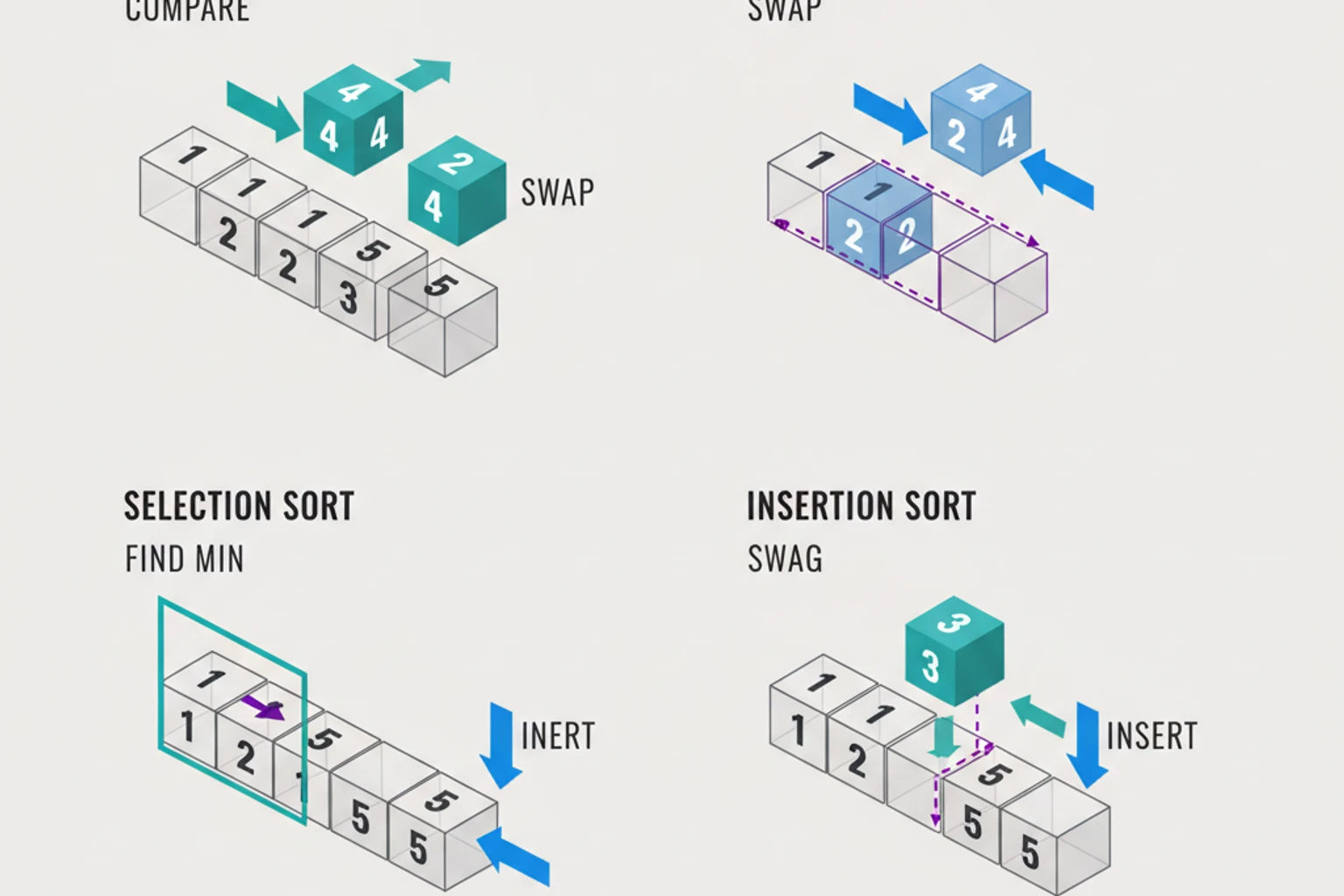
# Bubble Sort & Selection Sort Intermediate
## Overview
Now that we understand algorithm complexity and how to benchmark performance, let's dive into our first sorting algorithms. We'll start with two simple but inefficient sorting algorithms: **Bubble Sort** and **Selection Sort**.
While these algorithms aren't practical for large datasets, they're excellent learning tools that introduce fundamental sorting concepts. You'll implement these algorithms from scratch, understand why they're O(n²), and learn optimization techniques that can dramatically improve performance on certain types of data.
By the end of this chapter, you'll not only understand how sorting works at a fundamental level, but you'll also appreciate why modern sorting algorithms are necessary for real-world applications. You'll benchmark these algorithms against various dataset sizes and patterns, validating theoretical complexity analysis with real measurements.
This hands-on experience will prepare you for more advanced sorting algorithms in upcoming chapters, where you'll see how clever techniques can reduce O(n²) complexity to O(n log n) or even O(n) in special cases.
## What You'll Learn
**Estimated time:** 55 minutes
By the end of this chapter, you will:
- Implement Bubble Sort and Selection Sort from scratch in PHP
- Understand O(n²) time complexity and why it matters for sorting
- Learn optimization techniques like early termination for nearly-sorted data
- Benchmark these algorithms against various dataset sizes to validate complexity analysis
- Recognize when simple sorting algorithms are appropriate vs when to use advanced alternatives
## Prerequisites
Before starting this chapter, you should have:
- ✓ Understanding of Big O notation *(60 mins from [Chapter 01](/series/php-algorithms/chapters/01-algorithm-complexity-big-o-notation/) if not done)*
- ✓ Familiarity with arrays and loops *(10 mins review if needed)*
- ✓ Completion of [Chapter 00](/series/php-algorithms/chapters/00-quick-start-guide/), [Chapter 01](/series/php-algorithms/chapters/01-algorithm-complexity-big-o-notation/), and [Chapter 02](/series/php-algorithms/chapters/02-benchmarking-performance-testing/) *(180 mins if not done)*
- **Estimated Time**: ~55-65 minutes
## What You'll Build
By the end of this chapter, you will have created:
- ✅ **Complete Bubble Sort implementation** with basic and optimized versions
- ✅ **Selection Sort implementation** with visualization capabilities
- ✅ **Performance benchmark suite** comparing algorithms across different data patterns
- ✅ **Advanced variations** including Cocktail Shaker Sort and Comb Sort
- ✅ **Real-world examples** sorting user data and finding top K elements
- ✅ **Comprehensive test suite** validating algorithm correctness and complexity
## Quick Checklist
Complete these hands-on tasks as you work through the chapter:
- [ ] Implement basic Bubble Sort with nested loops
- [ ] Add optimization flag to detect if array is already sorted (early termination)
- [ ] Implement Selection Sort by finding minimum element in each pass
- [ ] Benchmark both algorithms with different array sizes (100, 500, 1000 items)
- [ ] Compare performance: random, sorted, and reverse-sorted arrays
- [ ] (Optional) Implement bidirectional Bubble Sort (Cocktail Shaker Sort)
## Why Learn "Slow" Algorithms?
You might wonder: "Why learn algorithms that are inefficient?"
Here's why:
1. **Foundation**: They teach core sorting concepts used in advanced algorithms
2. **Interviews**: Simple algorithms are common in technical interviews
3. **Small datasets**: They're perfectly fine for tiny arrays (< 100 items)
4. **Understanding**: You'll appreciate faster algorithms more after seeing slow ones
5. **Comparison**: They serve as benchmarks for better algorithms
## Bubble Sort
**Bubble Sort** repeatedly steps through the array, compares adjacent elements, and swaps them if they're in the wrong order. Larger values "bubble up" to the end.
### How It Works
Imagine sorting `[5, 2, 8, 1, 9]`:
**Pass 1:**
- Compare 5 and 2 → swap → `[2, 5, 8, 1, 9]`
- Compare 5 and 8 → no swap → `[2, 5, 8, 1, 9]`
- Compare 8 and 1 → swap → `[2, 5, 1, 8, 9]`
- Compare 8 and 9 → no swap → `[2, 5, 1, 8, 9]`
- ✅ Largest element (9) is now in place
**Pass 2:**
- Compare 2 and 5 → no swap
- Compare 5 and 1 → swap → `[2, 1, 5, 8, 9]`
- Compare 5 and 8 → no swap
- ✅ Second largest (8) is in place
Continue until the array is sorted.
### Basic Implementation
```php
# filename: bubble-sort-basic.php
$arr[$j + 1]) {
// Swap using array destructuring
[$arr[$j], $arr[$j + 1]] = [$arr[$j + 1], $arr[$j]];
}
}
}
return $arr;
}
// Test it
$numbers = [64, 34, 25, 12, 22, 11, 90];
print_r(bubbleSort($numbers));
// Output: Array ( [0] => 11 [1] => 12 [2] => 22 [3] => 25 [4] => 34 [5] => 64 [6] => 90 )
```
### Complexity Analysis
- **Time Complexity:**
- Best case: O(n) - already sorted, with optimization
- Average case: O(n²) - random order
- Worst case: O(n²) - reverse sorted
- **Space Complexity:** O(1) - sorts in place
::: info Why O(n²)?
The nested loop structure creates quadratic complexity:
- Outer loop runs n-1 times
- Inner loop runs (n-1), (n-2), (n-3), ..., 1 times
- Total comparisons: (n-1) + (n-2) + ... + 1 = n(n-1)/2 ≈ n²/2 → O(n²)
:::
### Optimized Bubble Sort
We can optimize by stopping early if no swaps occur (array is sorted):
```php
# filename: bubble-sort-optimized.php
$arr[$j + 1]) {
[$arr[$j], $arr[$j + 1]] = [$arr[$j + 1], $arr[$j]];
$swapped = true;
}
}
// If no swaps occurred, array is sorted
if (!$swapped) {
break;
}
}
return $arr;
}
// Best case: already sorted array
$sorted = [1, 2, 3, 4, 5];
bubbleSortOptimized($sorted); // Only one pass needed!
```
::: tip Optimization Impact
This optimization improves best-case complexity to **O(n)** when the array is already sorted. This makes bubble sort surprisingly efficient for nearly-sorted data!
:::
### How Bubble Sort Works
Understanding the mechanics of bubble sort:
- **Outer loop** controls the number of passes through the array
- **Inner loop** compares adjacent elements and swaps them if needed
- **Optimization**: The algorithm can exit early if no swaps occur in a pass, indicating the array is sorted
- Each pass guarantees that one more element is in its final position (largest values "bubble up" to the end)
### Visualizing Bubble Sort
```php
function bubbleSortWithVisualization(array $arr): array
{
$n = count($arr);
echo "Starting array: " . implode(', ', $arr) . "\n\n";
for ($i = 0; $i < $n - 1; $i++) {
echo "Pass " . ($i + 1) . ":\n";
for ($j = 0; $j < $n - $i - 1; $j++) {
if ($arr[$j] > $arr[$j + 1]) {
echo " Swap {$arr[$j]} and {$arr[$j + 1]}\n";
[$arr[$j], $arr[$j + 1]] = [$arr[$j + 1], $arr[$j]];
}
}
echo " Result: " . implode(', ', $arr) . "\n\n";
}
return $arr;
}
bubbleSortWithVisualization([5, 2, 8, 1, 9]);
```
**Output:**
```
Starting array: 5, 2, 8, 1, 9
Pass 1:
Swap 5 and 2
Swap 8 and 1
Result: 2, 5, 1, 8, 9
Pass 2:
Swap 5 and 1
Result: 2, 1, 5, 8, 9
Pass 3:
Swap 2 and 1
Result: 1, 2, 5, 8, 9
Pass 4:
Result: 1, 2, 5, 8, 9
```
## Selection Sort
**Selection Sort** works by repeatedly finding the minimum element and placing it at the beginning of the unsorted portion.
### How It Works
Sorting `[64, 25, 12, 22, 11]`:
**Pass 1:**
- Find minimum in `[64, 25, 12, 22, 11]` → **11**
- Swap with first element → `[11, 25, 12, 22, 64]`
**Pass 2:**
- Find minimum in `[25, 12, 22, 64]` → **12**
- Swap with first unsorted element → `[11, 12, 25, 22, 64]`
**Pass 3:**
- Find minimum in `[25, 22, 64]` → **22**
- Swap → `[11, 12, 22, 25, 64]`
**Pass 4:**
- Find minimum in `[25, 64]` → **25**
- Already in place → `[11, 12, 22, 25, 64]`
Done!
### Implementation
```php
# filename: selection-sort.php
11 [1] => 12 [2] => 22 [3] => 25 [4] => 64 )
```
### Complexity Analysis
- **Time Complexity:**
- Best case: O(n²) - even if sorted
- Average case: O(n²)
- Worst case: O(n²)
- **Space Complexity:** O(1) - sorts in place
::: warning No Optimization Possible
Unlike bubble sort, selection sort always performs O(n²) comparisons regardless of input:
- Always makes the same number of comparisons
- No early exit optimization possible
- Comparisons: (n-1) + (n-2) + ... + 1 = n(n-1)/2 → O(n²)
However, it minimizes the number of **swaps** to O(n), making it useful when write operations are expensive.
:::
### How Selection Sort Works
Understanding the mechanics of selection sort:
- **Outer loop** moves the boundary between the sorted and unsorted portions of the array
- **Inner loop** scans through the unsorted portion to find the minimum element
- Only **one swap per pass** (at most), making it efficient when write operations are expensive
- No early termination is possible—the algorithm always performs all comparisons regardless of the initial order
### Selection Sort with Visualization
```php
function selectionSortWithVisualization(array $arr): array
{
$n = count($arr);
echo "Starting array: " . implode(', ', $arr) . "\n\n";
for ($i = 0; $i < $n - 1; $i++) {
$minIndex = $i;
// Find minimum
for ($j = $i + 1; $j < $n; $j++) {
if ($arr[$j] < $arr[$minIndex]) {
$minIndex = $j;
}
}
// Swap if needed
if ($minIndex !== $i) {
echo "Pass " . ($i + 1) . ": ";
echo "Swap {$arr[$i]} (position $i) with {$arr[$minIndex]} (position $minIndex)\n";
[$arr[$i], $arr[$minIndex]] = [$arr[$minIndex], $arr[$i]];
echo " Result: " . implode(', ', $arr) . "\n\n";
}
}
return $arr;
}
selectionSortWithVisualization([64, 25, 12, 22, 11]);
```
## Comparing Bubble Sort vs Selection Sort
Let's benchmark them:
```php
require_once 'Benchmark.php'; // From Chapter 2
$bench = new Benchmark();
// Test with different sizes
$sizes = [100, 500, 1000, 2000];
foreach ($sizes as $size) {
$data = range(1, $size);
shuffle($data);
echo "Array size: $size\n";
$bench->compare([
'Bubble Sort' => fn($arr) => bubbleSort($arr),
'Bubble Sort (Optimized)' => fn($arr) => bubbleSortOptimized($arr),
'Selection Sort' => fn($arr) => selectionSort($arr),
], $data, iterations: 10);
echo "\n";
}
```
### Key Differences
| Feature | Bubble Sort | Selection Sort |
|---------|-------------|----------------|
| **Comparisons** | O(n²) | O(n²) |
| **Swaps** | O(n²) worst case | O(n) always |
| **Best case** | O(n) with optimization | O(n²) always |
| **Stable?** | Yes | No |
| **When to use** | Nearly sorted data | Minimize writes |
::: info What is Stability?
**Stability** means equal elements maintain their relative order after sorting. This matters when sorting objects by one field while preserving order from a previous sort:
```php
# filename: stability-example.php
'Alice', 'score' => 85],
['name' => 'Bob', 'score' => 90],
['name' => 'Charlie', 'score' => 85],
];
// Stable sort: Alice stays before Charlie (both scored 85)
// Unstable sort: Charlie might come before Alice
// This matters when you sort by multiple fields:
// 1. First sort by name (alphabetical)
// 2. Then stable-sort by score
// Result: Same scores appear in alphabetical order
```
Bubble sort is **stable** because it only swaps adjacent elements when needed. Selection sort is **unstable** because it can swap non-adjacent elements, disrupting the original order.
:::
### Memory Usage Comparison
Both algorithms are **in-place**, meaning they sort the array without requiring significant extra memory:
| Aspect | Bubble Sort | Selection Sort |
|--------|-------------|----------------|
| **Space complexity** | O(1) | O(1) |
| **Extra variables** | 2-3 temp vars | 2 index vars |
| **Recursion stack** | None | None |
| **Memory efficient?** | ✅ Yes | ✅ Yes |
::: info Why Memory Matters
In-place sorting is crucial for:
- **Memory-constrained environments** (embedded systems, mobile devices)
- **Large datasets** that barely fit in RAM
- **Real-time systems** where memory allocation is expensive
- **Systems with fragmented memory** where large allocations fail
Both bubble and selection sort excel here, unlike merge sort which requires O(n) extra space.
:::
```php
# filename: memory-comparison.php
$arr[$maxIndex]) {
$maxIndex = $j;
}
}
if ($maxIndex !== $i) {
[$arr[$i], $arr[$maxIndex]] = [$arr[$maxIndex], $arr[$i]];
}
}
return array_slice($arr, 0, $k);
}
$scores = [45, 92, 67, 88, 71, 95, 53];
print_r(findTopK($scores, 3)); // [95, 92, 88]
```
### When NOT to Use These Algorithms
::: danger Avoid for Large Datasets
**Never use Bubble Sort or Selection Sort for:**
❌ **Arrays larger than 100 elements** — O(n²) becomes painfully slow
- 100 elements: ~10,000 operations
- 1,000 elements: ~1,000,000 operations
- 10,000 elements: ~100,000,000 operations (minutes to complete!)
❌ **Performance-critical code paths** — Use optimized algorithms instead
❌ **Production sorting** — PHP's built-in functions are 10-100x faster
❌ **Large objects or complex data** — Each swap is expensive
❌ **Parallel/concurrent sorting** — Not parallelizable due to sequential nature
❌ **Real-time applications** — Unpredictable performance on random data
:::
**Example of bad usage:**
```php
# filename: bad-usage-example.php
query("SELECT * FROM customers")->fetchAll();
// 10,000 records
$start = microtime(true);
$sorted = bubbleSort($customers); // Takes 30+ seconds! ⏱️
$time = microtime(true) - $start;
echo "Bubble sort: {$time}s\n"; // 30+ seconds
// ✅ GOOD: Use built-in sort with custom comparator
$start = microtime(true);
usort($customers, fn($a, $b) => $a['name'] <=> $b['name']);
$time = microtime(true) - $start;
echo "PHP usort: {$time}s\n"; // ~0.05 seconds (600x faster!)
```
**Why built-in functions are faster:**
- Written in C (compiled, not interpreted)
- Use optimized algorithms (Quicksort/Timsort hybrid)
- Cache-friendly memory access patterns
- Decades of performance tuning
**When to use bubble/selection sort:**
- ✅ Educational purposes (learning how sorting works)
- ✅ Tiny arrays (< 10 elements) where simplicity matters
- ✅ Nearly-sorted data (bubble sort optimized only)
- ✅ Embedded systems with extreme memory constraints
- ✅ Technical interviews to demonstrate understanding
## Real-World Example: Sorting User Data
```php
class User
{
public function __construct(
public string $name,
public int $age
) {}
}
function sortUsersByAge(array $users): array
{
$n = count($users);
// Using bubble sort for small user arrays
for ($i = 0; $i < $n - 1; $i++) {
for ($j = 0; $j < $n - $i - 1; $j++) {
if ($users[$j]->age > $users[$j + 1]->age) {
[$users[$j], $users[$j + 1]] = [$users[$j + 1], $users[$j]];
}
}
}
return $users;
}
$users = [
new User('Alice', 30),
new User('Bob', 25),
new User('Charlie', 35),
new User('David', 25),
];
$sorted = sortUsersByAge($users);
foreach ($sorted as $user) {
echo "{$user->name}: {$user->age}\n";
}
```
## Quick Decision Guide
Choosing the right sorting approach depends on your specific needs and constraints. Here's a practical guide to help you decide:
**For arrays larger than 100 elements or production code:** Always use PHP's built-in `sort()` or `usort()` functions. They're 10-100x faster, written in optimized C code, and battle-tested across millions of applications.
**For smaller arrays in learning or interview contexts:**
- **Nearly sorted data?** → Use Bubble Sort (optimized) for O(n) best-case performance
- **Need stability?** → Use Bubble Sort to maintain relative order of equal elements
- **Minimize write operations?** → Use Selection Sort for only O(n) swaps
- **Random data?** → Either algorithm works; both are O(n²) anyway
### Decision Table Summary
| Scenario | Best Choice | Reason |
|----------|-------------|--------|
| **Array > 100 elements** | PHP `sort()` | Much faster, optimized |
| **Production code** | PHP `sort()` / `usort()` | Reliable, tested, fast |
| **Nearly sorted data** | Bubble Sort (optimized) | O(n) best case |
| **Need stability** | Bubble Sort | Maintains relative order |
| **Minimize writes** | Selection Sort | Only O(n) swaps |
| **Random small array** | Either (or built-in) | Both O(n²) anyway |
| **Learning/Teaching** | Both | Understand fundamentals |
| **Memory constrained** | Either | Both O(1) space |
## Common Mistakes to Avoid
::: danger Off-by-One Errors
One of the most common bugs in sorting algorithms:
```php
# filename: mistake-off-by-one.php
$arr[$j + 1]) { // $j + 1 can exceed bounds!
// This will cause: "Undefined array key" error
}
}
// ✅ Correct: stop before the last element
for ($j = 0; $j < $n - 1; $j++) {
if ($arr[$j] > $arr[$j + 1]) {
[$arr[$j], $arr[$j + 1]] = [$arr[$j + 1], $arr[$j]];
}
}
```
Always remember: when comparing `$arr[$j]` with `$arr[$j + 1]`, loop must stop at `$n - 1`.
:::
::: danger Forgetting to Return
Arrays in PHP are passed by value, not reference:
```php
# filename: mistake-no-return.php
$arr[$i + 1]) {
[$arr[$i], $arr[$i + 1]] = [$arr[$i + 1], $arr[$i]];
$swapped = true;
}
}
if (!$swapped) break;
$swapped = false;
$end--;
// Backward pass (right to left)
for ($i = $end; $i > $start; $i--) {
if ($arr[$i] < $arr[$i - 1]) {
[$arr[$i], $arr[$i - 1]] = [$arr[$i - 1], $arr[$i]];
$swapped = true;
}
}
$start++;
}
return $arr;
}
// Test
$numbers = [5, 1, 4, 2, 8, 0, 2];
print_r(cocktailSort($numbers));
// Output: [0, 1, 2, 2, 4, 5, 8]
```
**Advantages over regular bubble sort:**
- Slightly faster on some inputs
- Better handles "turtles" (small values at the end)
- Still O(n²) worst case but can be faster in practice
### Performance Comparison
```php
require_once 'Benchmark.php';
$bench = new Benchmark();
// Test on different data patterns
$patterns = [
'Random' => function($n) { $arr = range(1, $n); shuffle($arr); return $arr; },
'Nearly Sorted' => function($n) {
$arr = range(1, $n);
// Swap a few elements
for ($i = 0; $i < $n / 10; $i++) {
$j = rand(0, $n - 1);
$k = rand(0, $n - 1);
[$arr[$j], $arr[$k]] = [$arr[$k], $arr[$j]];
}
return $arr;
},
'Reversed' => function($n) { return range($n, 1); },
];
foreach ($patterns as $patternName => $generator) {
echo "\n{$patternName} data (n=100):\n";
$data = $generator(100);
$bench->compare([
'Bubble Sort' => fn($arr) => bubbleSort($arr),
'Bubble Sort (Optimized)' => fn($arr) => bubbleSortOptimized($arr),
'Cocktail Sort' => fn($arr) => cocktailSort($arr),
'Selection Sort' => fn($arr) => selectionSort($arr),
], $data, iterations: 100);
}
```
## Adaptive Bubble Sort
Adaptive sort: performs better on partially sorted data.
```php
function adaptiveBubbleSort(array $arr): array
{
$n = count($arr);
$swapped = true;
$passes = 0;
while ($swapped) {
$swapped = false;
$lastSwap = 0;
for ($i = 0; $i < $n - $passes - 1; $i++) {
if ($arr[$i] > $arr[$i + 1]) {
[$arr[$i], $arr[$i + 1]] = [$arr[$i + 1], $arr[$i]];
$swapped = true;
$lastSwap = $i;
}
}
// Optimize: elements after last swap are already sorted
$passes = $n - $lastSwap - 1;
if (!$swapped) break;
}
return $arr;
}
// Best for nearly sorted data
$nearlySorted = [1, 2, 3, 5, 4, 6, 7, 8, 9, 10];
$start = hrtime(true);
adaptiveBubbleSort($nearlySorted);
$time = (hrtime(true) - $start) / 1_000_000;
echo "Time: {$time}ms\n"; // Very fast!
```
## Comb Sort (Improved Bubble Sort)
Uses a gap larger than 1 and shrinks it:
```php
function combSort(array $arr): array
{
$n = count($arr);
$gap = $n;
$shrink = 1.3;
$swapped = true;
while ($gap > 1 || $swapped) {
// Update gap
$gap = (int)($gap / $shrink);
if ($gap < 1) $gap = 1;
$swapped = false;
// Compare elements with current gap
for ($i = 0; $i + $gap < $n; $i++) {
if ($arr[$i] > $arr[$i + $gap]) {
[$arr[$i], $arr[$i + $gap]] = [$arr[$i + $gap], $arr[$i]];
$swapped = true;
}
}
}
return $arr;
}
// Significantly faster than bubble sort on large arrays
$large = range(1, 1000);
shuffle($large);
$start = hrtime(true);
bubbleSort($large);
$bubbleTime = (hrtime(true) - $start) / 1_000_000;
$start = hrtime(true);
combSort($large);
$combTime = (hrtime(true) - $start) / 1_000_000;
echo "Bubble Sort: {$bubbleTime}ms\n";
echo "Comb Sort: {$combTime}ms\n";
echo "Speedup: " . round($bubbleTime / $combTime, 2) . "x\n";
```
## Interview Questions & Answers
### Q1: When would you use bubble sort in production?
**Answer:**
- Very small datasets (< 10 elements) where code simplicity matters
- Nearly sorted data with optimization enabled
- Educational purposes or as a fallback
- When memory is extremely limited (in-place, no recursion)
- **Realistically:** Almost never. Use `sort()` or better algorithms.
### Q2: What's the space complexity and why?
**Answer:**
O(1) space complexity (constant). Both bubble sort and selection sort are in-place algorithms:
- Only use a few variables for swapping and loop counters
- Don't create additional arrays proportional to input size
- Compare to merge sort which needs O(n) extra space
### Q3: How do you detect if an array is already sorted efficiently?
**Answer:**
```php
function isSorted(array $arr): bool
{
$n = count($arr);
for ($i = 0; $i < $n - 1; $i++) {
if ($arr[$i] > $arr[$i + 1]) {
return false;
}
}
return true;
}
// Or using optimized bubble sort:
function isSortedViaBubble(array $arr): bool
{
$n = count($arr);
$swapped = false;
for ($i = 0; $i < $n - 1; $i++) {
if ($arr[$i] > $arr[$i + 1]) {
return false; // Early exit on first inversion
}
}
return true; // No swaps needed
}
```
### Q4: Implement stable selection sort
**Answer:**
Regular selection sort is unstable. Make it stable by shifting instead of swapping:
```php
function stableSelectionSort(array $arr): array
{
$n = count($arr);
for ($i = 0; $i < $n - 1; $i++) {
$minIndex = $i;
// Find minimum
for ($j = $i + 1; $j < $n; $j++) {
if ($arr[$j] < $arr[$minIndex]) {
$minIndex = $j;
}
}
// Instead of swapping, shift elements
if ($minIndex !== $i) {
$minValue = $arr[$minIndex];
// Shift elements right
for ($j = $minIndex; $j > $i; $j--) {
$arr[$j] = $arr[$j - 1];
}
$arr[$i] = $minValue;
}
}
return $arr;
}
// Test stability
$items = [
['name' => 'Alice', 'age' => 30],
['name' => 'Bob', 'age' => 25],
['name' => 'Charlie', 'age' => 30],
];
// Sort by age (stable)
$sorted = stableSelectionSort($items);
// Alice should still come before Charlie (both age 30)
```
### Q5: Optimize bubble sort for a linked list
**Answer:**
```php
class ListNode
{
public function __construct(
public int $value,
public ?ListNode $next = null
) {}
}
function bubbleSortLinkedList(?ListNode $head): ?ListNode
{
if ($head === null) return null;
$swapped = true;
while ($swapped) {
$swapped = false;
$current = $head;
while ($current->next !== null) {
if ($current->value > $current->next->value) {
// Swap values (easier than rewiring pointers)
$temp = $current->value;
$current->value = $current->next->value;
$current->next->value = $temp;
$swapped = true;
}
$current = $current->next;
}
}
return $head;
}
// Create list: 4 -> 2 -> 1 -> 3
$head = new ListNode(4, new ListNode(2, new ListNode(1, new ListNode(3))));
$sorted = bubbleSortLinkedList($head);
// Print: 1 -> 2 -> 3 -> 4
$current = $sorted;
while ($current !== null) {
echo $current->value . " ";
$current = $current->next;
}
```
### Q6: Count minimum swaps needed to sort array
**Answer:**
```php
function minSwapsToSort(array $arr): int
{
$n = count($arr);
$arrPos = [];
// Store value => position
for ($i = 0; $i < $n; $i++) {
$arrPos[] = [$arr[$i], $i];
}
// Sort by value
usort($arrPos, fn($a, $b) => $a[0] <=> $b[0]);
$visited = array_fill(0, $n, false);
$swaps = 0;
for ($i = 0; $i < $n; $i++) {
// Skip if already visited or in correct position
if ($visited[$i] || $arrPos[$i][1] === $i) {
continue;
}
// Count cycle size
$cycleSize = 0;
$j = $i;
while (!$visited[$j]) {
$visited[$j] = true;
$j = $arrPos[$j][1];
$cycleSize++;
}
// Add cycle size - 1 swaps
if ($cycleSize > 0) {
$swaps += $cycleSize - 1;
}
}
return $swaps;
}
echo minSwapsToSort([4, 3, 2, 1]); // 2
echo minSwapsToSort([1, 5, 4, 3, 2]); // 2
```
## Comprehensive Benchmark Suite
```php
class SortingBenchmark
{
private Benchmark $bench;
private array $results = [];
public function __construct()
{
$this->bench = new Benchmark();
}
public function runComprehensiveTests(): void
{
$sizes = [10, 50, 100, 500, 1000];
$dataTypes = [
'Random' => fn($n) => $this->generateRandom($n),
'Sorted' => fn($n) => range(1, $n),
'Reversed' => fn($n) => range($n, 1),
'Nearly Sorted' => fn($n) => $this->generateNearlySorted($n),
'Many Duplicates' => fn($n) => $this->generateDuplicates($n),
];
foreach ($sizes as $size) {
echo "\n" . str_repeat('=', 60) . "\n";
echo "Array Size: {$size}\n";
echo str_repeat('=', 60) . "\n";
foreach ($dataTypes as $typeName => $generator) {
echo "\n{$typeName}:\n";
$data = $generator($size);
$this->bench->compare([
'Bubble' => fn($arr) => bubbleSort($arr),
'Bubble Optimized' => fn($arr) => bubbleSortOptimized($arr),
'Cocktail' => fn($arr) => cocktailSort($arr),
'Selection' => fn($arr) => selectionSort($arr),
'Comb' => fn($arr) => combSort($arr),
'PHP sort()' => function($arr) {
sort($arr);
return $arr;
},
], $data, iterations: $size > 500 ? 10 : 100);
}
}
}
private function generateRandom(int $n): array
{
$arr = range(1, $n);
shuffle($arr);
return $arr;
}
private function generateNearlySorted(int $n): array
{
$arr = range(1, $n);
$swaps = max(1, (int)($n / 10));
for ($i = 0; $i < $swaps; $i++) {
$j = rand(0, $n - 1);
$k = rand(0, $n - 1);
[$arr[$j], $arr[$k]] = [$arr[$k], $arr[$j]];
}
return $arr;
}
private function generateDuplicates(int $n): array
{
$arr = [];
$uniqueValues = max(1, (int)($n / 5));
for ($i = 0; $i < $n; $i++) {
$arr[] = rand(1, $uniqueValues);
}
return $arr;
}
}
// Run comprehensive benchmarks
$benchmark = new SortingBenchmark();
$benchmark->runComprehensiveTests();
```
## Practice Exercises
Test your understanding with these hands-on challenges:
### Exercise 1: Descending Bubble Sort
**Goal**: Modify bubble sort to sort in descending order instead of ascending.
**Requirements**:
- Create a function `bubbleSortDesc()` that sorts from largest to smallest
- Use the same optimization technique (early termination)
- Test with the array `[5, 2, 8, 1, 9]`
**Validation**:
```php
# filename: exercise-01-descending-sort.php
💡 Click to see solution
```php
# filename: solution-01-descending-sort.php
to < for descending order
if ($arr[$j] < $arr[$j + 1]) {
[$arr[$j], $arr[$j + 1]] = [$arr[$j + 1], $arr[$j]];
$swapped = true;
}
}
if (!$swapped) break;
}
return $arr;
}
// Test
$result = bubbleSortDesc([5, 2, 8, 1, 9]);
echo implode(', ', $result); // Output: 9, 8, 5, 2, 1
```
**Key insight**: Simply flip the comparison operator from `>` to `<` to reverse the sort order.
### Exercise 2: Count Swaps
**Goal**: Modify bubble sort to track and return the number of swaps performed.
**Requirements**:
- Return both the sorted array and swap count
- Test with random, sorted, and reverse-sorted arrays
- Compare swap counts between the three cases
**Validation**:
```php
# filename: exercise-02-count-swaps.php
$arr, 'swaps' => $swaps];
}
// Test
$result = bubbleSortCountSwaps([5, 2, 8, 1, 9]);
echo "Sorted: " . implode(', ', $result['array']) . "\n";
echo "Swaps performed: {$result['swaps']}\n";
```
**Expected output:**
```
Sorted: 1, 2, 5, 8, 9
Swaps performed: 6
```
💡 Click to see solution
```php
# filename: solution-02-count-swaps.php
$arr[$j + 1]) {
[$arr[$j], $arr[$j + 1]] = [$arr[$j + 1], $arr[$j]];
$swaps++; // Increment counter
}
}
}
return ['array' => $arr, 'swaps' => $swaps];
}
// Test different patterns
$patterns = [
'Random' => [5, 2, 8, 1, 9],
'Sorted' => [1, 2, 5, 8, 9],
'Reversed' => [9, 8, 5, 2, 1],
];
foreach ($patterns as $name => $data) {
$result = bubbleSortCountSwaps($data);
echo "{$name}: {$result['swaps']} swaps\n";
}
// Output:
// Random: 6 swaps
// Sorted: 0 swaps
// Reversed: 10 swaps
```
**Key insight**: Reverse-sorted arrays require the maximum number of swaps (n(n-1)/2), while sorted arrays require zero.
### Exercise 3: Find Kth Smallest Element
**Goal**: Use selection sort to efficiently find the Kth smallest element without fully sorting the array.
**Requirements**:
- Only perform K passes of selection sort (not full sort)
- Return the Kth smallest element
- Must work for K from 1 to n
**Validation**:
```php
# filename: exercise-03-kth-smallest.php
💡 Click to see solution
```php
# filename: solution-03-kth-smallest.php
## Key Takeaways
- **Bubble Sort**: Simple but O(n²), good for nearly sorted data with optimization
- **Selection Sort**: Always O(n²), but minimizes swaps
- Both are **in-place** algorithms (O(1) space)
- **Bubble sort is stable**, selection sort is not
- Use only for **small datasets** (< 100 elements)
- Understanding these helps you appreciate better algorithms
## Wrap-up
Congratulations! You've completed Chapter 05. Here's what you accomplished:
- ✅ **Implemented Bubble Sort** from scratch with both basic and optimized versions
- ✅ **Mastered Selection Sort** and understood its unique characteristics
- ✅ **Analyzed time complexity** of O(n²) algorithms with mathematical proofs
- ✅ **Created visualization functions** to see how sorting works step-by-step
- ✅ **Built benchmark suites** comparing algorithms across different data patterns
- ✅ **Explored advanced variations** like Cocktail Shaker Sort and Comb Sort
- ✅ **Understood stability** in sorting and why it matters
- ✅ **Learned when to use** simple algorithms vs advanced alternatives
- ✅ **Applied sorting concepts** to real-world problems like finding top K elements
You now have a solid foundation in sorting algorithms and understand the fundamental trade-offs between simplicity and efficiency. This knowledge will make the more advanced sorting algorithms in the next chapters much easier to understand.
::: tip What You Can Do Now
- Sort small arrays efficiently with appropriate algorithms
- Optimize bubble sort for nearly-sorted data
- Choose between bubble sort and selection sort based on constraints
- Benchmark and compare algorithm performance empirically
- Explain time complexity with both theory and practical examples
:::
## Further Reading
- [Sorting Algorithm - Wikipedia](https://en.wikipedia.org/wiki/Sorting_algorithm) — Comprehensive overview of all sorting algorithms
- [Big-O Cheat Sheet](https://www.bigocheatsheet.com/) — Quick reference for algorithm complexities
- [Visualgo: Sorting Algorithms](https://visualgo.net/en/sorting) — Interactive visualizations of sorting algorithms
- [PHP Manual: Sorting Arrays](https://www.php.net/manual/en/array.sorting.php) — Built-in PHP sorting functions
- [Stable Sorting Algorithms](https://en.wikipedia.org/wiki/Sorting_algorithm#Stability) — Deep dive into sorting stability
- [Chapter 06: Insertion Sort & Merge Sort](/series/php-algorithms/chapters/06-insertion-sort-merge-sort) — Next chapter on more efficient sorting
## What's Next: Leveling Up to O(n log n)
You've mastered O(n²) sorting algorithms—congratulations! But there's a dramatic performance leap waiting in the next chapter.
### Bridge to Chapter 06: Better Algorithms
Here's what changes when we move beyond O(n²):
| This Chapter (05) | Next Chapter (06) | Improvement |
|-------------------|-------------------|-------------|
| **Bubble Sort**: O(n²) | **Insertion Sort**: O(n²) but adaptive | ⚡ 10x faster on nearly-sorted data |
| **Selection Sort**: Always O(n²) | **Merge Sort**: Always O(n log n) | 🚀 100x faster on 10,000 elements |
| Simple nested loops | Divide-and-conquer strategy | 🧠 Powerful new paradigm |
| Good for learning | Good for production | 💼 Real-world applicable |
| 10,000 elements: 100M ops | 10,000 elements: 130K ops | ⚡ 770x improvement! |
**The key difference**: O(n log n) algorithms like Merge Sort use **recursion and divide-and-conquer**—they split problems into smaller subproblems, solve them independently, and combine results. This strategy reduces 100 million operations to just 130,000!
### What You'll Learn Next
In **Chapter 06: Insertion Sort & Merge Sort**, you'll:
1. **Insertion Sort** — Your first adaptive algorithm (speeds up on nearly-sorted data)
2. **Merge Sort** — Your first O(n log n) algorithm (reliably fast on any data)
3. **Divide-and-conquer** — A paradigm you'll use throughout the series
4. **Stable sorting** — Why maintaining order matters for real applications
5. **Recursive thinking** — Breaking problems down to solve them efficiently
**Why this matters**: The jump from O(n²) to O(n log n) is one of the most important leaps in algorithm performance. Once you understand it, you'll never look at nested loops the same way!
**Ready to level up?** → Continue to [Chapter 06: Insertion Sort & Merge Sort](/series/php-algorithms/chapters/06-insertion-sort-merge-sort)
## 💻 Code Samples
All code examples from this chapter are available in the GitHub repository:
**[View Chapter 05 Code Samples](https://github.com/dalehurley/codewithphp/tree/main/code/php-algorithms/chapter-05)**
Files included:
- `01-sorting-algorithms.php` - Complete sorting implementations including Bubble Sort (basic and optimized), Selection Sort, Cocktail Shaker Sort, visualizations, and performance benchmarks
- `README.md` - Complete documentation and usage guide
Clone the repository to run the examples locally:
```bash
git clone https://github.com/dalehurley/codewithphp.git
cd codewithphp/code/php-algorithms/chapter-05
php 01-sorting-algorithms.php
```
---
Continue to [Chapter 06: Insertion Sort & Merge Sort](/series/php-algorithms/chapters/06-insertion-sort-merge-sort).