# 01: Algorithm Complexity & Big O Notation
[Original page](https://codewithphp.com/series/php-algorithms/chapters/01-algorithm-complexity-big-o-notation/)
> Learn to analyze algorithm efficiency using Big O notation. Understand time and space complexity with practical PHP examples.
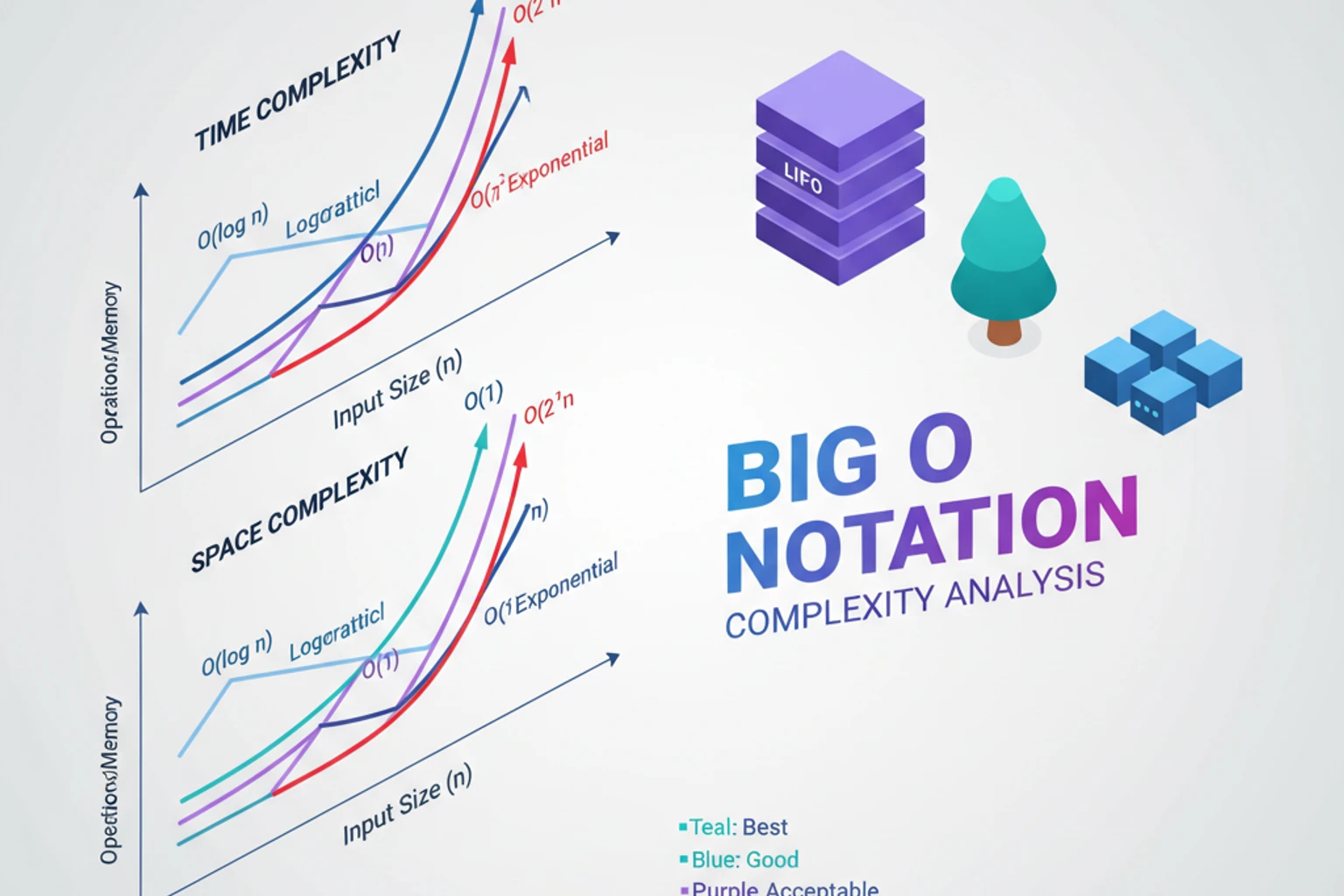
# Algorithm Complexity & Big O Notation Intermediate
In the previous chapter, we saw that some algorithms are faster than others. But how do we measure and compare algorithm efficiency? Enter **Big O notation**—the language we use to describe how algorithms scale.
## What You'll Learn
**Estimated time:** 60 minutes
By the end of this chapter, you will:
- Master Big O notation to analyze algorithm efficiency mathematically
- Understand time and space complexity with practical PHP examples and real-world scenarios
- Learn to calculate complexity for nested loops, recursion, and built-in PHP functions
- Recognize common complexity patterns (O(1), O(n), O(n²), etc.) and when to use each
- Apply complexity analysis to security considerations and avoid performance pitfalls
## Prerequisites
Before starting this chapter, ensure you have:
- ✓ Understanding of basic PHP syntax *(10 mins review if needed)*
- ✓ Familiarity with loops and functions *(10 mins review if needed)*
- ✓ Completion of Chapter 0 *(45 mins if not done)*
## Why Algorithm Complexity Matters
Imagine you're building a user search feature for your PHP application:
```php
// Version 1: Linear search - O(n)
function findUserLinear(array $users, string $email): ?array
{
foreach ($users as $user) {
if ($user['email'] === $email) {
return $user;
}
}
return null;
}
// Version 2: Hash lookup - O(1)
function findUserHash(array $usersByEmail, string $email): ?array
{
return $usersByEmail[$email] ?? null;
}
```
With 10 users, both versions feel instant. But with 1,000,000 users:
- **Linear search**: Might check 500,000 users on average
- **Hash lookup**: Always checks ~1 user
This is why complexity analysis matters—**it predicts how your code performs as data grows**.
## What Is Big O Notation?
**Big O notation** describes how an algorithm's runtime or memory usage grows relative to input size. It answers: "As my input gets larger, how much slower does my code get?"
### The Basics
Big O uses this format: **O(expression)**
- **O(1)**: Constant time—stays the same regardless of input size
- **O(n)**: Linear time—grows proportionally with input size
- **O(n²)**: Quadratic time—grows with the square of input size
The **n** represents input size (number of elements, string length, etc.).
### An Analogy
Think of Big O like describing how long it takes to find a book:
- **O(1)**: You know exactly where it is—grab it instantly
- **O(log n)**: Use the library catalog to narrow down the section
- **O(n)**: Check every shelf one by one
- **O(n²)**: Check every shelf, and for each book, flip through every page
## Common Time Complexities
Let's explore the most common complexities you'll encounter:
### O(1) - Constant Time
Operations that take the same time regardless of input size:
```php
// Array access by key - O(1)
function getFirstElement(array $arr): mixed
{
return $arr[0];
}
// Hash table lookup - O(1)
function getUserById(array $users, int $id): ?array
{
return $users[$id] ?? null;
}
// Simple arithmetic - O(1)
function calculateDiscount(float $price): float
{
return $price * 0.1;
}
```
**Key insight**: The operation takes the same amount of time whether you have 10 items or 10 million.
### O(log n) - Logarithmic Time
Algorithms that halve the problem size with each step:
```php
// Binary search - O(log n)
function binarySearch(array $sorted, int $target): int|false
{
$left = 0;
$right = count($sorted) - 1;
while ($left <= $right) {
$mid = (int)(($left + $right) / 2);
if ($sorted[$mid] === $target) {
return $mid;
} elseif ($sorted[$mid] < $target) {
$left = $mid + 1;
} else {
$right = $mid - 1;
}
}
return false;
}
// Searching 1,000,000 items takes only ~20 steps!
$numbers = range(1, 1000000);
$index = binarySearch($numbers, 742518);
```
**Key insight**: Doubling the input size only adds one more step. Very efficient!
### O(n) - Linear Time
Algorithms that process each element once:
```php
// Sum array - O(n)
function sum(array $numbers): int|float
{
$total = 0;
foreach ($numbers as $number) {
$total += $number;
}
return $total;
}
// Find maximum - O(n)
function findMax(array $numbers): int|float
{
$max = $numbers[0];
foreach ($numbers as $number) {
if ($number > $max) {
$max = $number;
}
}
return $max;
}
// Filter array - O(n)
function filterEven(array $numbers): array
{
$result = [];
foreach ($numbers as $number) {
if ($number % 2 === 0) {
$result[] = $number;
}
}
return $result;
}
```
**Key insight**: Doubling the input size doubles the runtime.
### O(n log n) - Linearithmic Time
Efficient sorting algorithms fall into this category:
```php
// Merge sort - O(n log n)
function mergeSort(array $arr): array
{
if (count($arr) <= 1) {
return $arr;
}
$mid = (int)(count($arr) / 2);
$left = mergeSort(array_slice($arr, 0, $mid));
$right = mergeSort(array_slice($arr, $mid));
return merge($left, $right);
}
function merge(array $left, array $right): array
{
$result = [];
$i = $j = 0;
while ($i < count($left) && $j < count($right)) {
if ($left[$i] <= $right[$j]) {
$result[] = $left[$i++];
} else {
$result[] = $right[$j++];
}
}
return array_merge($result, array_slice($left, $i), array_slice($right, $j));
}
```
**Key insight**: Much faster than O(n²) for sorting, but slower than O(n).
### O(n²) - Quadratic Time
Nested loops over the same data:
```php
// Bubble sort - O(n²)
function bubbleSort(array $arr): array
{
$n = count($arr);
for ($i = 0; $i < $n - 1; $i++) {
for ($j = 0; $j < $n - $i - 1; $j++) {
if ($arr[$j] > $arr[$j + 1]) {
[$arr[$j], $arr[$j + 1]] = [$arr[$j + 1], $arr[$j]];
}
}
}
return $arr;
}
// Find all pairs - O(n²)
function findAllPairs(array $items): array
{
$pairs = [];
for ($i = 0; $i < count($items); $i++) {
for ($j = $i + 1; $j < count($items); $j++) {
$pairs[] = [$items[$i], $items[$j]];
}
}
return $pairs;
}
```
**Key insight**: Doubling the input size quadruples the runtime. Gets slow quickly!
### O(2ⁿ) - Exponential Time
Algorithms that double in runtime with each additional input:
```php
// Fibonacci (naive recursive) - O(2ⁿ)
function fibonacci(int $n): int
{
if ($n <= 1) {
return $n;
}
return fibonacci($n - 1) + fibonacci($n - 2);
}
// This is VERY slow for large n!
// fibonacci(40) might take seconds
// fibonacci(50) might take hours!
```
**Key insight**: Avoid exponential algorithms for anything but tiny inputs.
## Complexity Comparison Chart
Here's how these complexities compare with different input sizes:
| n (input) | O(1) | O(log n) | O(n) | O(n log n) | O(n²) | O(2ⁿ) |
|-----------|------|----------|------|------------|-------|-------|
| 10 | 1 | 3 | 10 | 33 | 100 | 1,024 |
| 100 | 1 | 7 | 100 | 664 | 10,000| ~10³⁰ |
| 1,000 | 1 | 10 | 1,000| 9,966 | 1M | ∞ |
| 10,000 | 1 | 13 | 10K | 130K | 100M | ∞ |
Notice how O(2ⁿ) becomes unusable very quickly!
## Space Complexity
Big O also describes memory usage:
```php
// O(1) space - only uses a fixed amount of extra memory
function sumArray(array $numbers): int
{
$total = 0; // Only one variable
foreach ($numbers as $number) {
$total += $number;
}
return $total;
}
// O(n) space - creates a new array proportional to input
function doubleValues(array $numbers): array
{
$doubled = []; // New array grows with input
foreach ($numbers as $number) {
$doubled[] = $number * 2;
}
return $doubled;
}
// O(n) space - recursive call stack
function factorial(int $n): int
{
if ($n <= 1) {
return 1;
}
return $n * factorial($n - 1); // Stack grows with n
}
```
## Analyzing Real PHP Code
Let's analyze complexity for a practical example:
```php
class UserRepository
{
private array $users = [];
// O(1) - direct array access
public function findById(int $id): ?array
{
return $this->users[$id] ?? null;
}
// O(n) - must check each user
public function findByEmail(string $email): ?array
{
foreach ($this->users as $user) {
if ($user['email'] === $email) {
return $user;
}
}
return null;
}
// O(n) - must process each user
public function findActive(): array
{
$active = [];
foreach ($this->users as $user) {
if ($user['active']) {
$active[] = $user;
}
}
return $active;
}
// O(n²) - nested loops!
public function findCommonFriends(int $userId1, int $userId2): array
{
$user1Friends = $this->users[$userId1]['friends'];
$user2Friends = $this->users[$userId2]['friends'];
$common = [];
foreach ($user1Friends as $friend1) {
foreach ($user2Friends as $friend2) {
if ($friend1 === $friend2) {
$common[] = $friend1;
}
}
}
return $common;
}
// Better: O(n) using hash lookup
public function findCommonFriendsOptimized(int $userId1, int $userId2): array
{
$user1Friends = $this->users[$userId1]['friends'];
$user2Friends = $this->users[$userId2]['friends'];
// Create hash set - O(n)
$friendSet = array_flip($user1Friends);
// Check membership - O(n)
$common = [];
foreach ($user2Friends as $friend) {
if (isset($friendSet[$friend])) {
$common[] = $friend;
}
}
return $common;
}
}
```
## Rules for Calculating Big O
### Rule 1: Drop Constants
O(2n) → O(n)
O(500) → O(1)
```php
// Both are O(n), even though one does twice the work
function example1(array $arr): void {
foreach ($arr as $item) { }
}
function example2(array $arr): void {
foreach ($arr as $item) { }
foreach ($arr as $item) { }
}
```
### Rule 2: Drop Non-Dominant Terms
O(n² + n) → O(n²)
O(n + log n) → O(n)
```php
// This is O(n²), not O(n² + n)
function example(array $arr): void {
foreach ($arr as $item) { } // O(n)
foreach ($arr as $item1) { // O(n²)
foreach ($arr as $item2) { }
}
}
```
### Rule 3: Different Inputs = Different Variables
```php
// This is O(a + b), not O(n)
function mergeTwoArrays(array $a, array $b): array {
$result = [];
foreach ($a as $item) {
$result[] = $item;
}
foreach ($b as $item) {
$result[] = $item;
}
return $result;
}
// This is O(a * b), not O(n²)
function findCommonElements(array $a, array $b): array {
$common = [];
foreach ($a as $itemA) {
foreach ($b as $itemB) {
if ($itemA === $itemB) {
$common[] = $itemA;
}
}
}
return $common;
}
```
## Best, Worst, and Average Case
Some algorithms have different complexities depending on input:
```php
function linearSearch(array $arr, $target): int|false
{
foreach ($arr as $index => $value) {
if ($value === $target) {
return $index;
}
}
return false;
}
// Best case: O(1) - target is first element
// Worst case: O(n) - target is last or not present
// Average case: O(n/2) → O(n)
```
We typically focus on **worst-case complexity** because it guarantees performance.
## Practical Tips for PHP Developers
### 1. Know Your Built-in Functions
```php
// in_array() - O(n)
if (in_array($needle, $haystack)) { }
// isset() - O(1) for arrays
if (isset($array[$key])) { }
// array_search() - O(n)
$key = array_search($value, $array);
// sort() - O(n log n)
sort($array);
```
### 2. Use Hash Lookups When Possible
```php
// Bad: O(n) for each check
$validEmails = ['user1@example.com', 'user2@example.com'];
if (in_array($email, $validEmails)) { }
// Good: O(1) for each check
$validEmails = [
'user1@example.com' => true,
'user2@example.com' => true
];
if (isset($validEmails[$email])) { }
```
### 3. Watch for Hidden Loops
```php
// This looks like O(n) but is actually O(n²)!
function joinWithCommas(array $items): string
{
$result = '';
foreach ($items as $item) {
$result .= $item . ','; // String concatenation is O(n)
}
return rtrim($result, ',');
}
// Better: O(n)
function joinWithCommas(array $items): string
{
return implode(',', $items);
}
```
## Amortized Complexity
Sometimes an operation is expensive occasionally but cheap most of the time. **Amortized analysis** considers the average cost over a sequence of operations.
### Dynamic Array Example
```php
class DynamicArray
{
private array $data = [];
private int $size = 0;
private int $capacity = 1;
public function append($value): void
{
// If array is full, double the capacity
if ($this->size === $this->capacity) {
$this->resize($this->capacity * 2); // Expensive O(n) operation
}
$this->data[$this->size++] = $value;
}
private function resize(int $newCapacity): void
{
$newData = [];
for ($i = 0; $i < $this->size; $i++) {
$newData[$i] = $this->data[$i];
}
$this->data = $newData;
$this->capacity = $newCapacity;
}
}
// Individual append: O(1) usually, O(n) occasionally
// Amortized complexity: O(1) per append
```
**Why O(1) amortized?**
- Resize happens at sizes: 1, 2, 4, 8, 16, 32...
- For n appends, you copy: 1 + 2 + 4 + 8 + ... + n/2 = n-1 elements total
- Average: (n-1)/n ≈ 1 copy per append → **O(1) amortized**
### PHP's Array Implementation
PHP arrays use this strategy internally:
```php
// PHP arrays have amortized O(1) append
$arr = [];
for ($i = 0; $i < 1000000; $i++) {
$arr[] = $i; // Amortized O(1), not O(n) each time!
}
```
## Common Mistakes in Complexity Analysis
### Mistake 1: Confusing Best, Worst, and Average Cases
```php
function findElement(array $arr, $target): bool
{
foreach ($arr as $item) {
if ($item === $target) {
return true; // Might return early
}
}
return false;
}
// WRONG: "This is O(1) because it might find it immediately"
// CORRECT: Worst case is O(n), which is what we report
```
**Rule:** Unless specified, always report **worst-case complexity**.
### Mistake 2: Ignoring Hidden Complexity
```php
// This looks like O(n) but is actually O(n²)!
function buildString(array $words): string
{
$result = '';
foreach ($words as $word) {
$result .= $word; // String concatenation creates new string: O(n)
}
return $result;
}
// Each concatenation copies the entire string
// Total: 0 + len(word1) + len(word1+word2) + ... = O(n²)
```
### Mistake 3: Not Considering Input Characteristics
```php
// Complexity depends on BOTH array sizes
function findCommonElements(array $a, array $b): array
{
$common = [];
foreach ($a as $itemA) {
foreach ($b as $itemB) {
if ($itemA === $itemB) {
$common[] = $itemA;
}
}
}
return $common;
}
// WRONG: O(n²)
// CORRECT: O(a × b) where a = len($a), b = len($b)
```
### Mistake 4: Calling count() in Loops
```php
// Inefficient: count() called n times
for ($i = 0; $i < count($arr); $i++) {
// If count() is O(n), this becomes O(n²)!
}
// Efficient: cache the count
$n = count($arr);
for ($i = 0; $i < $n; $i++) {
// O(n)
}
```
**Note:** In PHP, `count()` is O(1) for regular arrays, but O(n) for some objects implementing Countable.
## Security Considerations
Algorithm complexity affects security, not just performance.
### Algorithmic Complexity Attacks
Attackers can exploit O(n²) or worse algorithms to cause denial of service:
```php
// Vulnerable to hash collision attacks
class VulnerableCache
{
private array $cache = [];
public function add(string $key, $value): void
{
// If attacker finds hash collisions, this degrades to O(n)
$this->cache[$key] = $value;
}
public function get(string $key)
{
return $this->cache[$key] ?? null;
}
}
// Better: Use cryptographically secure hashing or rate limiting
```
### ReDoS (Regular Expression Denial of Service)
```php
// Vulnerable: catastrophic backtracking O(2ⁿ)
function validateEmail_VULNERABLE(string $email): bool
{
// Pattern with nested quantifiers
return (bool)preg_match('/^([a-zA-Z0-9]+)+@[a-zA-Z]+\.com$/', $email);
}
// Attack: "aaaaaaaaaaaaaaaaaaaaaaaaaaaaaa!" takes exponential time
// Safe: Avoid nested quantifiers
function validateEmail_SAFE(string $email): bool
{
return (bool)preg_match('/^[a-zA-Z0-9]+@[a-zA-Z]+\.com$/', $email);
}
```
### Input Validation
Always validate input size to prevent resource exhaustion:
```php
function processArray(array $data): array
{
// Prevent attacks with huge inputs
if (count($data) > 10000) {
throw new InvalidArgumentException('Input too large');
}
// Your O(n²) algorithm is now bounded
return someExpensiveOperation($data);
}
```
## Advanced PHP Performance Tips
### Tip 4: Array Functions vs Loops
```php
// Benchmark reveals: loops are often faster for simple operations
$bench = new Benchmark();
$data = range(1, 10000);
$bench->compare([
'array_map' => fn() => array_map(fn($x) => $x * 2, $data),
'foreach loop' => function() use ($data) {
$result = [];
foreach ($data as $x) {
$result[] = $x * 2;
}
return $result;
},
], null, 100);
// Loops often win for simple operations due to function call overhead
```
### Tip 5: Generator for Memory Efficiency
```php
// Memory-intensive: O(n) space
function rangeArray(int $start, int $end): array
{
$result = [];
for ($i = $start; $i <= $end; $i++) {
$result[] = $i;
}
return $result;
}
// Memory-efficient: O(1) space
function rangeGenerator(int $start, int $end): Generator
{
for ($i = $start; $i <= $end; $i++) {
yield $i;
}
}
// Process 1 million items without using 1 million items of memory
foreach (rangeGenerator(1, 1000000) as $num) {
processItem($num);
}
```
### Tip 6: Opcode Cache Impact
```php
// With OPcache enabled, code is compiled once
// This can significantly affect benchmarks
// Always benchmark with production-like settings:
// - OPcache enabled
// - JIT enabled (PHP 8.0+)
// - Production error reporting levels
```
## Edge Cases to Consider
### Empty Input
```php
function findMax(array $numbers): int|float
{
// Bug: Crashes on empty array
// return max($numbers);
// Fixed: Handle edge case
if (empty($numbers)) {
throw new InvalidArgumentException('Array cannot be empty');
}
return max($numbers);
}
```
### Single Element
```php
function binarySearch(array $arr, $target): int|false
{
// Edge case: single element
if (count($arr) === 1) {
return $arr[0] === $target ? 0 : false;
}
// Main algorithm...
}
```
### Very Large Numbers
```php
function factorial(int $n): int
{
// Edge case: integer overflow for large n
if ($n > 20) {
throw new OverflowException('Result would overflow');
}
// Use GMP for arbitrary precision if needed
// return gmp_fact($n);
$result = 1;
for ($i = 2; $i <= $n; $i++) {
$result *= $i;
}
return $result;
}
```
### Negative Numbers
```php
function power(int $base, int $exponent): int|float
{
// Edge case: negative exponent
if ($exponent < 0) {
return 1 / power($base, -$exponent);
}
if ($exponent === 0) {
return 1;
}
return $base * power($base, $exponent - 1);
}
```
## Practice Problems
### Problem 1: Analyze This Code
What's the time complexity?
```php
function mystery(array $arr): int
{
$count = 0;
for ($i = 0; $i < count($arr); $i++) {
if ($arr[$i] % 2 === 0) {
$count++;
}
}
for ($i = 0; $i < count($arr); $i++) {
if ($arr[$i] % 3 === 0) {
$count++;
}
}
return $count;
}
```
Answer
O(n) - Two sequential loops, each O(n), so O(n + n) = O(n)
### Problem 2: Optimize This
Improve the complexity:
```php
// Current: O(n²)
function hasDuplicate(array $arr): bool
{
for ($i = 0; $i < count($arr); $i++) {
for ($j = $i + 1; $j < count($arr); $j++) {
if ($arr[$i] === $arr[$j]) {
return true;
}
}
}
return false;
}
```
Solution
```php
// Optimized: O(n)
function hasDuplicate(array $arr): bool
{
$seen = [];
foreach ($arr as $value) {
if (isset($seen[$value])) {
return true;
}
$seen[$value] = true;
}
return false;
}
```
### Problem 3: Identify the Complexity
What's the complexity of this nested loop?
```php
function printPairs(int $n): void
{
for ($i = 0; $i < $n; $i++) {
for ($j = $i; $j < $n; $j++) {
echo "($i, $j) ";
}
}
}
```
Answer
O(n²) - Even though inner loop starts at $i, total iterations:
- i=0: n iterations
- i=1: n-1 iterations
- i=2: n-2 iterations
- ...
- Total: n + (n-1) + (n-2) + ... + 1 = n(n+1)/2 ≈ n²/2 → O(n²)
### Problem 4: Space Complexity
What's the space complexity?
```php
function fibonacci(int $n, array $memo = []): int
{
if ($n <= 1) return $n;
if (isset($memo[$n])) return $memo[$n];
$memo[$n] = fibonacci($n - 1, $memo) + fibonacci($n - 2, $memo);
return $memo[$n];
}
```
Answer
O(n) space:
- Memoization array stores n values: O(n)
- Call stack depth: O(n)
- Total: O(n)
### Problem 5: Real-World Optimization
Optimize this function that checks if any email in a list is valid:
```php
// Current: O(n × m) where m is average email length
function hasValidEmail(array $emails): bool
{
foreach ($emails as $email) {
if (filter_var($email, FILTER_VALIDATE_EMAIL)) {
return true;
}
}
return false;
}
```
Answer
This is already optimal - O(n) in best/average case, O(n × m) in worst case where no valid email is found. The complexity is unavoidable since we must check emails until we find a valid one. However, we can add optimizations:
```php
function hasValidEmail(array $emails): bool
{
// Quick check: if empty, return false
if (empty($emails)) {
return false;
}
// Optimization: check shorter emails first (faster validation)
usort($emails, fn($a, $b) => strlen($a) <=> strlen($b));
foreach ($emails as $email) {
// Skip obviously invalid (O(1) check before expensive validation)
if (strpos($email, '@') === false) {
continue;
}
if (filter_var($email, FILTER_VALIDATE_EMAIL)) {
return true;
}
}
return false;
}
```
Note: Sorting adds O(n log n) but can reduce average case if validation is expensive.
### Problem 6: Hidden Complexity
What's wrong with this code's complexity?
```php
function removeDuplicates(array $arr): array
{
$result = [];
foreach ($arr as $item) {
if (!in_array($item, $result)) {
$result[] = $item;
}
}
return $result;
}
```
Answer
This is O(n²) because `in_array()` is O(n), called n times.
Optimized O(n) solution:
```php
function removeDuplicates(array $arr): array
{
return array_values(array_unique($arr));
// Or manually:
// return array_keys(array_flip($arr)); // O(n)
}
```
## Key Takeaways
- **Big O notation** describes how algorithms scale with input size
- Focus on **worst-case complexity** for reliable performance guarantees
- **Common complexities**: O(1) < O(log n) < O(n) < O(n log n) < O(n²) < O(2ⁿ)
- **Space complexity** is just as important as time complexity
- **Optimize smartly**: Profile first, then optimize bottlenecks
- **Know your tools**: Understand PHP's built-in function complexities
## What's Next
In the next chapter, we'll build a **benchmarking framework** to actually measure algorithm performance in PHP. You'll learn to validate your complexity analysis with real data.
## 💻 Code Samples
All code examples from this chapter are available in the GitHub repository:
**[View Chapter 01 Code Samples](https://github.com/dalehurley/codewithphp/tree/main/code/php-algorithms/chapter-01)**
Files included:
- `01-complexity-examples.php` - Demonstrates all major time complexity classes with working code
- `02-space-complexity.php` - Shows memory usage patterns and space complexity analysis
- `README.md` - Complete documentation and usage guide
Clone the repository to run the examples locally:
```bash
git clone https://github.com/dalehurley/codewithphp.git
cd codewithphp/code/php-algorithms/chapter-01
php 01-complexity-examples.php
```
---
Continue to [Chapter 02: Benchmarking & Performance Testing](/series/php-algorithms/chapters/02-benchmarking-performance-testing).